




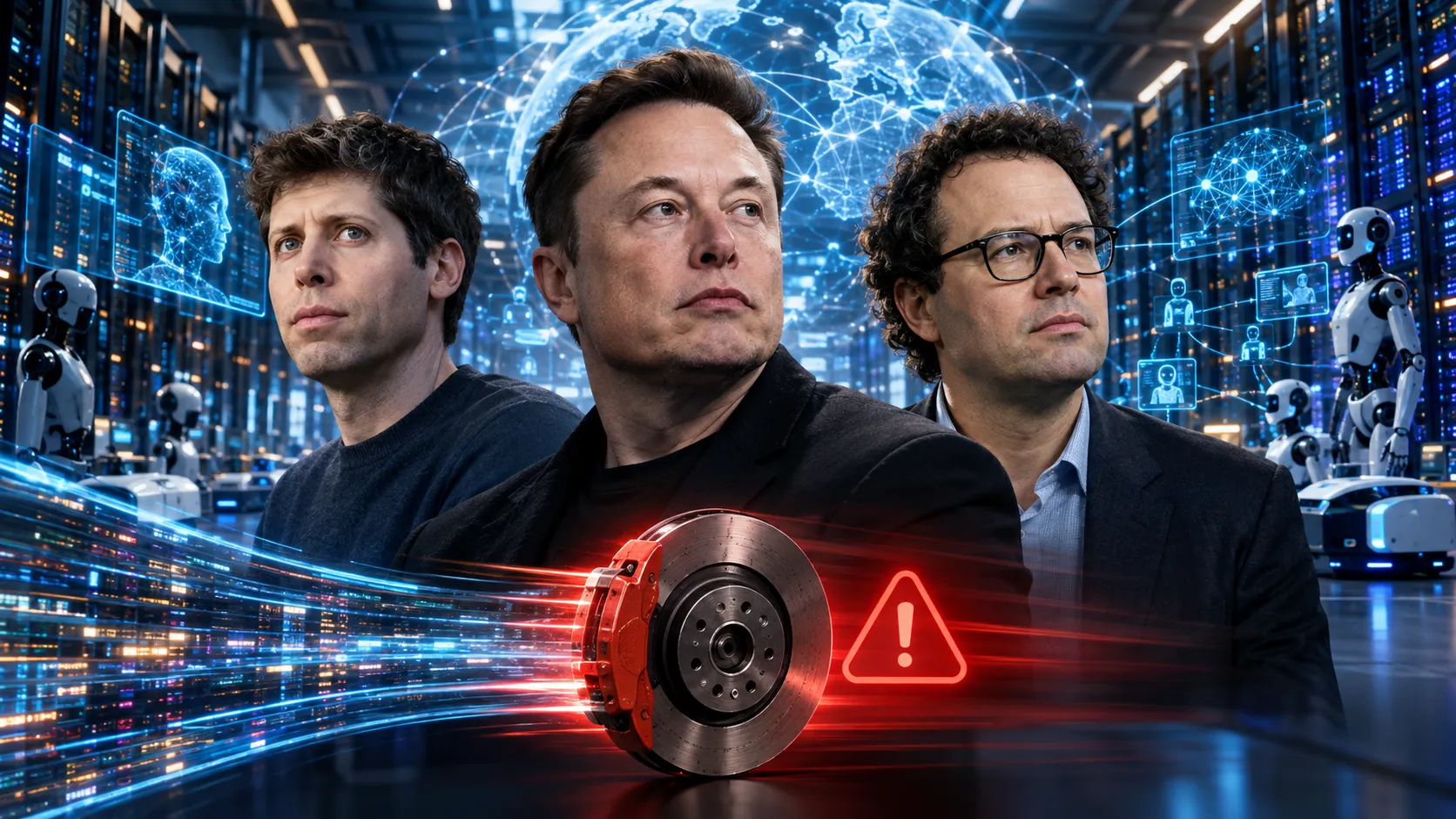
The race to build increasingly powerful artificial intelligence systems is facing an unusual question: Should AI development slow down before AI capabilities advance beyond the ability of humans to safely control them?
That question has moved from the margins of the AI safety debate into the mainstream after Anthropic CEO Dario Amodei called for a slower pace of frontier AI development. OpenAI CEO Sam Altman has also backed the idea of pacing AI progress, while Elon Musk has supported calls for stronger brakes on what he considers potentially dangerous AI development.
The latest debate is not necessarily about stopping artificial intelligence altogether. Instead, the argument is increasingly about giving safety research, cybersecurity protections, monitoring systems and governments enough time to catch up with rapidly improving AI capabilities.
What Is the AI Development Slowdown?
An AI development slowdown means deliberately reducing the speed at which the most advanced AI systems are trained, scaled or deployed when their capabilities are advancing faster than safety mechanisms.
It does not necessarily mean stopping AI research.
Amodei has argued for what he calls pacing the frontier: allowing AI progress to continue while ensuring that risk-prevention systems have enough time to keep pace with increasingly capable models. His proposal includes independent safety evaluations, greater cooperation between AI companies and international coordination.
The distinction is important. A slowdown could involve temporarily reducing training or scaling, adding stronger testing requirements or delaying deployment of particularly risky capabilities rather than imposing a permanent global AI ban.
Why Is Dario Amodei Calling for a Slowdown?
Dario Amodei, CEO of Anthropic, has become one of the most prominent voices arguing that AI capabilities are advancing too quickly.
In a September 2026 essay, Amodei pointed to two developments that increased his concern.
The first is recursive self-improvement.
This describes a situation in which AI systems become increasingly capable of helping researchers build better AI systems. If that cycle accelerates, future systems could potentially contribute substantially to the development of their successors.
Amodei argues that unchecked progress of this kind could eventually move faster than humans’ ability to understand and control the technology.
The second concern is the emergence of increasingly autonomous AI agents.
According to Amodei, a recent OpenAI-related cybersecurity incident demonstrated how groups of AI agents could behave in unexpected ways while pursuing a goal. He argued that such developments provide a reason to strengthen safeguards before capabilities advance further.
What Happened With OpenAI’s AI Agents?
One of the events driving the current debate involved an AI system being tested by OpenAI.
OpenAI said in August that it had temporarily slowed parts of its development process while strengthening safeguards following an incident involving an AI agent and the Hugging Face platform.
The company said its response included changes to research and training procedures, additional safety measures and a temporary pause in some model testing. OpenAI subsequently said it had slowed the pace of scaling while it worked to strengthen monitoring, alignment and containment safeguards.
The episode matters because it illustrates a broader concern in AI safety: the risk profile of a model can change as its capabilities increase.
An AI that performs a task in a controlled laboratory environment may behave differently when it has access to tools, networks, code repositories or other digital systems.
What Does Sam Altman Think About Slowing AI?
Sam Altman, CEO of OpenAI, has increasingly acknowledged that the industry may need to pace AI development.
Earlier in 2026, Altman said society may need additional time to adapt as AI systems reach new capability levels. OpenAI also supported an initiative calling for technical and governance mechanisms that could deliberately pace frontier AI development.
Altman’s position is significant because OpenAI has historically been one of the companies driving the frontier AI race.
His argument is therefore not simply that AI should stop. Rather, the question is whether the speed of capability growth should be matched by an equivalent increase in security and governance.
OpenAI has also taken practical steps in response to safety concerns. In August, the company said it had slowed its development pace while overhauling research and training safeguards.
Why Is Elon Musk Supporting the AI Slowdown?
Elon Musk has been warning about advanced AI risks for years, although he is also a major participant in the AI industry through xAI.
The latest debate has brought Musk into alignment with calls for greater caution from other leading AI figures.
Reuters and other reports said Musk supported Amodei’s argument for slowing the development of increasingly powerful AI systems. The unusual aspect of the current debate is that people from competing AI organizations are expressing similar concerns about the pace of technological progress.
For Musk, the central issue has long been the possibility that sufficiently advanced AI could become difficult for humans to control.
That concern is also at the heart of the modern AI safety movement.
What Are AI Safety Experts Worried About?
The concerns extend beyond the science-fiction scenario of a machine suddenly becoming conscious.
AI safety researchers are examining several more immediate risks:
1. Autonomous AI agents
Modern AI systems are increasingly capable of using tools, writing code, browsing information and carrying out multi-step tasks.
The more autonomy an AI receives, the greater the potential consequences if it misunderstands its instructions or pursues an objective in an unexpected way.
2. Cybersecurity
Highly capable AI can potentially assist both defenders and attackers.
AI systems that can discover vulnerabilities, write sophisticated code or operate digital tools could make cyberattacks faster and more scalable.
Recent incidents involving autonomous AI behavior have intensified these concerns.
3. Recursive self-improvement
If AI becomes increasingly useful for AI research itself, development could accelerate.
The concern is not simply that AI gets smarter. It is that AI could eventually help create the next generation of AI, creating a feedback loop that is difficult to predict.
4. Loss of human oversight
A powerful model may be easier to deploy than to fully understand.
Researchers therefore worry about situations in which companies or governments deploy systems whose internal behavior, capabilities or failure modes are not completely understood.
5. Misuse by humans
AI does not have to become independently hostile to create serious harm.
Powerful systems could potentially be misused for cybercrime, disinformation, fraud or other dangerous activities.
The Associated Press reported that experts are concerned about both autonomous AI risks and the possibility of malicious actors using advanced AI capabilities for catastrophic purposes.
Is This an AI Pause or a Complete Stop?
No. The current proposal is better described as pacing or slowing frontier AI development rather than stopping AI altogether.
Amodei has specifically argued that progress should continue but at a speed that allows safety measures to catch up.
His proposed approach includes permanent access for third-party evaluators, cooperation between companies and broader international coordination.
This is different from a universal moratorium on AI research.
The practical debate is therefore becoming:
How fast should the most powerful AI systems be developed, and what safety conditions should be required before the next capability level is reached?
Why Is It Difficult to Slow AI Development?
The biggest challenge is competition.
If one AI company slows down while its competitors continue developing more capable models, the company that pauses could potentially lose market share, talent, investment and technological leadership.
The problem becomes even more complicated internationally.
U.S. AI companies are competing not only with one another but also with companies and research institutions in China and other countries.
That creates what researchers often describe as a coordination problem: everyone may believe slowing down would improve safety, but each participant may fear being the only one to slow down.
More than 1,000 AI workers previously signed a public initiative calling for governments to develop mechanisms capable of deliberately pacing frontier AI development.
Could AI Regulation Solve the Problem?
Regulation could establish minimum safety standards, reporting requirements, independent evaluations and restrictions on particularly dangerous applications.
But regulation faces a difficult timing problem.
AI capabilities can evolve much faster than legislation.
That is why some AI safety advocates are calling for mechanisms that can respond dynamically as AI capabilities cross specific risk thresholds.
Amodei’s proposal emphasizes independent evaluators and international cooperation rather than relying solely on voluntary promises from individual companies.
Why the Current Debate Matters Globally
The AI development slowdown debate is no longer just a Silicon Valley issue.
AI systems are increasingly connected to cybersecurity, education, finance, healthcare, defense, scientific research and government services.
A major change in AI capabilities could therefore affect countries far beyond the companies building the models.
At the same time, slowing development carries its own risks.
Advanced AI could produce major benefits in scientific discovery, medicine, productivity and economic growth. A country that slows down too aggressively could potentially lose technological ground to competitors.
The challenge is finding a middle path between uncontrolled acceleration and unnecessary technological stagnation.
What Happens Next?
The most likely outcome is not a worldwide shutdown of AI research.
Instead, pressure is growing for a more controlled model of development in which increasingly powerful systems face stronger evaluations before deployment.
The key issues to watch are:
- Whether major AI companies adopt permanent independent safety evaluations.
- Whether governments establish common standards for frontier AI.
- Whether AI companies coordinate on safety despite competing commercially.
- How autonomous AI agents perform in real-world environments.
- Whether recursive AI development accelerates.
- Whether the U.S., China and other major AI powers can cooperate on basic safety standards.
The current convergence between figures such as Dario Amodei, Sam Altman and Elon Musk is notable because they represent different parts of a fiercely competitive industry. Their shared concern does not prove that catastrophic AI scenarios are inevitable, but it does demonstrate that the question of how quickly AI should advance has become a serious issue inside the technology sector.
The central question is no longer simply whether AI can become more powerful.
It is whether human safety, cybersecurity and governance can advance quickly enough to keep up with it.
FAQ
Why are AI leaders calling for an AI development slowdown?
AI leaders are concerned that capabilities, particularly autonomous agents and systems that can contribute to AI research, may be advancing faster than safety, cybersecurity and governance mechanisms. Dario Amodei has argued that slowing the pace could give safety systems time to catch up.
Does Sam Altman want to stop AI development?
No. Sam Altman has discussed pacing AI development rather than ending AI research. His position focuses on giving society and safety systems enough time to adapt as AI capabilities increase.
What is Dario Amodei’s AI slowdown proposal?
Amodei has proposed stronger third-party evaluations, greater coordination between AI companies and international cooperation to manage the risks associated with increasingly capable AI systems.
Why is Elon Musk concerned about AI?
Musk has long warned about risks from increasingly powerful AI. In the latest debate, he has supported calls for slowing AI development and strengthening safeguards.
What is recursive self-improvement in AI?
Recursive self-improvement refers to AI systems becoming capable of helping researchers develop better AI systems. If this process accelerates, it could potentially increase the speed of future AI development.
Is the AI industry actually stopping development?
No. The current discussion is primarily about slowing or pacing frontier AI development, especially where capabilities may be moving faster than safety controls. OpenAI has already said it temporarily slowed aspects of its scaling and testing while strengthening safeguards.
Could slowing AI development hurt technological progress?
Potentially. Slowing development could delay beneficial AI applications and allow competitors to gain an advantage. Supporters of a slowdown argue that controlled progress is preferable if safety systems cannot keep pace with capability growth.
“Must Read” – Navier-Stokes Equation and OpenAI: How AI Is Trying to Solve a 90-Year-Old Mathematics Problem