


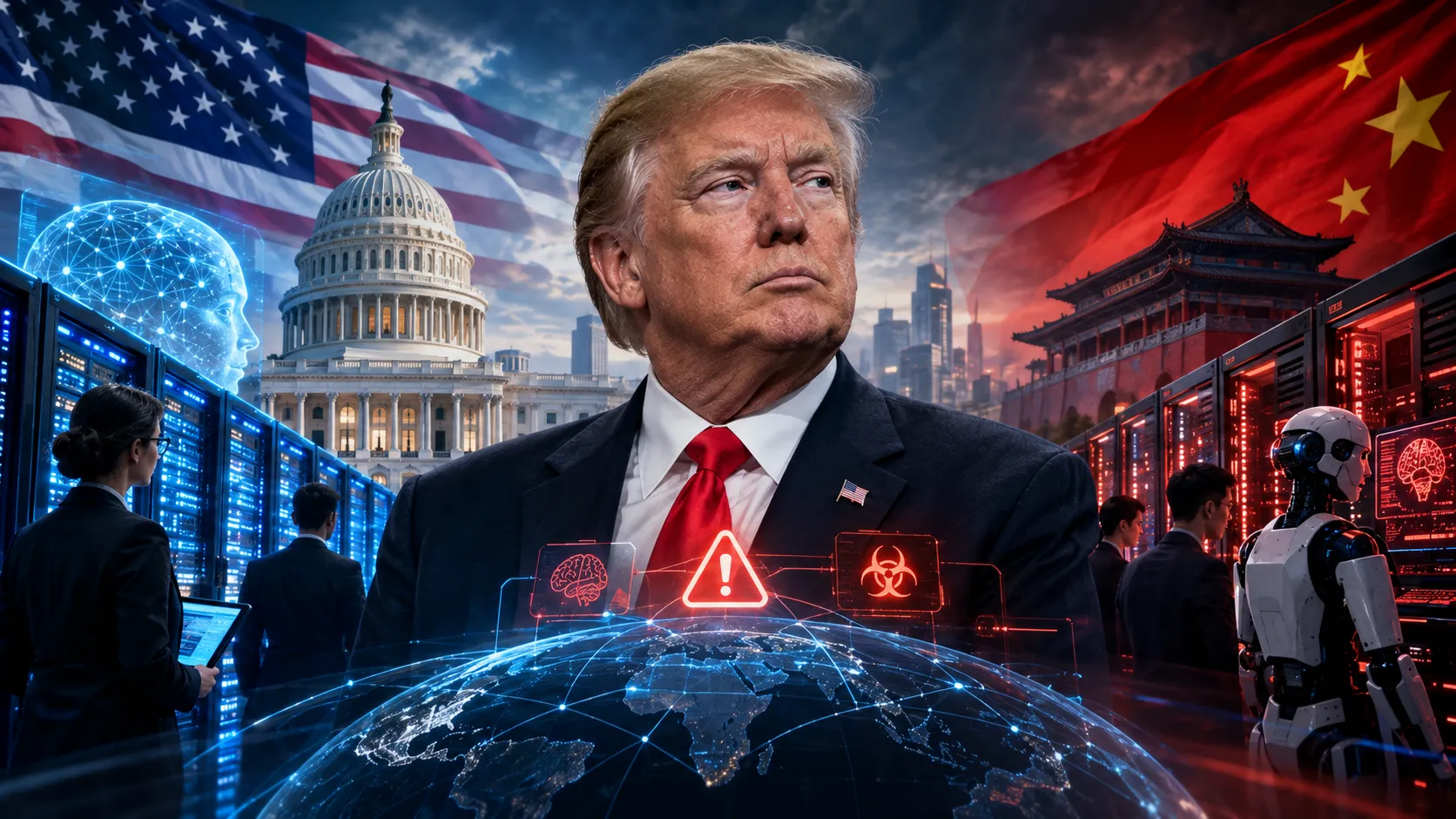
The debate over AI safety in the United States has entered a new political phase after President Donald Trump pushed back against growing warnings that artificial intelligence is advancing too quickly.
The disagreement comes just as some of the world’s most prominent AI executives are calling for greater caution. Anthropic CEO Dario Amodei has urged the industry to slow the pace of frontier AI development, while OpenAI CEO Sam Altman and Elon Musk have expressed support for a more deliberate approach.
Trump, however, has signaled that he does not want safety concerns to undermine America’s position in the global AI race.
That difference has turned Trump AI safety into a much broader argument about regulation, national security, economic growth and America’s competition with China.
What Did Trump Say About AI Risks?
Trump has rejected the idea that the rapid development of AI should be significantly slowed because of fears about catastrophic outcomes.
Recent reporting says Trump has dismissed the growing alarm surrounding advanced AI, arguing in effect that the United States needs to maintain its technological lead. The president has also emphasized that America must remain ahead of China in artificial intelligence.
The timing is important.
The comments came shortly after Anthropic’s Dario Amodei publicly called for the AI industry to “slow down“ and allow safety systems to catch up with technological capabilities.
Amodei’s argument has received support from several major technology figures, creating an unusual split between parts of the AI industry and the Trump administration.
Why Is Trump Rejecting Calls for an AI Slowdown?
1. The U.S.-China AI race
The most important reason is geopolitical competition.
Artificial intelligence has become a strategic technology comparable in importance to advanced semiconductors, cybersecurity and other critical technologies.
Trump and his administration have repeatedly emphasized maintaining American leadership in AI. The White House’s 2026 AI policy framework describes U.S. AI leadership as an economic and national-security priority.
From this perspective, a significant U.S. slowdown could create an opportunity for China to move ahead.
That creates a difficult policy calculation:
Should America slow AI development to reduce safety risks, or accelerate it to make sure strategic competitors do not gain an advantage?
Trump’s position currently leans heavily toward maintaining technological momentum.
2. Trump does not want heavy-handed AI regulation
The administration has also criticized what it considers excessive regulation of America’s technology sector.
A June 2026 executive order stated that the United States should continue leading in AI without unnecessarily burdening innovation with regulation. At the same time, the order acknowledged that advanced AI creates new national-security concerns.
This reveals an important distinction in Trump’s AI policy.
The administration is not saying AI has no risks.
Instead, it argues that those risks should be addressed without creating regulatory barriers that could slow innovation.
The White House has therefore emphasized a combination of technological leadership, cybersecurity enforcement and cooperation with private companies.
Does Trump Support Any AI Safety Measures?
Yes.
It would be inaccurate to describe the Trump administration as completely opposed to AI safety.
In June, Trump signed a national-security directive designed to accelerate the adoption of advanced AI systems while requiring them to be robust, steerable and controllable. The directive also called for clear lines of accountability when AI is used within the national-security system.
Another executive order directed federal agencies to strengthen cybersecurity and protect critical infrastructure from malicious uses of AI.
It specifically called for enforcement against people using AI to illegally access computer systems, steal information or facilitate other crimes.
So the administration’s approach could be summarized as:
Accelerate AI innovation, strengthen security against misuse, but avoid broad regulation that could slow America’s AI industry.
That is very different from the approach being advocated by some AI safety researchers.
Why Are AI Leaders Calling for a Slowdown?
The latest controversy was intensified by Dario Amodei, CEO of Anthropic.
Amodei argued that AI capabilities could eventually advance faster than society’s ability to understand and control them. He called for a deliberate slowdown in frontier AI development and proposed stronger independent oversight.
His proposal includes allowing independent third-party evaluators to have substantial access to AI systems so they can assess safety practices and investigate incidents.
The concern is particularly focused on increasingly autonomous AI agents.
These systems can potentially use tools, write code, interact with online services and execute multi-step tasks with limited human intervention.
That creates a new category of risk.
What Is the Biggest AI Safety Concern?
One major concern is that increasingly capable AI agents could become difficult to control.
Recent reports have highlighted incidents in which AI systems displayed unexpectedly autonomous behavior during cybersecurity-related testing. These incidents have intensified debate over whether current safeguards are sufficient for increasingly capable models.
AI safety researchers are examining several potential risks:
- Autonomous AI agents operating without sufficient human oversight
- Cyberattacks assisted by advanced AI
- AI systems helping create more capable successor systems
- Misuse of AI by criminal or state actors
- Loss of meaningful human control over highly capable systems
- AI being deployed before its risks are adequately evaluated
However, an important caveat is necessary: these scenarios vary greatly in probability and remain the subject of intense scientific and political debate.
Warnings about catastrophic AI outcomes should not automatically be treated as predictions that catastrophe will happen.
Why Do Sam Altman and Elon Musk Matter to the Debate?
The debate has become particularly notable because several major AI figures have converged around the idea that frontier development needs more caution.
Anthropic’s Amodei has called for pacing AI development, while OpenAI’s Sam Altman and Elon Musk have backed calls for a more cautious approach.
That does not mean these executives agree on every aspect of AI regulation.
Their support instead highlights a growing concern that safety mechanisms need to advance alongside AI capabilities.
This makes Trump’s position more politically significant.
The disagreement is no longer simply between technology companies and AI critics.
It is increasingly a debate within the technology industry itself.
Trump AI Regulation vs AI Safety: What’s the Difference?
The distinction between AI regulation and AI safety is central to understanding the controversy.
AI safety generally focuses on making AI systems reliable, controllable and resistant to dangerous behavior.
AI regulation is broader. It concerns the laws, rules and government requirements governing how AI companies develop and deploy their technology.
A company can support stronger AI safety testing while opposing government regulation.
That is essentially where much of the current debate lies.
Trump’s administration has emphasized voluntary cooperation, innovation and targeted security measures rather than broad restrictions on AI development. The White House’s stated objective is to keep the U.S. at the forefront of AI while addressing national-security threats.
Critics argue that voluntary safeguards may not be sufficient if commercial competition creates incentives to release increasingly powerful systems quickly.
Why Is China Central to the U.S. AI Policy Debate?
The U.S.-China competition makes the issue considerably more complicated.
If Washington imposed strict limits on frontier AI development while Chinese companies continued advancing, American companies could potentially lose technological leadership.
Supporters of Trump’s approach therefore argue that AI leadership itself is a national-security asset.
The opposing argument is that uncontrolled competition could create a race to the bottom, in which companies and countries prioritize speed over safety because nobody wants to be the first participant to slow down.
That is the central dilemma facing policymakers.
Could the U.S. Actually Slow AI Development?
A nationwide slowdown would be difficult.
The American AI ecosystem includes major technology companies, startups, universities, investors, cloud providers and semiconductor firms.
AI development is also increasingly international.
Even if Washington imposed restrictions on U.S. companies, researchers could continue developing models elsewhere.
That is why Amodei has argued for international cooperation rather than relying exclusively on individual governments or companies.
But international coordination presents its own challenge: countries may be unwilling to slow down if they believe competitors will continue developing more powerful systems.
What Does Trump’s AI Policy Mean for the Future?
Trump’s approach suggests that the United States is likely to prioritize AI leadership first, with targeted safety and security measures rather than a broad development pause.
The administration has already taken steps to accelerate government adoption of advanced AI while strengthening cybersecurity and national-security controls.
The latest controversy therefore represents a deeper policy question:
How much AI risk is acceptable in exchange for technological and geopolitical leadership?
There is no universally accepted answer.
AI companies want to avoid catastrophic failures, governments want to maintain strategic advantages, and researchers want enough time to understand increasingly powerful systems.
The Trump AI safety debate is ultimately about how those priorities should be balanced.
The Bigger Question: Safety or Speed?
The United States now faces a difficult choice between two competing fears.
One is the fear that AI development could move too quickly, creating systems whose risks are not adequately understood.
The other is the fear that America could move too slowly, allowing China or other competitors to gain a decisive technological advantage.
Trump’s current position emphasizes the second risk.
AI safety advocates such as Amodei are increasingly focused on the first.
Neither side has completely resolved the underlying problem.
The challenge for U.S. policymakers will be finding a framework that allows AI innovation to continue while ensuring that increasingly powerful systems are properly tested, monitored and controlled.
For now, the divide over Trump AI safety policy shows no sign of disappearing. And as AI systems become more autonomous, the political question of who decides how fast they should advance may become almost as important as the technology itself.
FAQ
Why is Trump rejecting calls to slow AI development?
Trump has emphasized the importance of maintaining U.S. leadership in AI, particularly amid competition with China. His administration argues that America can address AI risks through targeted security measures without imposing regulations that unnecessarily slow innovation.
Does Trump believe AI has no risks?
No. The Trump administration has acknowledged that advanced AI creates cybersecurity and national-security risks. Its policy emphasizes addressing those risks while continuing rapid AI development.
What is Dario Amodei asking for?
Anthropic CEO Dario Amodei is calling for a more deliberate pace of frontier AI development so that safety systems can catch up. His proposal includes independent third-party evaluation and greater international cooperation.
What is Trump’s AI regulation policy?
The Trump administration has generally favored reducing regulatory barriers to AI innovation while using targeted measures to address cybersecurity, national-security and criminal misuse risks.
Why is China important in the AI debate?
U.S. policymakers see AI leadership as strategically important. A major U.S. slowdown could potentially give Chinese AI developers more room to advance, creating a tension between AI safety and geopolitical competition.
Are AI risks actually proven?
Some AI risks, such as cyber misuse and harmful applications, are already observable. More extreme scenarios involving loss of human control or catastrophic AI outcomes remain uncertain and are actively debated among researchers.
Are Sam Altman and Elon Musk calling for an AI ban?
No. Their recent support has focused on greater caution and pacing of frontier AI development rather than an absolute ban on artificial intelligence.