


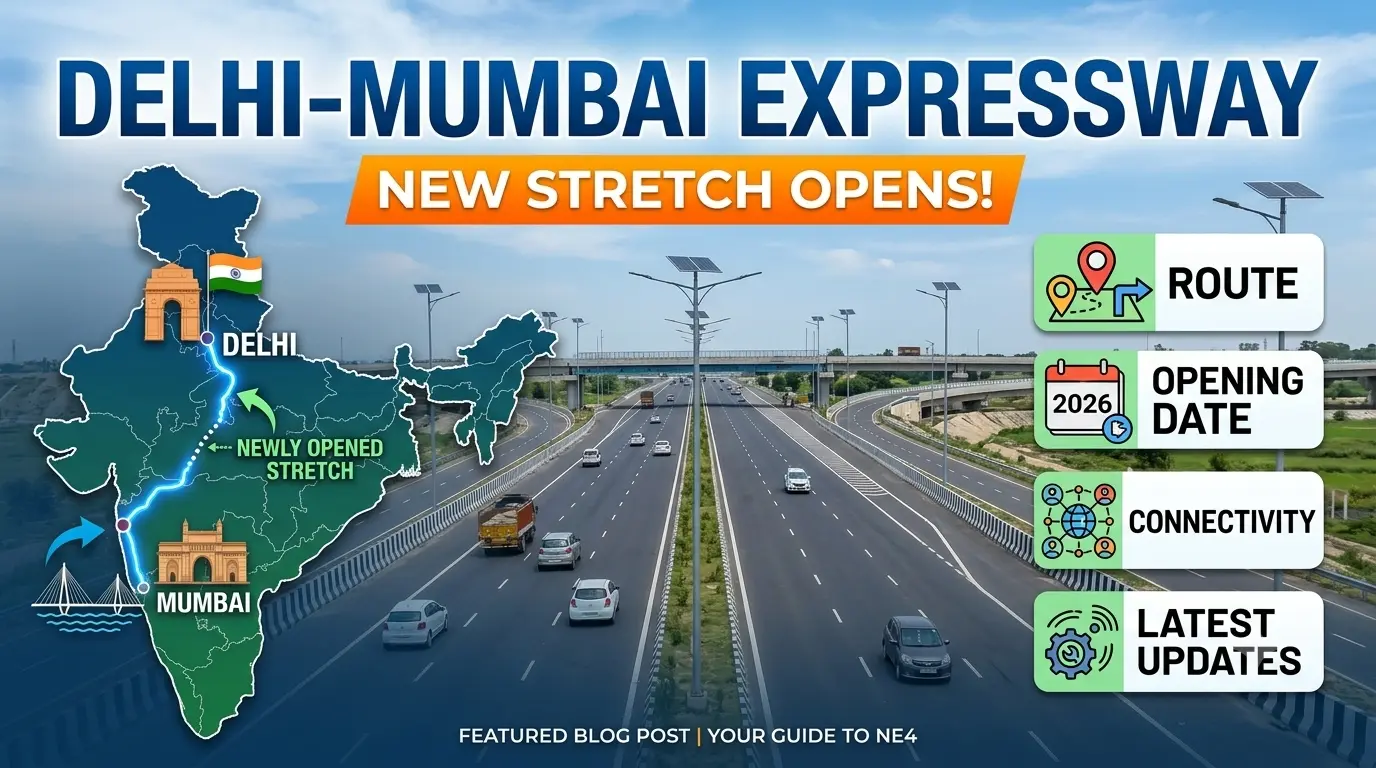
The Delhi Mumbai Expressway new stretch between DND Flyway and Jaitpur has opened for trial operations, providing commuters from Delhi, Noida and Ghaziabad with easier access to the Delhi-Mumbai Expressway. The Delhi Mumbai Expressway new stretch is approximately 9 km long, with nearly 8.5 km of the route elevated, connecting the DND/Maharani Bagh side with Jaitpur in South Delhi.
The National Highways Authority of India (NHAI) started trial operations in August 2026 before formal commissioning. The development is particularly significant for commuters travelling towards Faridabad and for motorists looking to access the expressway corridor towards Jaipur and other destinations.
Quick Answer
- New stretch: DND Flyway–Jaitpur
- Length: Approximately 9 km
- Elevated section: Approximately 8.5 km
- Status: Open for trial operations
- Authority: National Highways Authority of India (NHAI)
- Key beneficiaries: East Delhi, South Delhi, Noida, Ghaziabad and Faridabad commuters
- Major connection: Delhi-Mumbai Expressway
- Further connectivity: Jaipur, Sawai Madhopur and the wider Delhi-Mumbai corridor
Where Is the Delhi Mumbai Expressway New Stretch Located?
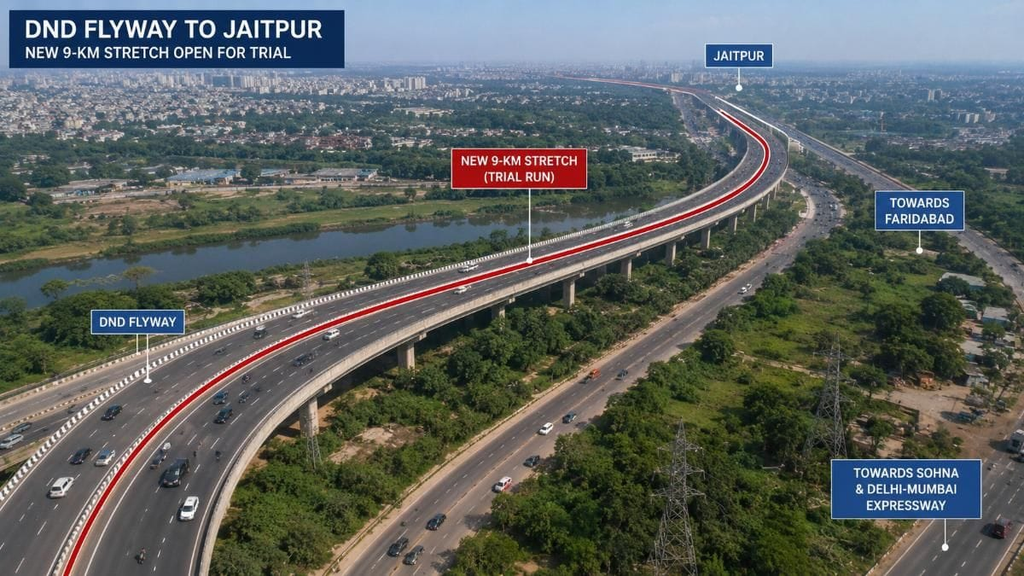
The new section is located in the Delhi-NCR region and runs between the DND Flyway/Maharani Bagh area and Jaitpur. It forms an important part of the Delhi-side connection to the Delhi-Mumbai Expressway.
According to NHAI’s project information, the DND-Faridabad-Ballabhgarh-KMP portion forms a dedicated spur connecting Delhi with the main expressway network. NHAI lists the DND Maharani Bagh to Jaitpur section as a 9-km access-controlled highway project.
For commuters, the practical advantage is that motorists can enter the expressway system from the Delhi side instead of relying exclusively on older road corridors.
What Is the Route of the New DND-Jaitpur Stretch?
The new route begins around the DND Flyway/Maharani Bagh side, passes through the elevated Delhi section and reaches Jaitpur. From Jaitpur, motorists can connect with the wider expressway network towards Faridabad and the KMP-linked corridor.
The broader route is designed to provide smoother connectivity between Delhi and the Delhi-Mumbai Expressway, while also improving access for commuters travelling from East and South Delhi, Noida and Ghaziabad.
Simplified Route
DND Flyway → Maharani Bagh → Jaitpur → Faridabad → KMP/Delhi-Mumbai Expressway corridor → Jaipur and onward destinations
The exact route a motorist should take will depend on the entry point and final destination, so travellers should follow live traffic and navigation instructions rather than relying only on a static route map.
Why Is the DND-Jaitpur Stretch Important?
The DND-Jaitpur section is important because it strengthens Delhi’s direct connection with the Delhi-Mumbai Expressway. Before this connection became available for trial operations, motorists from several parts of Delhi-NCR had to use existing urban corridors to reach the expressway network.
The new elevated section is expected to improve traffic distribution around busy routes such as the Ashram and Mathura Road corridors while giving motorists a more direct access route towards Faridabad and the expressway.
Who Will Benefit Most?
The biggest potential beneficiaries include:
- East Delhi commuters
- South Delhi commuters
- Noida residents
- Ghaziabad commuters
- Faridabad commuters
- People travelling towards Jaipur and Sawai Madhopur
- Long-distance motorists connecting to the wider Delhi-Mumbai Expressway
Is the New Stretch Fully Open or Still on Trial?
As of August 25, 2026, the DND-Jaitpur section is operating on a trial basis, rather than being treated as a fully commissioned corridor.
Trial operations allow authorities to monitor traffic movement, identify operational issues and assess the readiness of the infrastructure before formal commissioning. Reports published on August 23 said the trial was expected to continue for about a month.
Important: Travellers should check the latest traffic advisory before starting their journey because access arrangements can change during a trial phase.
What Is the Delhi-Mumbai Expressway?
The Delhi-Mumbai Expressway is a major access-controlled greenfield highway project designed to connect India’s national capital with Mumbai. NHAI describes the corridor as an eight-lane expressway with a design speed of 120 km/h, with provisions for future expansion.
NHAI’s project documentation puts the overall Delhi-Mumbai greenfield corridor at approximately 1,386 km, with an estimated project cost of around ₹1 lakh crore in its annual-report documentation. The corridor is intended to improve connectivity between Delhi, Haryana, Rajasthan, Madhya Pradesh, Gujarat and Maharashtra.
Delhi-Mumbai Expressway: Key Facts
| Feature | Details |
| Project | Delhi-Mumbai Expressway |
| Type | Greenfield, access-controlled expressway |
| Configuration | 8 lanes |
| Design speed | 120 km/h |
| Approx. corridor length | 1,386 km |
| Key states/regions | Delhi, Haryana, Rajasthan, Madhya Pradesh, Gujarat, Maharashtra |
| Implementing authority | NHAI |
| Major purpose | Faster passenger and freight connectivity |
| Delhi-side connection | DND-Faridabad-KMP spur |
NHAI has also stated that the corridor is planned with wayside amenities and infrastructure such as safety and traffic-management systems.
Which States Does the Delhi-Mumbai Expressway Pass Through?
The main Delhi-Mumbai corridor connects the Delhi-NCR region with western and central India through:
- Delhi
- Haryana
- Rajasthan
- Madhya Pradesh
- Gujarat
- Maharashtra
The route provides connectivity to important economic centres and is intended to improve both passenger mobility and freight movement.
NHAI has specifically highlighted improved connections to economic hubs such as Jaipur, Bhopal, Indore and Ahmedabad.
How Will the Delhi-Mumbai Expressway Reduce Travel Time?
The expressway is designed to reduce travel time by providing a straighter, controlled-access route with fewer interruptions from urban traffic.
NHAI’s documentation says the corridor’s design speed is 120 km/h and that the project is expected to reduce Delhi-Mumbai travel time substantially compared with the existing route.
However, motorists should not interpret the 120 km/h design speed as a blanket permission to drive at that speed. Actual legal speed limits, restrictions and traffic conditions must always be followed.
What Are the Major Benefits of the Delhi-Mumbai Expressway?
1. Faster Long-Distance Connectivity
The controlled-access design can reduce delays associated with intersections, local traffic and densely populated urban corridors.
2. Better Freight Movement
The expressway is strategically important for commercial transportation because it links major industrial regions with Mumbai’s port infrastructure.
3. Improved Delhi-NCR Connectivity
The DND-Jaitpur section gives Delhi-NCR motorists a more direct connection to the wider expressway network.
4. Reduced Pressure on Existing Roads
By diverting suitable long-distance traffic onto an access-controlled corridor, the project can help distribute traffic away from heavily congested conventional routes.
5. Economic Development
Better highway connectivity can reduce logistics friction and improve access between production centres, markets, ports and urban economies.
Delhi-Mumbai Expressway vs Existing Delhi-Mumbai Route
| Factor | Delhi-Mumbai Expressway | Existing Conventional Route |
| Road type | Access-controlled greenfield corridor | Mix of highways and urban roads |
| Design | Dedicated high-speed corridor | Multiple road environments |
| Intersections | Limited | More frequent |
| Local traffic interaction | Lower | Higher |
| Long-distance freight suitability | High | Variable |
| Design speed | 120 km/h | Varies by road section |
| Major purpose | Long-distance connectivity | Mixed local and long-distance traffic |
The comparison does not mean every journey will automatically be faster on the expressway. Actual travel time depends on the operational status of individual sections, traffic, entry/exit locations, tolls and the final destination.
What Is the Latest Delhi-Mumbai Expressway Opening Update?
The most significant recent Delhi-side development is the 9-km DND Flyway-Jaitpur section opening for trial operations in August 2026.
At the same time, work continues on different portions of the larger corridor. Recent reporting has also highlighted progress on the Vadodara-Mumbai section, with Maharashtra Chief Minister Devendra Fadnavis previously indicating a target of August 31, 2026 for the Maharashtra portion.
Because different packages have different construction and commissioning schedules, readers should distinguish between a particular stretch becoming operational and the entire Delhi-Mumbai corridor becoming continuously operational from Delhi to Mumbai.
Is Delhi-Mumbai Expressway Fully Operational From Delhi to Mumbai?
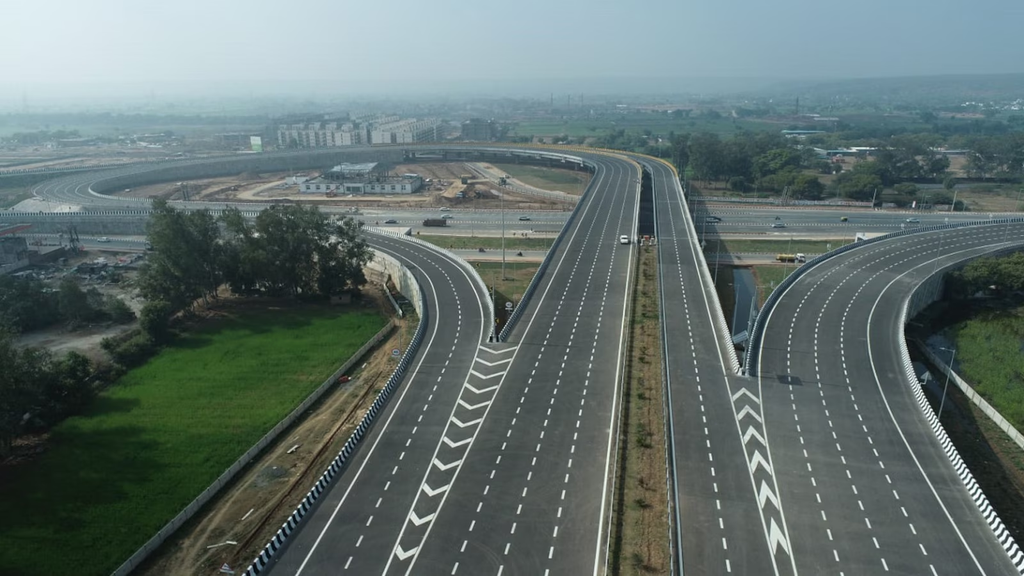
No single opening announcement should be interpreted as the entire Delhi-Mumbai Expressway becoming fully operational end-to-end. The corridor has been developed and commissioned in multiple packages and sections.
For example, NHAI documentation identifies separate sections and spurs, while recent reports show that individual sections continue to enter trial or operational stages at different times.
This distinction is particularly important for travellers planning a Delhi-to-Mumbai road trip.
What Should Travellers Check Before Using the Expressway?

Before beginning a long-distance journey, motorists should:
- Check whether the specific section they intend to use is operational.
- Verify the latest traffic advisory.
- Keep sufficient fuel.
- Carry essential vehicle safety equipment.
- Follow posted speed limits and lane discipline.
- Check toll and FASTag requirements.
- Avoid stopping on the carriageway except in an emergency.
- Use designated service areas and emergency facilities wherever available.
During trial operations, additional restrictions or diversions may apply.
Frequently Asked Questions
When did the new Delhi-Mumbai Expressway stretch open?
The approximately 9-km DND Flyway-Jaitpur section began trial operations in August 2026. Reports published on August 23, 2026 confirmed that the section had opened for trial traffic
How long is the new DND-Jaitpur stretch?
The newly opened section is approximately 9 km long, of which around 8.5 km is elevated.
Who can benefit from the new stretch?
Commuters from East Delhi, South Delhi, Noida and Ghaziabad can benefit from easier access to the Delhi-Mumbai Expressway, particularly for journeys towards Faridabad and onward destinations.
Is the DND-Jaitpur stretch toll-free?
Because the section is operating under trial arrangements, tolling and access conditions can differ from permanent commercial operations. Travellers should check the latest official advisory before travelling.
What is the design speed of the Delhi-Mumbai Expressway?
NHAI documentation identifies a 120 km/h design speed for the eight-lane expressway. Design speed should not be confused with the legally permitted speed limit for every vehicle or section.
Bottom Line
The DND Flyway-Jaitpur opening is an important milestone for Delhi-NCR connectivity with the Delhi-Mumbai Expressway. The approximately 9-km section, including around 8.5 km of elevated roadway, provides a more direct connection from the Delhi side towards Jaitpur, Faridabad and the wider expressway network.
For travellers, the most important point is that the new section is currently associated with trial operations, so route access and traffic arrangements should be verified before travelling.
The larger Delhi-Mumbai Expressway remains a major national infrastructure project, designed as an eight-lane, access-controlled corridor with a 120 km/h design speed and a planned role in improving passenger and freight connectivity across six states.