



The biggest question surrounding the iPhone 2026 vs iPhone 2025 comparison is not whether Apple will launch another iPhone. It is how different the new generation will actually feel.
Apple has confirmed its next major event for September 9, 2026, but it has not yet officially announced the iPhone models or specifications expected on stage. Current reporting points toward the iPhone 18 Pro and iPhone 18 Pro Max, alongside Apple’s first foldable iPhone. The standard iPhone 18 is reportedly being moved to 2027.
That means the most useful year-over-year comparison right now is between the iPhone 17 Pro generation and the expected iPhone 18 Pro generation.
And the early picture is interesting: the 2026 Pro models may look familiar on the outside while introducing meaningful changes underneath.
Important: The iPhone 18 Pro specifications discussed below are based on current reports and rumors. Apple has not confirmed these features yet.
iPhone 2026 vs iPhone 2025: What is actually changing?
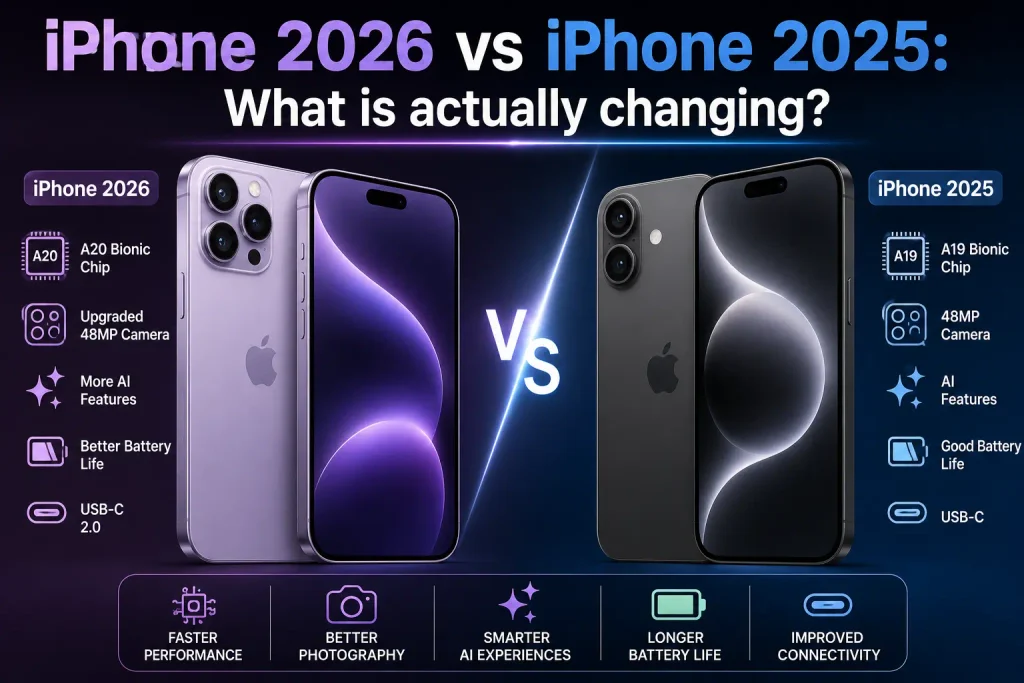
The biggest reported changes are expected in five areas:
- A20 Pro processor and potentially 2nm manufacturing
- Camera upgrades, including variable aperture
- Smaller Dynamic Island and changes to Face ID
- Apple’s C2 modem and potential connectivity improvements
- Battery and efficiency improvements
The overall design, however, may remain relatively close to the iPhone 17 Pro.
Current reporting suggests Apple is pursuing a more evolutionary external design while putting greater emphasis on internal upgrades.
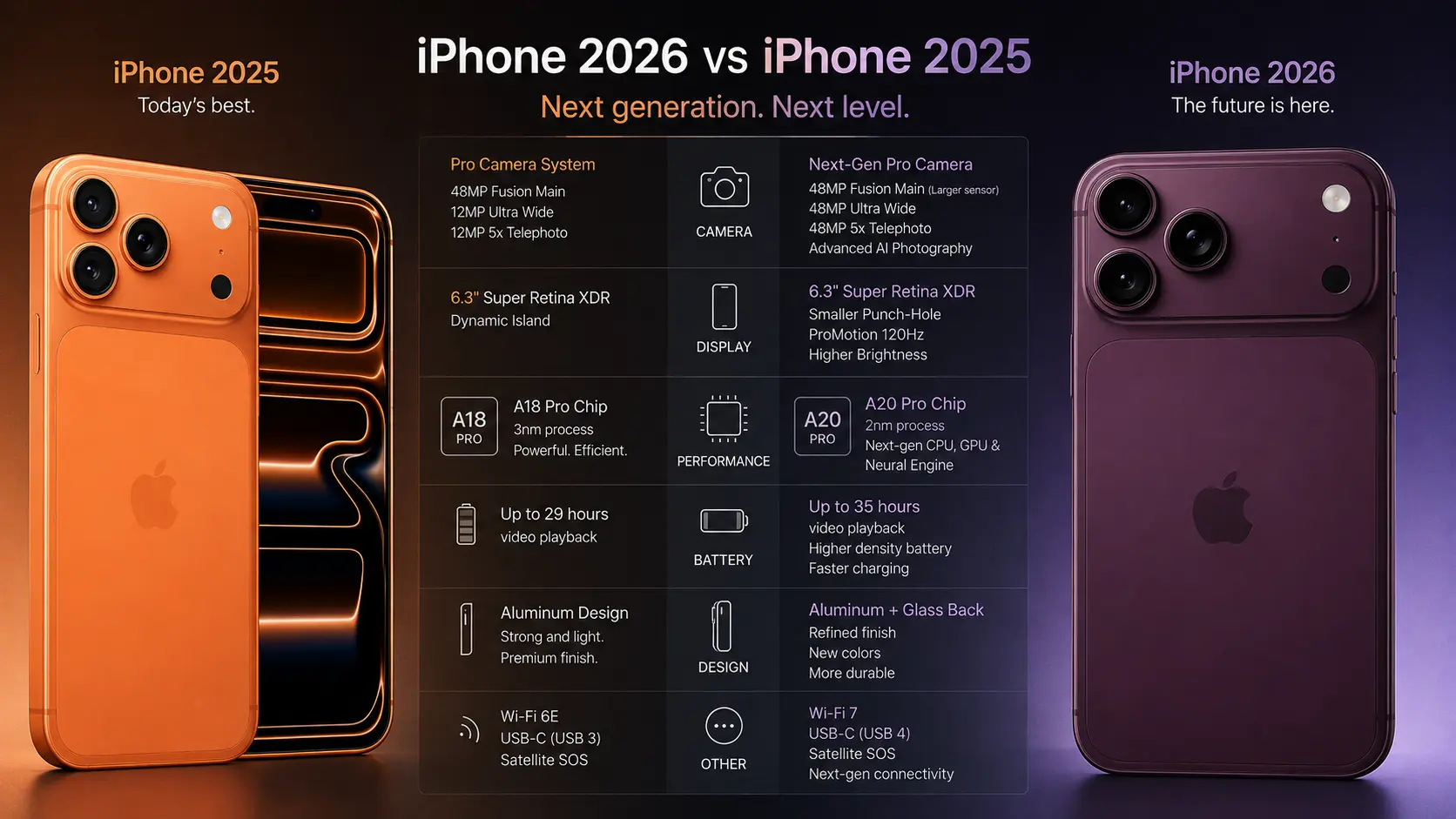
iPhone 18 Pro vs iPhone 17 Pro: Quick comparison
| Area | iPhone 17 Pro generation | Expected 2026 iPhone 18 Pro | What could actually matter |
|---|---|---|---|
| Processor | A19 Pro | A20 Pro | Performance, efficiency and AI |
| Chip process | Current generation | 2nm reported | Potential efficiency gains |
| Main camera | Existing Pro camera system | Variable aperture reported | Better control over depth/light |
| Dynamic Island | Current design | Smaller reported | More screen area / cleaner appearance |
| Face ID | Existing setup | Some components may move under display | Less visible sensor area |
| Modem | Qualcomm-based | Apple C2 reported | Efficiency/connectivity |
| Battery | Large Pro batteries | Possible improvement | Longer endurance |
| Overall design | New 2025 Pro design | Similar basic design reported | Upgrade may be more internal |
These are reported expectations, not Apple’s final specifications.
1. The biggest performance change could be the A20 Pro chip
One of the most important potential differences between the iPhone 2026 and iPhone 2025 generations is the processor.
The iPhone 18 Pro is widely expected to use Apple’s A20 Pro chip, with reports pointing to a move toward a 2nm manufacturing process.
The significance of 2nm is not simply a bigger benchmark number.
A newer manufacturing process can potentially allow Apple to improve:
- processing performance;
- power efficiency;
- thermal management;
- AI workloads;
- sustained performance.
For everyday users, the biggest benefit may therefore be efficiency rather than raw speed.
An iPhone 17 Pro already provides substantial performance, so most users should not expect ordinary apps to suddenly feel dramatically faster.
The difference could become more noticeable in demanding games, video processing and AI-heavy workloads.
Will the A20 Pro make iPhone 18 dramatically faster?
Probably not in every everyday task.
The more meaningful potential advantage could be the combination of performance and efficiency.
That means the upgrade may show up more in sustained workloads and battery life than in simply opening Instagram or WhatsApp a fraction of a second faster.
2. The camera could receive one of the most meaningful upgrades
Camera technology is another area where the iPhone 18 Pro could offer a genuine change rather than a simple specification bump.
Multiple reports point to a possible variable-aperture main camera.
A variable aperture would give the camera greater physical control over how much light reaches the sensor.
That could help with:
- exposure control;
- depth of field;
- portrait photography;
- bright outdoor scenes;
- creative photography.
This would be different from Apple’s usual approach of relying heavily on computational photography.
Why does variable aperture matter?
Imagine photographing a person against a busy background.
With greater control over aperture, the camera could potentially create a different depth-of-field effect while controlling the amount of incoming light.
For ordinary users, the difference may not be obvious in every photograph.
For photographers, however, it could become one of the more interesting upgrades in the new Pro generation.
3. Dynamic Island could become smaller
The exterior design of the iPhone 18 Pro may not look radically different from the iPhone 17 Pro.
But the Dynamic Island could become smaller.
Reports suggest Apple may move some Face ID components beneath the display, allowing the visible cutout to shrink.
If accurate, this could create a cleaner-looking display without requiring Apple to completely eliminate the front camera cutout.
This is an important distinction:
The rumored change is not necessarily “no Dynamic Island.”
Instead, Apple may make the visible area smaller.
Would users notice this?
Probably more than a small benchmark increase.
The Dynamic Island is present every time the display is used, so even a relatively subtle reduction could make the screen feel cleaner.
However, the exact implementation remains uncertain because reports about Apple’s front-camera and Face ID plans have not always agreed.
4. The modem could change from Qualcomm to Apple’s own C2
Another reported change is Apple’s next-generation C2 modem.
The C2 is expected to replace Qualcomm’s modem technology in the new generation, according to current reports.
For consumers, the important question is not simply who manufactured the modem.
The real question is what the change means for:
- power efficiency;
- cellular reliability;
- 5G performance;
- thermal performance;
- integration with Apple’s chip platform.
If Apple can better integrate its modem with the A20 Pro system, the benefit could be improved efficiency.
But actual network performance will depend heavily on carrier infrastructure and location.
So it would be misleading to say that every iPhone 18 Pro user will automatically experience dramatically faster 5G.
5. Battery life could improve
Battery life is potentially one of the most practical iPhone 18 Pro upgrades.
Reports suggest Apple could combine:
- a more efficient A20 Pro chip;
- the new C2 modem;
- battery capacity changes;
- other internal efficiency improvements.
9to5Mac has reported expectations of a larger iPhone 18 Pro Max battery, alongside efficiency gains from the new processor and modem.
This could make battery endurance one of the areas where the new generation feels noticeably better.
But battery life should not be treated as confirmed until Apple provides official specifications and testing.
6. Will the iPhone 18 Pro design look completely different?
Probably not.
This is one area where expectations should be kept realistic.
Current reports suggest the iPhone 18 Pro and Pro Max will retain broadly similar dimensions and design language to the iPhone 17 Pro models. Macworld reports expected screen sizes of approximately 6.3 inches and 6.9 inches, with the overall design remaining familiar.
That means the upgrade could be more about refinement than reinvention.
Possible visual differences include:
- smaller Dynamic Island;
- new colors;
- a more unified rear appearance;
- camera-module refinements.
So someone holding an iPhone 17 Pro next to an iPhone 18 Pro may not immediately see a completely different phone.
7. Display improvements could be subtle
The screen sizes are reportedly expected to remain broadly similar.
However, reports have pointed toward possible improvements in display brightness and other panel characteristics.
This is another example of an upgrade that may be more noticeable during specific situations than during normal indoor use.
A brighter display could matter when:
- using the phone outdoors;
- viewing HDR video;
- photographing in strong sunlight;
- navigating under bright conditions.
But the exact brightness figures remain unconfirmed.
8. What about Apple Intelligence?
Artificial intelligence is increasingly becoming part of Apple’s hardware strategy.
The A20 Pro’s expected improvements could provide additional processing capability for on-device AI workloads.
However, the key point is that better hardware does not automatically mean every existing iPhone 17 user will receive completely different AI features.
Software availability depends on Apple’s operating-system support and feature rollout.
Therefore, buyers should judge the iPhone 18 upgrade on the total package rather than assuming that the new chip alone will unlock a completely different AI experience.
9. The biggest change may actually be the launch strategy
There is another major difference between 2025 and 2026 that has nothing to do with the hardware.
Apple is reportedly changing the timing of its iPhone releases.
Instead of launching the complete lineup together in September, current reporting suggests Apple may introduce the Pro models in September 2026, while the standard iPhone 18, iPhone 18e and a second-generation iPhone Air could arrive around spring 2027.
That would make 2026 unusual.
Reported launch pattern
2025:
iPhone 17
iPhone 17 Pro
iPhone 17 Pro Max
iPhone Air
and other models
2026:
iPhone 18 Pro
iPhone 18 Pro Max
Possible foldable iPhone
2027:
Reportedly standard iPhone 18
Reportedly iPhone 18e
Reportedly next-generation iPhone Air
This is still a reported roadmap, not an official Apple product calendar.
What about the foldable iPhone?
The foldable iPhone could be the biggest difference of all—but it should technically be considered a new product category, rather than a direct iPhone 17-to-iPhone 18 upgrade.
Reuters reports that Apple is expected to unveil its first foldable iPhone at the September 9 event.
The foldable device is reportedly positioned at the premium end of Apple’s lineup.
If Apple launches it, the comparison with an iPhone 17 Pro becomes less about:
“Is this phone 20% faster?”
and more about:
“Do I want an entirely different form factor?”
That could make the foldable iPhone the most significant hardware announcement of Apple’s 2026 event.
iPhone 2026 vs iPhone 2025: Which upgrades could users actually notice?
Not every rumored specification will matter equally.
High-impact changes
Camera system: Potentially significant for photography enthusiasts.
Battery efficiency: Potentially useful every day.
Smaller Dynamic Island: A visible design improvement.
Foldable form factor: A completely new category.
Medium-impact changes
A20 Pro performance: Important for demanding users but probably less noticeable for basic tasks.
C2 modem: Potentially useful for connectivity and efficiency, but network conditions matter.
Low-impact changes for many users
New colors: Cosmetic rather than functional.
Small design refinements: Unlikely to justify an upgrade by themselves.
Benchmark gains: Interesting for enthusiasts but less important than battery and camera performance for most people.
Should you upgrade from iPhone 17 to iPhone 18?
There is no universal answer.
You may want to wait for iPhone 18 if:
- you want the newest camera technology;
- battery life is a major priority;
- you care about the latest processor;
- you want a smaller Dynamic Island;
- you are interested in the potential foldable iPhone;
- your current phone is already due for replacement.
You may not need to upgrade if:
- your iPhone 17 Pro already meets your performance needs;
- you mainly use social media and messaging;
- the current camera is already sufficient;
- you do not care about the rumored design changes;
- you prefer to wait until Apple’s specifications and reviews are available.
For many iPhone 17 Pro owners, the decision may ultimately come down to camera and battery improvements rather than basic performance.
What is confirmed and what is still rumor?
This distinction is especially important before Apple’s September event.
| Claim | Current status |
|---|---|
| Apple event on September 9, 2026 | Confirmed |
| iPhone 18 Pro announcement | Widely expected |
| iPhone 18 Pro Max announcement | Widely expected |
| Foldable iPhone | Widely reported/expected |
| A20 Pro | Reported |
| 2nm process | Reported |
| Variable-aperture camera | Reported |
| Smaller Dynamic Island | Reported |
| C2 modem | Reported |
| Larger battery | Reported |
| Standard iPhone 18 delayed to 2027 | Reported |
| Final prices | Not confirmed |
| Final specifications | Not confirmed |
Apple has not yet officially confirmed the product specifications in this comparison.
What does the iPhone 2026 vs iPhone 2025 comparison tell us?
The early evidence suggests Apple is not simply preparing another minor yearly refresh.
The iPhone 18 Pro generation could combine several incremental improvements—A20 Pro, camera changes, modem improvements, battery efficiency and a smaller Dynamic Island—into a more meaningful overall upgrade.
But the biggest story may be the change in Apple’s product strategy.
The company appears set to put its premium models at the centre of the September launch, potentially leaving the standard iPhone 18 for 2027.
And if the foldable iPhone arrives as expected, Apple will be entering an entirely new hardware category at the same time.
“Sources Used”
https://www.apple.com/in/store?afid=p240%7Cgo~cmp-11141176048~adg-112258962187~ad-816969290830_kwd-49065841~dev-c~ext-~prd-~mca-~nt-search&cid=aos-in-kwgo-txt-brand-brand–
The bottom line
The iPhone 2026 vs iPhone 2025 comparison currently points toward an upgrade that may be more substantial internally than externally.
The most interesting expected changes are the A20 Pro chip, possible 2nm technology, variable-aperture camera, smaller Dynamic Island, Apple’s C2 modem and improved battery efficiency.
The external design, however, is expected to remain relatively familiar.
For existing iPhone 17 Pro owners, that means the upgrade case will probably depend on what matters most: camera, battery, display design or new technology, rather than simply wanting a faster phone.
And for anyone considering the new generation, the September 9 Apple event is the point at which the rumors should finally turn into confirmed specifications.
For the full event schedule, expected products and launch details, see our iPhone 18 September event 2026 coverage.
FAQ
What is the biggest expected difference between iPhone 2026 and iPhone 2025?
The biggest reported changes are the A20 Pro chip, camera upgrades, a smaller Dynamic Island, Apple’s C2 modem and potential battery improvements. A foldable iPhone could represent an even larger change because it would introduce a new form factor.
Is iPhone 18 better than iPhone 17?
The iPhone 18 Pro is expected to offer hardware improvements over the iPhone 17 Pro, but Apple has not officially confirmed the final specifications. Whether the upgrade is worthwhile will depend on the user’s priorities.
Should I upgrade from iPhone 17 to iPhone 18?
Existing iPhone 17 owners may not need to upgrade simply for performance. The more compelling reasons could be the rumored camera, battery, display-cutout and modem improvements.
Will iPhone 18 have a new camera?
Reports suggest the iPhone 18 Pro could introduce a variable-aperture main camera, potentially providing more control over light and depth of field. This remains unconfirmed by Apple.
Will iPhone 18 Pro have a smaller Dynamic Island?
Current reports suggest the iPhone 18 Pro could have a smaller Dynamic Island because some Face ID components may move beneath the display. The exact implementation remains uncertain.
Will the regular iPhone 18 launch in September 2026?
Current reports suggest the standard iPhone 18 could be delayed until 2027, with the September 2026 launch focused on Pro models and potentially a foldable iPhone. Apple has not officially confirmed this roadmap.
Is the iPhone 18 Pro getting a 2nm chip?
The A20 Pro is widely reported to use a 2nm manufacturing process, but Apple has not yet officially confirmed the chip’s manufacturing technology.