


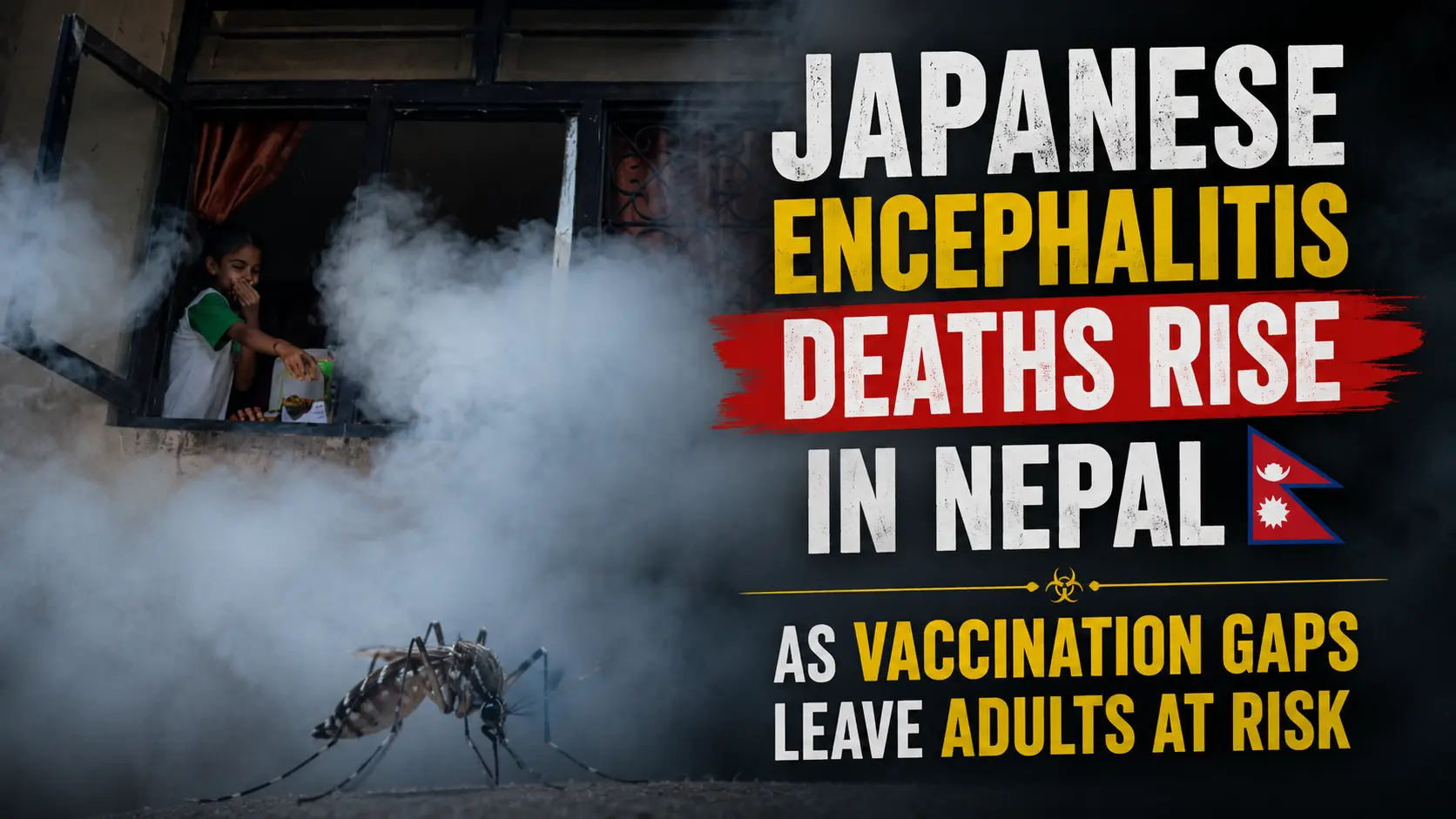
Nepal is facing a renewed Japanese encephalitis (JE) threat, with infections and deaths rising during the monsoon season and health officials warning that the situation could worsen as transmission reaches its seasonal peak.
The disease, a mosquito-borne viral infection that can cause severe inflammation of the brain, has historically been associated with Nepal’s Terai region. But recent surveillance has shown infections occurring across a wider geographical area and affecting people beyond the age group traditionally associated with routine childhood immunisation.
According to health officials cited in the source material, nine people had died and 37 had been infected within less than a month. Six deaths were reported in Koshi Province, two in Madhesh and one in Lumbini. Authorities were investigating additional suspected infections and deaths.
The immediate concern is not only the number of cases but the vaccination gap exposed by recent fatalities.
A death in a recently targeted district raises concern
One of the reported deaths occurred in Nawalparasi East, where health authorities had launched a JE vaccination campaign only months earlier.
Dr Abhiyan Gautam, chief of the Immunisation Section at the Family Welfare Division under Nepal’s Department of Health Services, said surveillance indicated that the person who died had not received the JE vaccine. He linked the death to incomplete vaccination coverage in the district, which stood at 77 percent.
The episode illustrates a central problem facing Nepal: routine childhood vaccination has reduced the historical burden of JE, but people who remain unvaccinated can still face serious consequences.
The World Health Organization says about one-third of people who develop severe JE die, while a significant proportion of survivors are left with permanent neurological disabilities. There is no specific antiviral treatment for JE; medical care primarily focuses on managing symptoms and complications.
The disease is no longer only a childhood threat
Historical outbreaks in Nepal were particularly devastating among children. The country experienced a major JE epidemic in 2005, when nearly 2,000 people died, mostly in the Tarai districts.
Nepal began introducing JE vaccination in 2006 and subsequently incorporated the vaccine into routine immunisation. According to Nepal’s health-sector reporting, mass vaccination campaigns were gradually expanded to high-risk districts, followed by inclusion of the vaccine in routine services nationwide.
Yet recent surveillance suggests that older people remain vulnerable.
Data cited by health officials showed that about 76 percent of JE deaths in the previous year were among people over 40, while around 70 percent of infections occurred among people older than 15. That pattern raises questions about whether protection achieved through childhood immunisation is reaching the wider population that remains unvaccinated.
Funding is becoming a major obstacle
Public-health specialists have argued that vaccination is the most effective way to prevent severe JE disease and deaths. However, extending vaccination beyond routine childhood programmes requires additional funding.
The government has allocated Rs460 million for a vaccination campaign covering 11 districts considered to have a high JE burden: Chitwan, Kailali, Tanahun, Dang, Jhapa, Kapilvastu, Morang, Rupandehi, Sunsari, Rautahat and Sarlahi.
The programme, however, was not expected to begin immediately because vaccine procurement and distribution require time.
That delay is significant because JE transmission is strongly seasonal. Nepal’s disease surveillance records show infections generally rise during the monsoon period, with cases historically peaking around August to October.
More recent reporting also shows that the disease continued to spread during 2025, eventually causing 41 deaths and 141 confirmed infections across more than 45 districts and 117 local units.
Prevention cannot rely on vaccination alone
Vaccination remains central, but health experts also stress the need for mosquito-bite prevention, public awareness and stronger surveillance.
JE virus is transmitted mainly by infected Culex mosquitoes. Pigs and water birds play an important role in the virus’s transmission cycle, while people living near rice fields and agricultural areas can face greater exposure.
Local governments are expected to play a major role in awareness and preventive campaigns. But health officials have acknowledged coordination problems between federal, provincial and local authorities, including delays in sharing information about outbreaks.
For a country that has already experienced some of Asia’s most serious historical JE outbreaks, those gaps matter.
The estimated 12.5 million people considered at high risk also underline the scale of the challenge.
“Sources Used“
The Kathmandu Post — JE vaccination to continue in Nawalparasi East
The Kathmandu Post — People from 11 high JE-burden districts to be vaccinated
What Nepal needs to watch next
The immediate priorities are identifying unvaccinated people in high-risk areas, improving outbreak surveillance and ensuring that vaccine procurement does not become a bottleneck.
The longer-term question is whether Nepal’s immunisation strategy can protect vulnerable adults as effectively as it has protected children.
The recent rise in deaths suggests that controlling JE will require more than maintaining routine childhood vaccination. Public-health authorities will need to close immunity gaps, strengthen coordination across levels of government and ensure that communities receive timely information before seasonal transmission intensifies.
New Malaria Strategy Uses Controlled Parasite Exposure to Build Longer-Lasting Immunity in Mice
Vitamin D Deficiency Widespread Among Children in Qatar, Study Finds
Coffee Consumption Linked to Leaner Body Composition and Distinct Hormone Patterns in Men and Women
Circadian Oncology: Could the Time of Day Change How Cancer Treatment Works?