




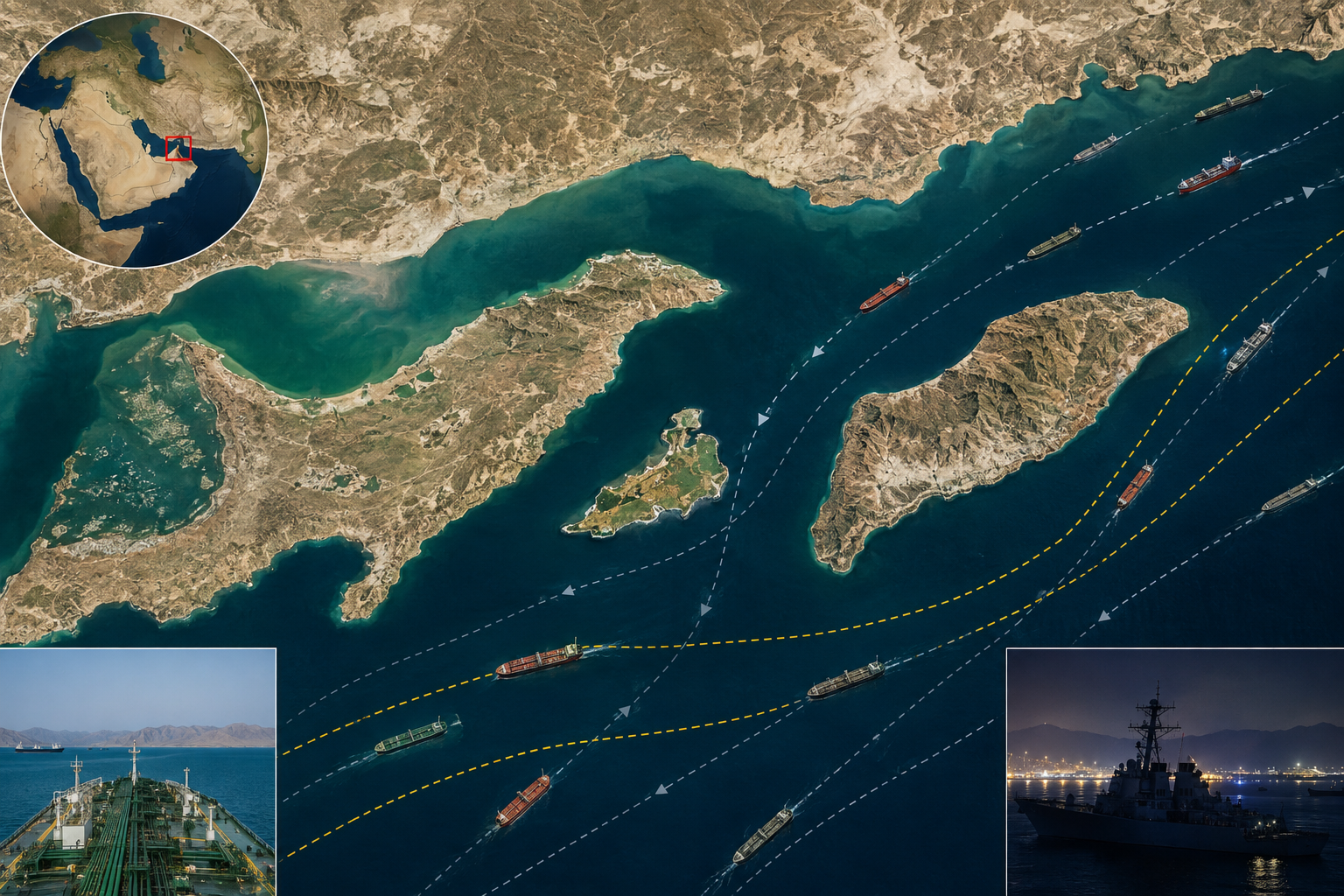
Larak Island is a small Iranian island in the Strait of Hormuz whose strategic importance comes from its location rather than its size. Situated near one of the world’s most important energy and shipping chokepoints, Larak gives Iran a position from which maritime activity in the surrounding waters can be monitored and potentially threatened.
The island has suddenly attracted global attention after US forces struck two Iranian launchers on Larak Island on August 30, 2026.
According to a US official, the launchers were operated by Iran’s Islamic Revolutionary Guard Corps (IRGC), and Iranian forces were preparing to launch rockets carrying sea mines into the Strait of Hormuz. The US said its action was intended to prevent an imminent threat to shipping.
Iran condemned the strike and its Revolutionary Guards vowed retaliation. Iran subsequently reported missile attacks against US positions in Jordan, while Jordan said its defenses intercepted missiles.
That sequence has put a previously unfamiliar name—Larak Island—at the center of the latest US-Iran escalation.
https://www.reuters.com/world/middle-east/us-forces-strike-two-iranian-launchers-irans-larak-island-us-official-says-2026-08-30/
Where Is Larak Island?
Larak Island is located in southern Iran, in the Strait of Hormuz, the narrow maritime passage connecting the Persian Gulf with the Gulf of Oman and the Arabian Sea.
It sits close to two other strategically important Iranian islands:
- Qeshm Island
- Hormuz Island
Together, these islands occupy a critical position around the eastern side of the Strait of Hormuz.
Larak itself is relatively small, covering roughly 49 square kilometres, but its geographical position gives it strategic significance far greater than its physical size. Al Jazeera describes it as the first major strategic island along the Strait and an important observation point for maritime movement.
This is a classic example of why geography matters in geopolitics.
A small island located beside a major international shipping route can have greater military and economic significance than a much larger piece of territory located far from a strategic chokepoint.
https://interactive.aljazeera.com/aje/2026/iran-coastline-islands/
Why Is Larak Island Important to Iran?
Larak Island is important because it sits close to the maritime gateway through which ships enter and leave the Persian Gulf.
The Strait of Hormuz is one of the world’s most important energy chokepoints.
Before the current conflict, approximately one-fifth of global oil consumption moved through the waterway. The passage is also important for liquefied natural gas shipments.
That means Iran does not need to control a huge area to exert pressure on international shipping.
Its geographic position around the Strait gives Tehran a strategic tool.
Larak’s importance comes from four factors:
- Location near the Strait of Hormuz
- Proximity to international shipping lanes
- Ability to support maritime surveillance
- Potential military use against shipping or naval forces
These factors explain why Larak has become important in the current conflict.
Is Larak Island Actually in the Strait of Hormuz?
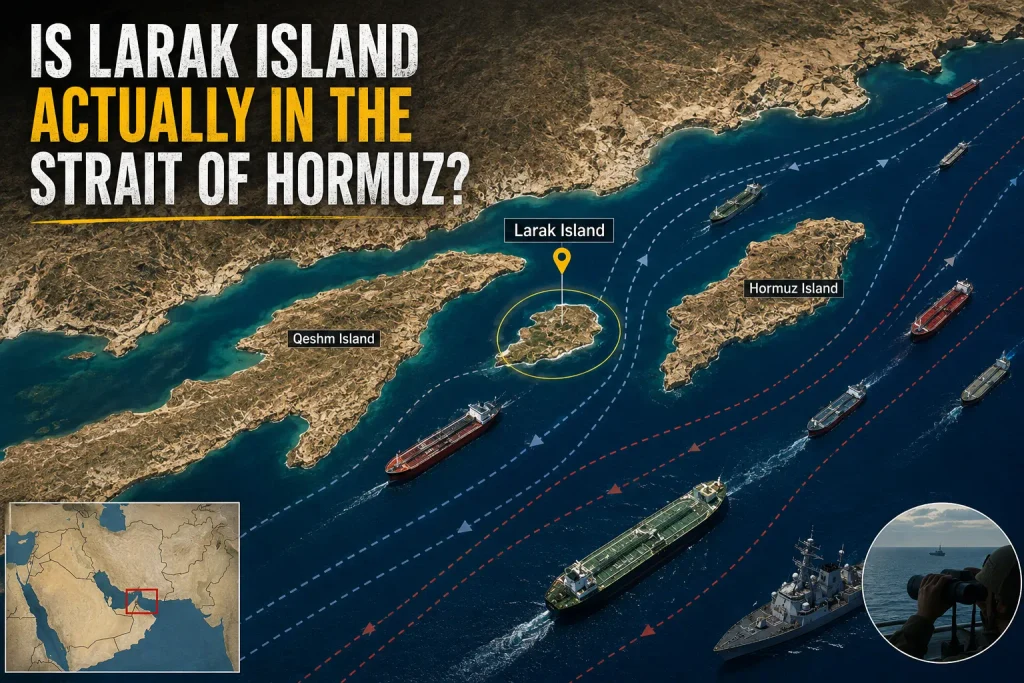
Yes, Larak Island is located in the Strait of Hormuz.
This is one of the most important facts for understanding its strategic value.
The Strait is relatively narrow. At its narrowest point, it is approximately 39 kilometres wide, while the deep-water shipping lanes available to large vessels occupy a much smaller portion of the waterway.
For large oil tankers and cargo ships, navigation is therefore concentrated through defined maritime routes.
That concentration creates what military strategists call a chokepoint.
A chokepoint is a narrow geographic passage through which large volumes of traffic must pass.
The Strait of Hormuz is one of the world’s most important examples.
Why Does the Strait of Hormuz Matter So Much?
The Strait of Hormuz matters because of the enormous quantity of energy transported through it.
Oil and gas from major Gulf producers must pass through or near this maritime corridor to reach international markets.
Any serious disruption can therefore affect countries far beyond the Middle East.
A problem in the Strait can lead to:
Shipping disruption → higher transportation costs → higher oil prices → higher energy costs → inflationary pressure.
That is why events occurring around a relatively small island such as Larak can immediately attract the attention of global financial and energy markets.
What Does Larak Island Have to Do With the US-Iran Conflict?
Larak Island became directly connected to the conflict on August 30, 2026, when US forces struck two Iranian launchers there.
The US said Iranian Revolutionary Guard forces were preparing to launch rockets carrying sea mines into the Strait of Hormuz.
The United States had recently cleared mines from international shipping routes in the Strait. US Central Command said the forces were taking limited action against what it considered an imminent threat to maritime traffic.
This explains why Washington focused on Larak.
The target was not simply an island.
The target was an alleged military capability positioned next to a critical shipping route.
https://www.euronews.com/2026/08/31/iran-fires-retaliatory-strikes-following-us-attacks-on-larak-island-in-the-strait-of-hormu
Why Are Sea Mines Such a Serious Threat?
Sea mines are underwater explosive devices designed to damage or destroy ships.
They can be particularly difficult to detect because they can remain hidden beneath the water.
For a commercial shipping company, even the possibility that a major route has been mined can create serious problems.
A vessel operator may have to:
- Delay a voyage
- Reroute the ship
- Pay higher insurance costs
- Use additional security measures
- Wait for mines to be cleared
The result can be a disruption to shipping even if no commercial ship is actually struck.
That is why the United States considered the alleged preparations on Larak Island a serious threat.
Why Did the US Strike Larak Island?
The immediate US explanation was straightforward: Washington said it wanted to stop Iranian forces from deploying sea mines into the Strait of Hormuz.
A US official told Reuters that American forces struck two Iranian launchers after observing IRGC personnel preparing to launch rockets carrying sea mines.
The strike was significant because it was the first publicly acknowledged US attack against Iranian military positions in more than a month.
For a deeper breakdown of the attack itself—including what the US said it was targeting, Iran’s response and the potential oil-market consequences read HNN24x7’s related article:
Why Did the US Strike Larak Island? What the Attack Means for Iran and the Strait of Hormuz
This article should function as the news-event internal link, while the current page serves as the evergreen entity/explainer page about Larak Island.
Is Larak Island a Major Iranian Military Base?
Larak’s importance should not be reduced to the claim that it is simply a conventional “military base.”
The more important point is its strategic military position.
The island can form part of Iran’s broader maritime-security and military network around the Strait of Hormuz.
Its location can support surveillance and potentially military operations involving:
- Shipping
- Naval movements
- Maritime security
- Mine warfare
- Coastal defense
- Control of nearby sea lanes
Recent events demonstrate that military equipment positioned on the island can become directly relevant to the US-Iran confrontation.
The August 30 strike specifically targeted Iranian launchers, according to US officials.
Larak Island vs. Hormuz Island: Are They the Same?
No. Larak Island and Hormuz Island are different Iranian islands.
This distinction is important because their names can easily cause confusion.
- Larak Island: A small island near the Strait of Hormuz and close to Qeshm Island.
- Hormuz Island: Another Iranian island located nearby and also strategically positioned around the Strait.
- Qeshm Island: A much larger Iranian island west of Larak.
All three are part of the broader geography surrounding the Strait of Hormuz, but they are separate islands.
The current US strike specifically involved Larak Island, not Hormuz Island.
Why Is Larak More Important During the Current Conflict?
Larak’s importance has increased because the conflict has increasingly centered on the Strait of Hormuz.
The waterway has been affected by the wider US-Iran confrontation, with maritime traffic significantly disrupted compared with normal conditions.
Washington wants to keep the shipping route open.
Iran, meanwhile, has demonstrated its ability to threaten or restrict movement through the waterway.
That creates a strategic contest:
Iran’s geographic advantage vs. US naval power and international shipping interests.
Larak sits directly inside this contest.
How Does Larak Island Affect Global Oil Prices?
The island itself does not determine oil prices.
The concern is what happens around the Strait of Hormuz.
If shipping through the Strait becomes more dangerous, traders may price in the risk of reduced oil supplies.
That can push crude prices higher.
The latest Larak strike was followed by renewed concern in oil markets, with oil prices rising as investors assessed the possibility of further conflict and disruption around the Strait.
This is why a military event on a small Iranian island can quickly become an economic story.
For the India-specific consequences of crude-price movements, readers can also follow HNN24x7’s crude oil price coverage.
Why Is Larak Island Important for Global Shipping?
The importance of Larak ultimately comes down to geography.
International shipping depends on predictable and secure maritime routes.
The Strait of Hormuz connects major Gulf energy producers with global markets. If vessels cannot safely pass through the waterway, the effects can extend across:
- Asia
- Europe
- North America
- Global oil markets
- Shipping markets
- Insurance markets
That makes Larak part of a much larger international security equation.
What Happened After the US Strike?
Iran’s Revolutionary Guards said the US strike caused casualties among Iranian fighters and civilians and promised retaliation. The exact casualty figure was not immediately disclosed.
Iran later said it had launched ballistic missiles at US positions in Jordan.
Jordan’s military said it intercepted eight missiles that entered its airspace.
The exchange demonstrated how an incident around Larak can quickly expand beyond the island and the Strait itself.
That is one reason analysts are watching the area closely.
Could Larak Island Become a Bigger Flashpoint?
Yes, although the scale of future escalation remains uncertain.
The island’s importance comes from the fact that it sits next to a critical maritime corridor.
If Iran continues trying to deploy mines or otherwise threaten shipping, the United States and other countries may attempt to neutralize those capabilities.
That creates the risk of repeated military encounters.
At the same time, any prolonged disruption of the Strait could increase pressure on global energy markets.
The situation therefore involves three overlapping battles:
Military: US and Iranian forces competing for control of the maritime security environment.
Economic: Iran and the US using energy and shipping pressure as leverage.
Geopolitical: Regional and international powers trying to prevent the conflict from spreading.
Why Larak Island Matters More Than Its Size Suggests
Larak Island is a useful example of how geography can create geopolitical power.
At around 49 square kilometres, it is tiny compared with Iran itself. But its location places it beside one of the world’s most important maritime chokepoints.
That means the island’s strategic value comes from what surrounds it.
Its proximity to the Strait of Hormuz means that military activity there can affect:
Iranian security → Strait security → global shipping → oil markets → the wider global economy.
The August 2026 US strike has made that connection impossible to ignore.
FAQ
What is Larak Island?
Larak Island is a small Iranian island located in the Strait of Hormuz near Qeshm and Hormuz islands. Its strategic location gives it importance for maritime surveillance and security.
Where is Larak Island located?
Larak Island is in southern Iran, in the Strait of Hormuz between the Persian Gulf and the Gulf of Oman.
Why is Larak Island important to Iran?
Its importance comes primarily from its strategic position near international shipping routes through the Strait of Hormuz. The island can form part of Iran’s broader maritime security and military network.
Why did the US strike Larak Island?
The US said it struck two Iranian launchers on Larak Island because Iranian forces were preparing to launch rockets carrying sea mines into the Strait of Hormuz.
Is Larak Island the same as Hormuz Island?
No. Larak Island and Hormuz Island are separate Iranian islands, although both are located near the strategically important Strait of Hormuz.
Why is the Strait of Hormuz important?
The Strait is one of the world’s major energy chokepoints. Before the current conflict, about one-fifth of global oil consumption passed through the waterway.
Does Larak Island affect oil prices?
Larak Island itself does not directly determine oil prices. However, military activity around the island can affect perceptions of risk around the Strait of Hormuz, which can influence oil prices.
What happened to Larak Island after the US strike?
US forces struck two Iranian launchers on August 30, 2026, according to a US official. Iran’s Revolutionary Guards said the attack caused casualties and vowed retaliation.
The Bottom Line
Larak Island is a small Iranian island with outsized strategic importance because it sits in the Strait of Hormuz, a critical route for global energy and maritime trade.
Its importance to the current Iran conflict comes from its location and its potential role in Iran’s military strategy around the Strait.
The August 30 US strike brought that strategic importance into sharp focus after Washington said Iranian forces on Larak were preparing to launch sea mines into the waterway.
The bigger story, however, is not simply Larak Island.
It is the continuing struggle over the Strait of Hormuz—and the question of whether the world’s energy trade can move safely through one of its most important chokepoints while the US-Iran conflict continues.