




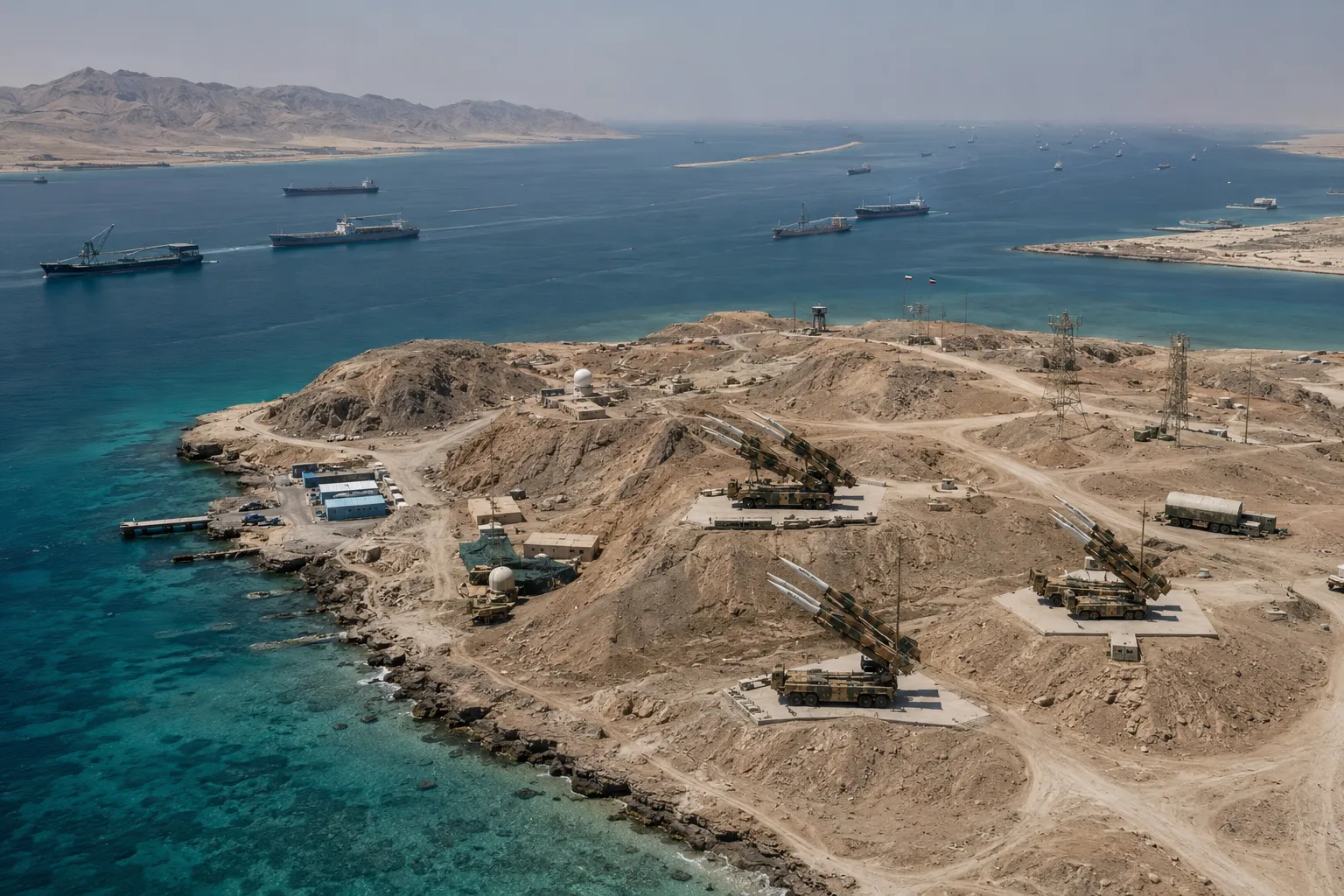
The United States struck two Iranian launchers on Larak Island on August 30, 2026, in what Washington described as a limited action aimed at preventing Iranian forces from deploying sea mines into the Strait of Hormuz.
A U.S. official said the launchers were operated by Iran’s Islamic Revolutionary Guard Corps and that Iranian forces were preparing to use rockets to launch sea mines into the strategically important waterway. The strike was the first publicly acknowledged U.S. attack on Iranian forces since late July.
The attack immediately raised a larger question: Why was Larak Island important enough to become the target of a U.S. military strike?
The answer lies less in the island itself and more in its location.
Larak sits in the Strait of Hormuz, one of the world’s most important maritime chokepoints. Any attempt to mine or otherwise disrupt the waterway could threaten commercial shipping, energy supplies and global oil markets.
What Happened on Larak Island?
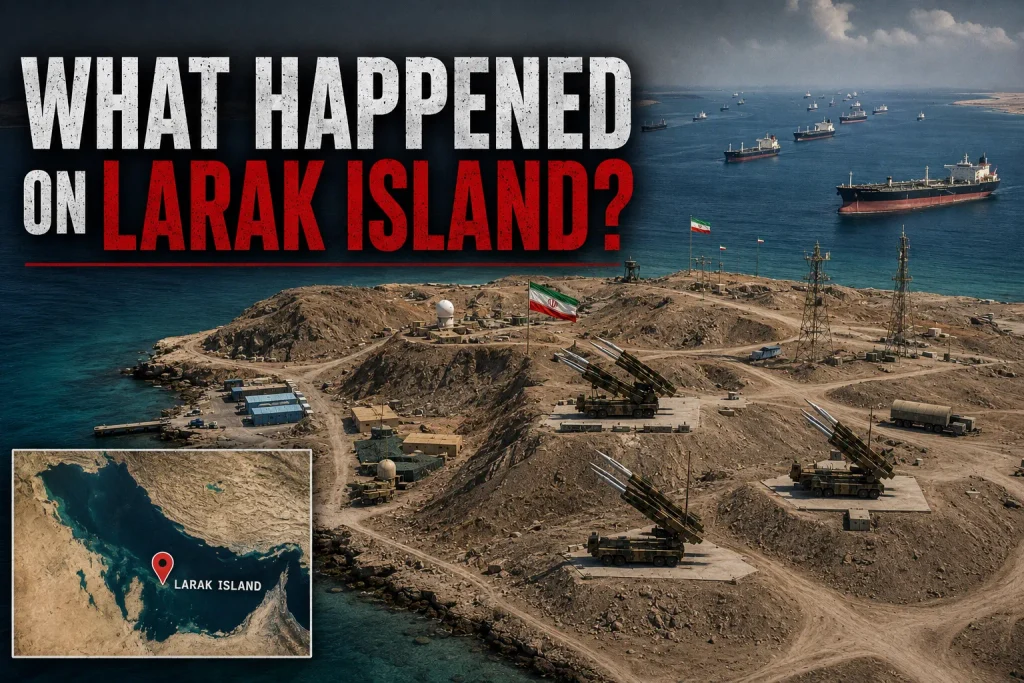
On August 30, U.S. forces conducted strikes against two Iranian launchers on Larak Island, according to a U.S. official cited by Reuters.
Washington said Iranian forces were preparing to launch rockets carrying sea mines into the Strait of Hormuz.
The U.S. military characterized the operation as limited and defensive, saying the objective was to remove an imminent threat to maritime traffic.
Iran’s Islamic Revolutionary Guard Corps, meanwhile, said the attack caused casualties among military personnel and civilians and vowed retaliation.
The situation escalated further when Iran launched missile attacks against U.S. military positions in Jordan, according to subsequent reporting. Jordan said its defenses intercepted missiles during the attack.
So, the Larak Island strike was not an isolated attack. It became the trigger for a new exchange between Washington and Tehran after weeks of comparatively reduced direct U.S.-Iran military activity.
https://www.reuters.com/world/middle-east/us-forces-strike-two-iranian-launchers-irans-larak-island-us-official-says-2026-08-30/
Why Did the US Strike Larak Island?
The immediate U.S. reason was to prevent Iranian forces from deploying sea mines into the Strait of Hormuz.
That explanation comes from U.S. officials and Central Command.
The U.S. said the Iranian launchers posed an imminent maritime threat because they could be used to place mines in shipping routes.
This is significant because the United States had recently been conducting mine-clearing operations in the Strait.
CENTCOM said it had completed clearing sea mines from international shipping routes shortly before the Larak Island strike. U.S. officials therefore viewed any attempt to place new mines as a direct threat to the maritime routes they had just worked to reopen.
In simple terms:
US clears mines → Iran allegedly prepares new mine deployment → US strikes launchers → Iran retaliates.
That sequence explains the immediate military logic behind the attack.
Why Is Larak Island Strategically Important?
Larak Island is strategically important because of its position in the Strait of Hormuz.
The island lies near one of the world’s most important oil and shipping corridors. Its location gives military forces positioned there the ability to monitor and potentially threaten maritime activity passing through the surrounding waters.
The Strait of Hormuz itself has become one of the central strategic issues in the current US-Iran conflict.
Before the war, roughly one-fifth of the world’s oil consumption passed through the waterway, making any sustained disruption potentially significant for global energy markets.
That is why a relatively small island can have geopolitical importance far beyond its physical size.
What Are Sea Mines and Why Are They So Dangerous?
Sea mines are explosive devices placed in or near waterways to damage or destroy ships.
Their danger comes partly from uncertainty.
Unlike missiles or aircraft, mines can remain hidden underwater. Commercial ships may not know that a route has been mined until a vessel strikes one.
For the United States and other countries operating ships through the Strait of Hormuz, the possibility of new mines creates a major maritime-security problem.
It can also discourage commercial shipping companies from sending vessels through the area even before an actual ship is hit.
That means the strategic effect can be larger than the physical damage caused by a single mine.
How Does the Larak Island Strike Affect the Strait of Hormuz?
The strike matters because the Strait of Hormuz is already under severe pressure from the broader conflict.
Maritime traffic through the waterway has been substantially reduced, while the United States has been attempting to maintain or restore safe commercial passage.
A renewed mining threat could make shipping companies even more reluctant to use the route.
That could create three major consequences:
- Higher shipping costs
- Higher insurance premiums for vessels
- Higher energy prices if oil supplies are disrupted
The economic consequences extend far beyond Iran and the United States because the Strait is connected to global oil and energy markets.
Did Iran Retaliate After the US Strike?
Yes.
Iran subsequently launched missile attacks against U.S. military positions in Jordan, according to reports published on August 31.
The Iranian Revolutionary Guard described the action as retaliation for the U.S. and Israeli attacks, while Jordan said it intercepted eight missiles.
This response is significant because it demonstrates how quickly a localized incident around the Strait of Hormuz can expand into a wider regional confrontation.
It also raises the possibility of additional attacks against U.S. forces or American allies in the Middle East.
Why Did the US Strike Matter So Much for Oil Prices?
The Strait of Hormuz is one of the most important arteries for global energy trade.
Any military incident that threatens the waterway can therefore influence oil markets almost immediately.
Reuters reported that oil prices rose by more than 2% following the Larak Island attack and Iran’s retaliation.
Brent crude subsequently moved back above the psychologically important $90-per-barrel level, according to reporting on the renewed escalation.
This is where the Larak Island story directly connects to everyday economic concerns.
Higher crude prices can eventually feed into:
- Petrol and diesel prices
- Transportation costs
- Airline operating costs
- Manufacturing expenses
- Inflation
- Shipping costs
- Food prices
For readers tracking this economic impact, see HNN24x7’s related coverage:
Crude Oil Price Today: Why Oil Prices Are Rising and What It Means for India
That article provides the broader context for understanding how geopolitical shocks can move crude prices and affect the Indian economy.
Is This a New US-Iran War Escalation?
It is a significant escalation, but it should be understood in the context of an already ongoing conflict.
The Larak Island attack was reportedly the first known U.S. military strike against Iranian forces since late July.
That makes the timing particularly important.
The two sides had entered a period of reduced direct fighting, while diplomatic efforts and economic pressure continued.
The renewed exchange suggests that the Strait of Hormuz remains a major flashpoint even as Washington’s broader strategy has increasingly emphasized economic pressure on Tehran.
What Does the Larak Island Strike Mean for the US-Iran Conflict?
The biggest significance is that the Strait of Hormuz has become a central battlefield in the conflict’s economic dimension.
The United States wants to protect maritime commerce and prevent Iran from using mines or other military measures to restrict shipping.
Iran, meanwhile, retains the ability to threaten the waterway and use disruption as leverage against the United States and its allies.
That creates a dangerous cycle:
Military pressure → threat to shipping → oil-price reaction → economic pressure → retaliation → further military escalation.
The Larak Island strike fits directly into that cycle.
Could the Conflict Escalate Further?
That remains uncertain.
The immediate risk is that Iran could respond with additional attacks against U.S. forces or regional allies, while Washington could conduct further strikes if it believes Iranian forces are preparing new attacks on shipping.
The larger danger is an escalation around the Strait of Hormuz that disrupts commercial traffic for an extended period.
At the same time, diplomatic efforts remain relevant. Reporting indicates that mediation efforts involving countries including Pakistan and Qatar have continued, although negotiations have struggled to produce a lasting settlement.
For now, the Larak Island strike has demonstrated that the conflict can rapidly reignite even after periods of relative calm.
Why the Larak Island Strike Matters Beyond Iran
The most important point is that this was not simply a strike on an Iranian island.
It was a strike connected to the security of one of the world’s most important maritime chokepoints.
If mines are deployed successfully, shipping can become more dangerous. If shipping becomes more dangerous, insurance and freight costs can rise. If oil shipments are disrupted, crude prices can rise. And if energy prices remain elevated, the economic effects can spread globally.
That is why the question “why did US strike Larak Island?” has an answer that extends far beyond the island itself.
The immediate U.S. justification was to neutralize Iranian launchers allegedly preparing to deploy sea mines. But the broader issue is the struggle over control, security and access through the Strait of Hormuz—and the enormous economic consequences attached to it.
FAQ
Why did the US strike Larak Island?
The U.S. said it struck two Iranian launchers on Larak Island because Iranian forces were preparing to launch rockets carrying sea mines into the Strait of Hormuz. Washington described the operation as a limited action to prevent an imminent threat to maritime shipping.
What is Larak Island?
Larak is a small Iranian island located near the Strait of Hormuz. Its strategic position makes it important for monitoring and controlling activity around the major maritime chokepoint.
What did the US destroy on Larak Island?
According to a U.S. official, American forces struck two Iranian launchers on the island.
Why are sea mines important in the Strait of Hormuz?
Sea mines can damage or destroy ships and make commercial vessels reluctant to use a waterway. Even the threat of mines can increase shipping and insurance costs.
Did Iran retaliate after the Larak Island strike?
Yes. Iran subsequently launched missile attacks against U.S. positions in Jordan, according to reports, escalating the confrontation.
How could the Larak Island strike affect oil prices?
Any increased threat to shipping through the Strait of Hormuz can raise concerns about global oil supplies. Oil prices rose more than 2% following the latest escalation, according to Reuters.
Why is the Strait of Hormuz so important?
The Strait is a critical global energy chokepoint through which a substantial share of the world’s oil supply traditionally passes. Disruption can affect energy prices, shipping and inflation worldwide.
Could the US-Iran conflict escalate after the Larak Island strike?
Yes, further escalation is possible, particularly if Iran conducts additional attacks or the United States launches further strikes to protect shipping and military forces. However, the eventual trajectory remains uncertain.