



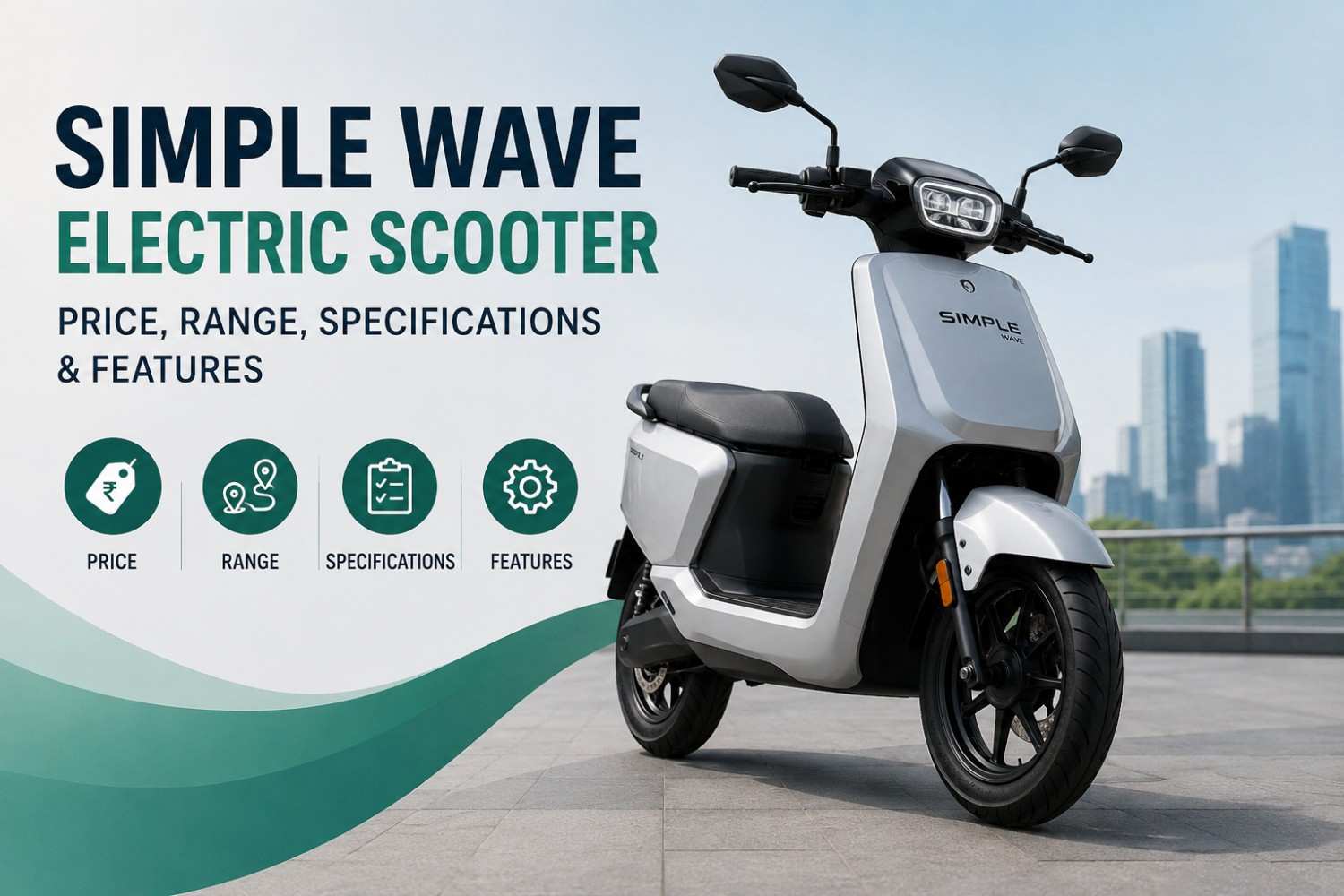
Simple Energy has unveiled its new model called the Simple Wave electric scooter in India, with a price tag of ₹1,09,999. Built as a family electric scooter, it has battery capacities of up to 2.2 kWh to 5 kWh and features a range of up to 243 km with an IDC of up to 70 liters of capacity.
Delivery of Simple Wave will start from September 25, 2026. It has been built below the performance segment of One by Simple Energy and is focused towards practicality, comfort, and usability.
Simple Wave Electric Scooter Price in India
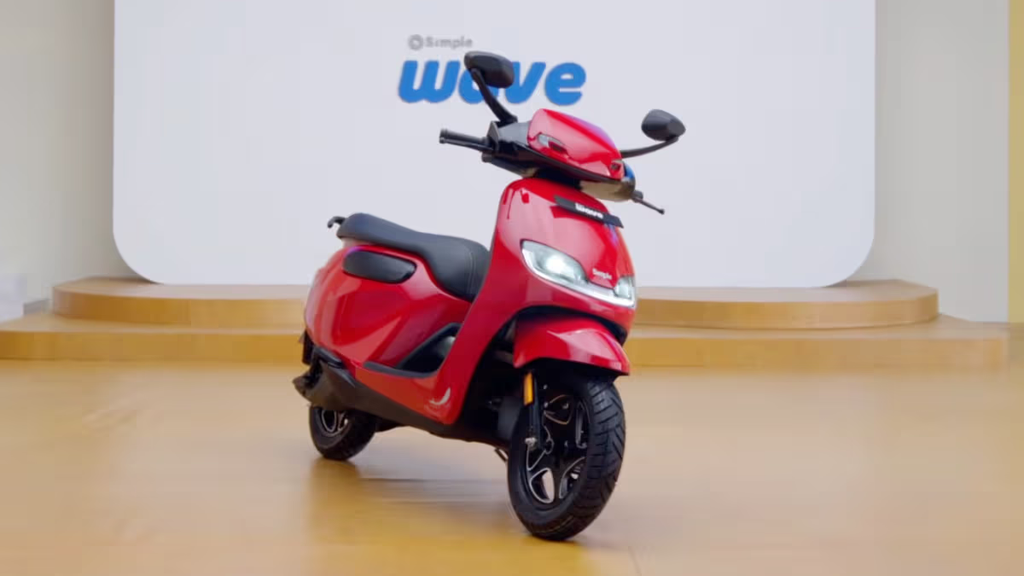
The Simple Wave price starts at ₹1,09,999 under the introductory launch pricing announced by Simple Energy.
The company has introduced the Wave in three broad variants with multiple battery and equipment configurations. However, buyers should distinguish the introductory starting price from the eventual city-wise and variant-wise pricing.
Simple Wave price and battery options
| Variant / Configuration | Battery | Claimed IDC Range | Motor Power |
| Simple Wave+ | 5 kWh | 243 km | 6.4 kW |
| Simple Wave TFT | 3.7 kWh | 171 km | 6.4 kW |
| Simple Wave EBN | 3.7 kWh | 171 km | 6.4 kW |
| Simple Wave S TFT | 2.7 kWh | 132 km | 6.4 kW |
| Simple Wave S EBN | 2.7 kWh | 132 km | 6.4 kW |
| Simple Wave S entry version | 2.2 kWh | 110 km | 4.5 kW |
Important: The 243 km figure is a claimed IDC range, not a guaranteed real-world riding range. Actual range will depend on riding mode, speed, rider/load, road conditions, temperature and traffic.
What is the Simple Wave’s range?
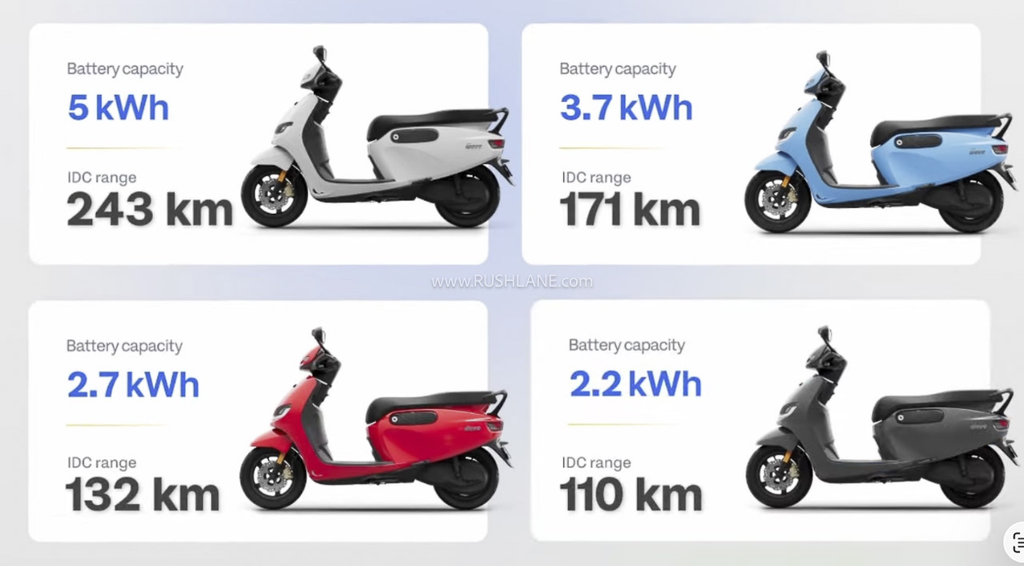
IDC range varies from 110 km to 243 km according to the battery size of Simple Wave.
The Premium version of Simple Wave+ uses 5 kWh battery and it is expected to have an IDC range of 243 km. Bigger batteries of 3.7 kWh offer the range of 171 km, while 2.7 kWh batteries have an IDC range of 132 km. The base version of the car (with 2.2 kWh battery) offers an IDC range of 110 km.
If one wants to use his car for commuting purposes only, it will be more reasonable to choose cheaper batteries. And for those, who need to make long distance travels daily, it will be reasonable to choose 3.7 kWh or 5 kWh batteries.
IDC ranges mentioned above are supported by data available on Simple Energy official website for Wave+, Wave and Wave S versions of the car.
Simple Wave battery options
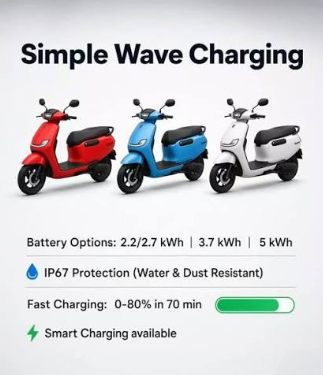
The Simple Wave is available with four battery capacities:
- 2.2 kWh
- 2.7 kWh
- 3.7 kWh
- 5 kWh
The 5 kWh battery is used by the range-topping Wave+. The lower configurations use lithium iron phosphate battery packs, while the Wave+ uses a Nickel Cobalt Aluminium battery.
All battery packs are claimed to have an IP67 rating for water and dust resistance.
Simple Energy also claims a water-wading capability of up to 300 mm.
Simple Wave top speed and performance
The more powerful variants of the Simple Wave come with a 6.4 kW permanent magnet synchronous motor.
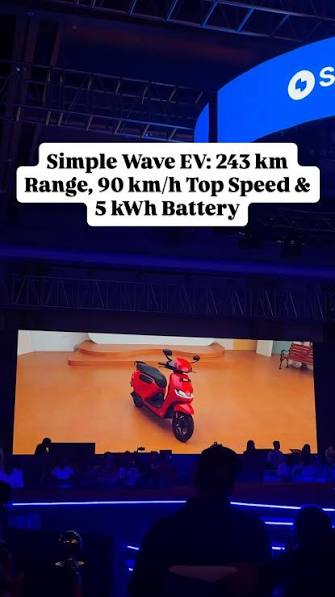
The Wave and Wave+ have a maximum speed of 90 km/h, while the Wave S is supposed to be the more affordable model, having a maximum speed of 75 km/h according to Simple Energy’s present-day product line.
Both Wave and Wave+ can achieve the speed of 0 to 40 km/h in 3.3 seconds.
The lowest-end specification comes with a 4.5 kW motor.
Riding modes depend on the variant but include EcoX, Eco, Ride, and Sport. Sport mode is only included in the higher-end specifications.
Simple Wave charging time
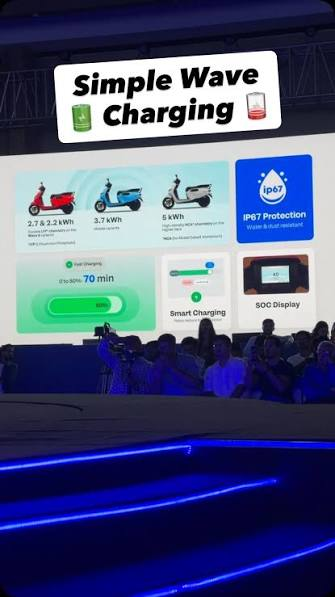
The Simple Wave is shipped with a 750W charger which is external.
The manufacturer claims that the charging time for the smallest battery configuration from 0 to 80% would be approximately 70 minutes, and for the 5 kWh battery, the charging time will be around 2 hours 15 minutes to get to 80%.
Moreover, the device is equipped with smart charging features.
There is a battery management system installed on the board including thermal protection and diagnostic capabilities.
Simple Wave storage space: 70 litres

One of the biggest selling points of the Simple Wave is its storage capacity.
The scooter offers up to 70 litres of combined storage, divided into:
- 63 litres: Under-seat storage
- 4 litres: Side-mounted Pill compartment
- 3 litres: Front glovebox
Simple Energy asserts that the under-seat compartment capacity is sufficiently big to accommodate two helmets.
The extra compartment named “Pill” is intended for small objects used on a daily basis including documents, sunglasses, bottles, or raincoat. An extra compartment called “Pill” may also be purchased separately as an accessory.
For a family customer, it may become the most advantageous feature of Wave compared to other scooters.
Simple Wave seat height and dimensions
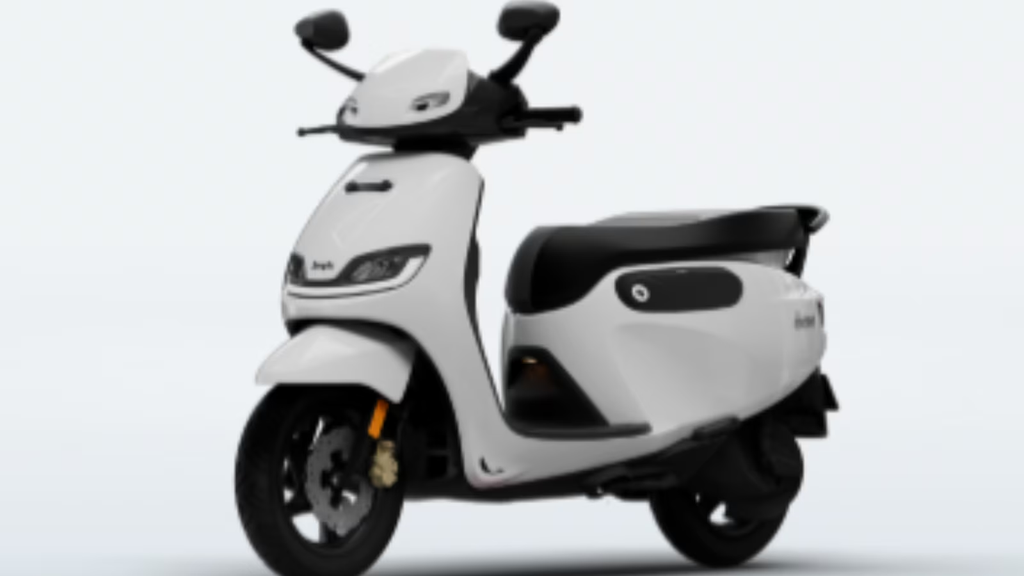
The Simple Wave is designed around a family-scooter riding position.
Key dimensions include:
- Seat length: 920 mm
- Seat height: 775 mm
- Ground clearance: 175 mm
- Wheel size: 12 inches
The 920 mm seat is particularly significant because Simple Energy positions it as one of the longest seats offered on an Indian scooter.
The combination of a long seat, flat floorboard and large storage compartment is intended to make the Wave suitable for shared family use.
Simple Wave design
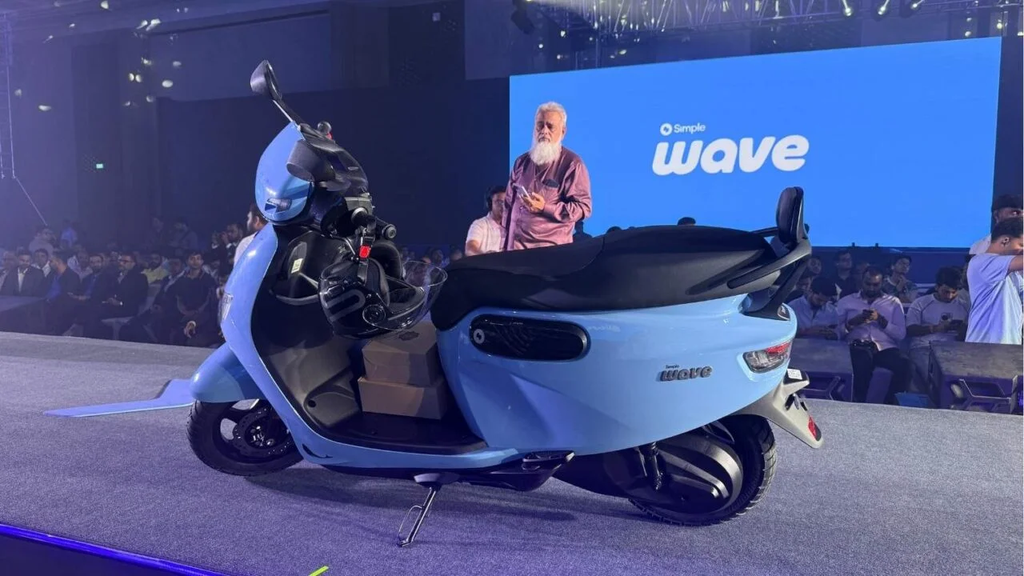
The Wave is clearly a departure from the design path taken by Simple Energy’s previous offerings.
Whereas the Simple One is more athletic and sporty looking, the Wave has a more traditional family-scooter look with rounded lines and a wider front apron.
As per Simple Energy, the design theme for this scooter is influenced by dolphins.
It is equipped with LED daytime running lights and LED lights on its headlights, tail lights, and indicators.
Other lighting options are boot lighting, charging port lighting, and exit lighting.
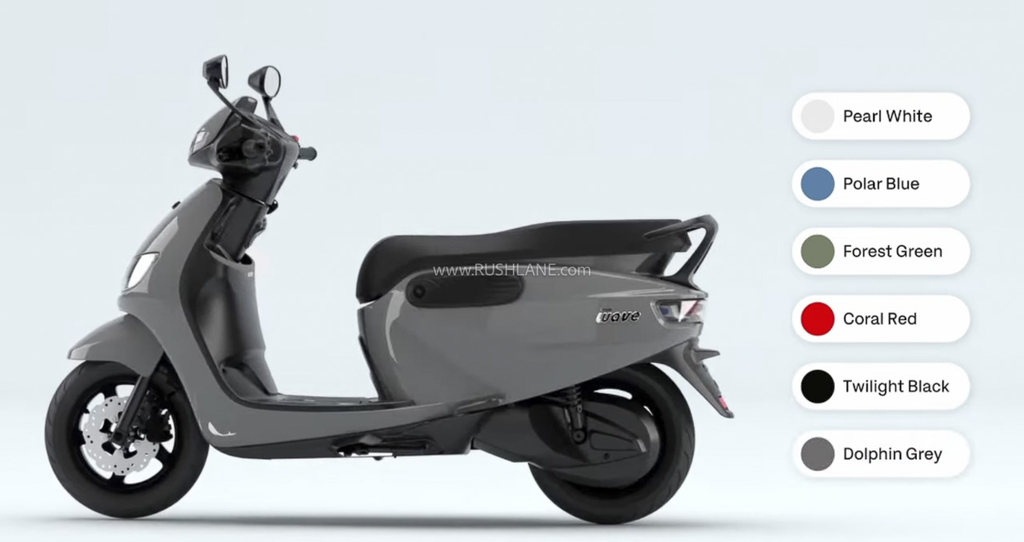
The available colours include:
- Pearl White
- Coral Red
- Twilight Black
- Polar Blue
- Dolphin Grey
- Forest Green
Colour availability can vary by configuration.
Simple Wave features and technology
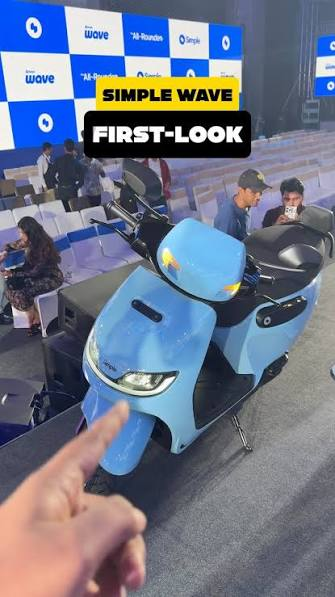
Higher-specification versions get a 7-inch non-touch TFT instrument display with automatic brightness adjustment.
Depending on the variant, the scooter offers features such as:
- Turn-by-turn navigation
- Bluetooth connectivity
- GPS
- Wi-Fi
- Call controls
- Music controls
- Message notifications
- Live efficiency information
- Remaining-range estimation
- Do Not Disturb mode
- Over-the-air software updates
Lower versions use an InfiniteBlack multi-segment digital display.
The Simple Connect smartphone and smartwatch ecosystem adds features including live location, ride statistics, vehicle diagnostics, navigation sharing, geofencing, theft alerts and towing notifications.
The scooter also includes an Incognito mode, which can temporarily suspend location tracking and sharing.
Simple Wave safety features
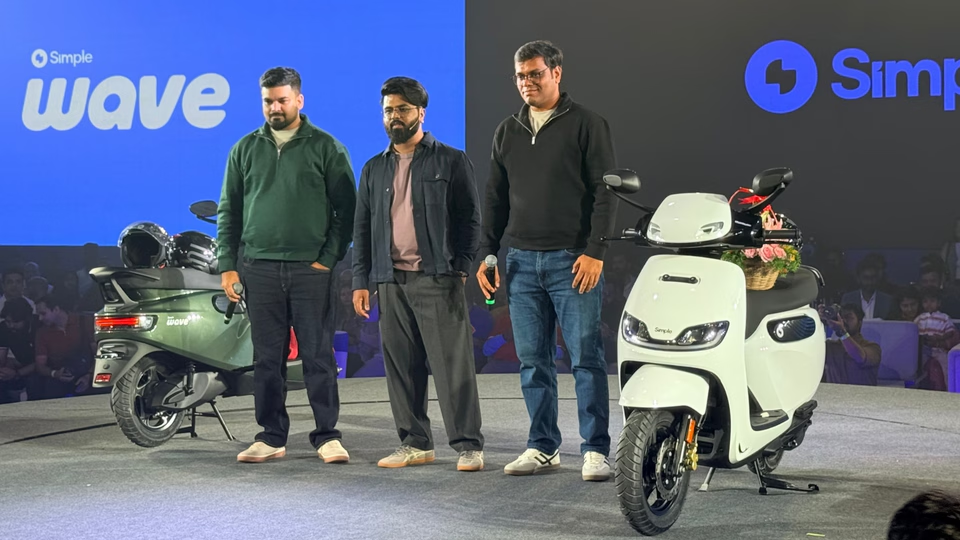
The Simple Wave is equipped with a combination of active and convenience-focused safety systems.
Depending on the configuration, features include:
- Combined braking system
- Front disc brake
- Rear drum brake
- Traction control
- Super Hold
- DropSafe
- Reverse mode
- Crawl mode
- Limp Home mode
The front brake uses a 220 mm disc, while braking at the rear is handled by a drum brake.
The scooter uses a telescopic front fork and adjustable twin rear shock absorbers.
The switch to twin rear suspension also helps Simple Energy package the large storage compartment and improve the scooter’s family-oriented load-carrying capability.
Simple Wave technology: what is HushDrive?
Simple Energy’s proprietary HushDrive transmission technology is now being used on the Wave.
The technology uses moulded rubber dampers that are supposed to help dampen any noise coming from the chain.
The motor is also said to be made without using any rare earth metals by Simple Energy.
Simple Wave vs Simple One
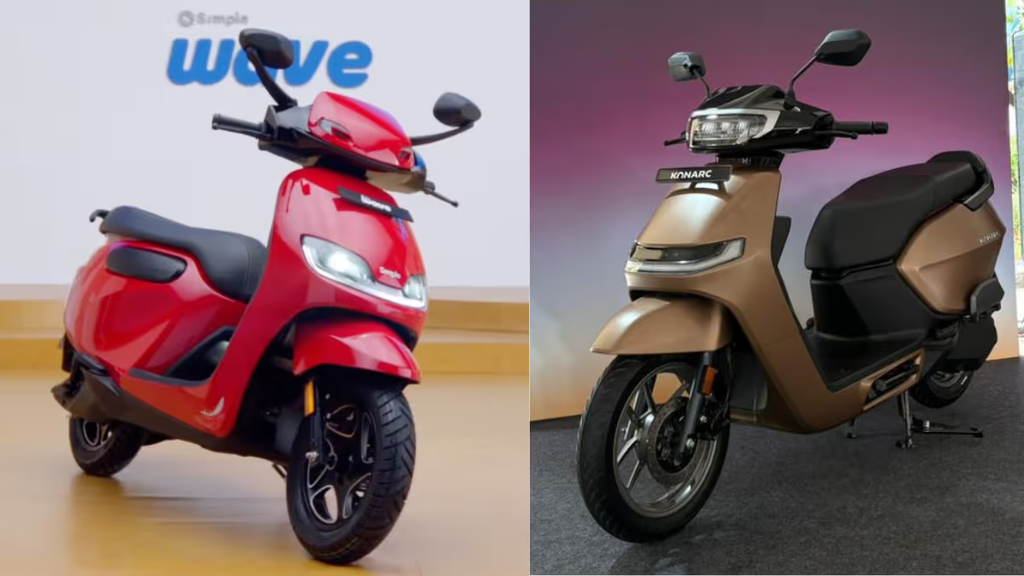
The two products target different customers.
The Simple One is the top performing model among all models of electric scooters manufactured by Simple Energy while the Wave is designed for the family use and convenience.
According to the current price list, the One can be purchased at a minimum cost of ₹1,94,999, having maximum range of 265 km and maximum speed of 115 km/h.
Conversely, the Wave has a minimum cost of ₹1,09,999 and emphasizes storage, comfort and a choice of batteries.
Therefore, the Wave is not only the cheaper version of the Simple One.
Simple Wave vs rivals
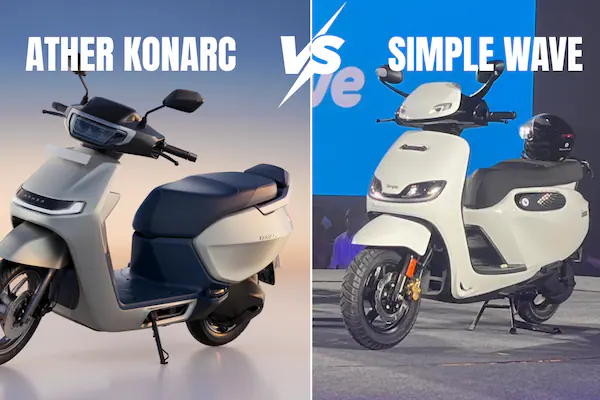
The Simple Wave enters a crowded family-electric-scooter segment.
Its potential alternatives include:
- Ather Rizta
- Ather Konarc
- TVS iQube
- Bajaj Chetak
- VIDA VX2
- River Indie
The Ather Konarc, for instance, has just been introduced in the market with an initial price tag of ₹99,999, thus making the entry level price comparison very pertinent for consumers.
Nevertheless, it is important to remember that comparing vehicles should not be done only based on the entry level price. There are several other factors that could have an impact on ownership.
Simple Wave delivery date
Simple Wave deliveries are scheduled to begin on September 25, 2026.
The scooter has been launched in India with bookings available through Simple Energy touchpoints.
The company is also expanding its retail and service footprint as it prepares for higher production and sales volumes. Independent launch coverage has reported that Simple Energy currently has more than 75 outlets across 63 cities.
Simple Wave service network
Service availability will be an important consideration for potential buyers because Simple Energy is still expanding its footprint.
The company has announced plans for company-operated Simple Super Labs, with the first facilities planned for cities including Bengaluru, Chennai, Kochi, Goa, Pune, Delhi, Odisha and Kolkata.
Simple Energy’s stated objective is to reduce repair turnaround time as the service network expands.
For buyers considering the Wave, checking the availability of an authorised Simple Energy service facility in their city before booking would be sensible.
Is the Simple Wave worth buying?
The Simple Wave looks particularly interesting for buyers who prioritise practicality over outright performance.
Its strongest points on paper are:
- Starting price of ₹1,09,999
- Up to 243 km claimed IDC range
- Four battery capacities
- Up to 70 litres of storage
- 920 mm-long seat
- Up to 90 km/h claimed top speed
- Connected technology
- Multiple riding modes
- Family-focused design
However, the biggest question marks do not relate to the figures in the technical specifications.
The range, longevity, experience of the rider and even the cost of the scooters remain unknown factors.
This is important since when the IDC scooter claims to travel up to 243 kilometers with a single charge, it does not imply that all riders using this model will travel 243 kilometers with a single charge.
In addition, the initial cost of ₹1,09,999 cannot be taken to remain constant upon hitting the roads of all Indian cities.
Simple Wave: Key specifications at a glance
| Specification | Simple Wave |
| Starting price | ₹1,09,999 introductory |
| Battery options | 2.2 kWh, 2.7 kWh, 3.7 kWh, 5 kWh |
| Claimed IDC range | 110-243 km |
| Top speed | Up to 90 km/h |
| Motor | PMSM |
| Motor power | Up to 6.4 kW |
| 0-40 km/h | 3.3 seconds on higher variants |
| Storage | Up to 70 litres |
| Seat length | 920 mm |
| Seat height | 775 mm |
| Ground clearance | 175 mm |
| Front brake | 220 mm disc |
| Rear brake | Drum |
| Wheels | 12-inch alloy |
| Charging | 750W external charger |
| Delivery start | September 25, 2026 |
Frequently Asked Questions
What is the Simple Wave price in India?
The Simple Wave has an introductory starting price of ₹1,09,999. The final price can vary depending on configuration and location.
What is the Simple Wave range?
The Simple Wave offers a claimed IDC range from 110 km to 243 km, depending on the battery configuration. The Wave+ with its 5 kWh battery claims up to 243 km.
How many batteries are available with the Simple Wave?
The Simple Wave is offered with four battery capacities: 2.2 kWh, 2.7 kWh, 3.7 kWh and 5 kWh.
What is the top speed of the Simple Wave?
The Simple Wave and Wave+ have a claimed top speed of 90 km/h. The Wave S is rated at 75 km/h.
How much storage does the Simple Wave have?
The Simple Wave offers up to 70 litres of combined storage, including a 63-litre under-seat compartment, a 4-litre Pill compartment and a 3-litre glovebox.
When will Simple Wave deliveries start?
Simple Energy has scheduled Simple Wave deliveries to begin on September 25, 2026.
What are the main Simple Wave competitors?
The Simple Wave competes in the family electric-scooter segment against models such as the Ather Rizta, Ather Konarc, TVS iQube, Bajaj Chetak, VIDA VX2 and River Indie.
Is the 243 km Simple Wave range real-world range?
No. 243 km is the company’s claimed IDC range. Actual range can be lower or higher depending on speed, riding mode, traffic, rider weight, road conditions, temperature and other factors.
Our Verdict
The Simple Wave is an important offering for Simple Energy as it allows them to shift focus away from the performance segment of electric scooters and towards the far more lucrative family scooter segment in India.
It’s a simple proposition, multiple batteries, large storage capacity, long seat, connectivity, and an affordable pricing point.
While the advertised range of 243 km will definitely turn heads, it’s possible that the most important differentiation factor for the Simple Wave could be its 70-litre storage and family-friendly nature.
Ultimately, the choice for customers would have to come down to which variant it is, the on-road price, range, and access to services in their city.
All in all, it is evident that the Simple Wave is looking good on paper, but it will be the experience of owning one that will decide its fate in the long run.