



The next major energy challenge may not be producing enough electricity in total. It may be producing enough reliable electricity in the right place and at the right time.
Artificial intelligence is accelerating demand for data centers, while electric vehicles, industrial electrification and heat pumps are adding further pressure to electricity systems.
The International Energy Agency expects global electricity demand to grow at an average rate of 3.6% annually from 2026 to 2030, with data centers and electric vehicles among the structural drivers.
That is bringing an old technology back into a new conversation:
nuclear power.
But instead of relying only on enormous conventional nuclear plants, governments and technology companies are increasingly examining Small Modular Reactors (SMRs).
SMRs are smaller nuclear reactors designed around modular construction and, depending on the design, potentially more flexible deployment.
The attraction is particularly strong for AI infrastructure.
A large data center cannot simply wait for the sun to come out or the wind to strengthen. It needs electricity continuously.
Batteries can help bridge short-duration gaps and manage power demand, but they are not a substitute for a continuous electricity-generation source.
That is where SMRs could become important.
For the wider technology landscape, see HNN24x7’s Future Technology 2026 pillar.
What Are Small Modular Nuclear Reactors?
Small Modular Reactors are nuclear reactors designed with smaller individual generating capacities and a modular approach to construction compared with traditional large nuclear power plants.
There is no single SMR design.
Different projects use different reactor technologies, fuels, cooling systems and power outputs.
The International Atomic Energy Agency says interest in SMRs is growing because of characteristics including potentially lower upfront capital requirements, modularization, flexible siting and applications beyond electricity generation.
The word “modular” is particularly important.
Instead of constructing every component of a giant nuclear facility on-site, SMR developers aim to manufacture more components in controlled industrial environments and assemble them at the final site.
In theory, this could:
- simplify construction,
- improve manufacturing consistency,
- reduce construction time,
- allow multiple reactor modules to be deployed,
- spread investment over several units.
But these are potential advantages, not guarantees.
The commercial economics of SMRs remain an important unresolved question.
How Do Small Modular Reactors Work?
At the most basic level, an SMR still performs the same fundamental job as a conventional nuclear power plant:
nuclear energy → heat → steam or another working fluid → turbine → electricity
The reactor produces heat through nuclear fission.
That heat is transferred into a system that ultimately drives a turbine or another electricity-generation mechanism, depending on the reactor design.
What changes is the architecture.
A conventional nuclear plant may contain a very large reactor and associated systems designed for hundreds or more than a thousand megawatts.
An SMR generally uses smaller reactor modules.
Some advanced designs also use different coolants or fuel configurations.
The IAEA tracks a wide range of SMR concepts and emphasizes that technology readiness varies significantly between designs.
That means it is misleading to talk about “the SMR technology” as if every reactor operates identically.
Why Are SMRs Suddenly Important Again in 2026?
Three trends are converging.
1. Electricity Demand Is Rising
Global electricity demand is expected to grow rapidly through 2030.
The IEA forecasts average annual growth of 3.6% from 2026 to 2030.
2. AI Is Creating Large New Loads
Data centers require large amounts of electricity and increasingly concentrated power capacity.
AI workloads are making this challenge more pronounced.
3. Power Systems Need Reliable Low-Carbon Electricity
Solar and wind are expanding rapidly, but their output varies with weather.
Batteries can help manage this variability, but storage duration, cost and resource requirements matter.
Nuclear power offers something different:
continuous electricity generation with low operational carbon emissions.
That combination is driving renewed interest in advanced nuclear technologies.
Can SMRs Power AI Data Centers?
Yes, potentially — and this is becoming an important area of SMR research and policy.
The IAEA itself has scheduled a 2026 technical meeting specifically on “Powering and Cooling Data Centres using Small Modular Reactors.”
That is significant because it shows the connection between nuclear reactor development and data-center infrastructure is no longer purely theoretical.
An SMR could potentially provide electricity directly to a large computing facility or supply power to the surrounding grid from which the facility draws electricity.
The attraction is reliability.
AI data centers may operate continuously and require large amounts of electricity around the clock.
An SMR does not depend on whether it is:
- sunny,
- windy,
- raining,
- nighttime,
- or experiencing a short-term renewable-energy shortfall.
That makes nuclear power fundamentally different from variable renewable generation.
Why AI Data Centers Need a Different Energy Strategy
AI computing is changing the physical design of data centers.
The IEA identifies expanding data-center capacity as one of the structural drivers of electricity-demand growth through 2030.
The problem isn’t simply annual electricity consumption.
It is also power density.
Modern AI processors can consume substantial power, and large clusters can create concentrated electricity loads.
That means a data-center developer needs to answer several questions:
- Is enough electricity available?
- Can the local grid deliver it?
- Is the supply reliable?
- How quickly can new generation be connected?
- What happens during outages?
- How much backup storage is required?
- How will the facility meet emissions goals?
SMRs potentially address one of these questions particularly well:
Where does the continuous electricity come from?
SMRs vs Renewable Energy for Data Centers
It is not necessarily an either-or decision.
A future AI campus could combine several technologies.
| Technology | Main Role |
|---|---|
| Solar | Daytime renewable generation |
| Wind | Variable renewable generation |
| Batteries | Short-duration storage and power management |
| SMR | Continuous/firm generation |
| Grid | Additional supply and flexibility |
| Backup generators | Emergency resilience |
This could create a hybrid energy system.
For example:
SMR → continuous baseline power
Solar/wind → additional low-carbon electricity
Battery → short-term balancing
Grid → additional flexibility
That may be more realistic than expecting a single technology to solve every energy problem.
Why Batteries Cannot Solve Every Data-Center Power Problem
Batteries are extremely useful.
They can provide:
- backup power,
- fast response,
- frequency regulation,
- peak shaving,
- renewable-energy shifting,
- short-duration resilience.
But batteries do not generate electricity.
They store electricity that has already been generated.
That creates a fundamental difference.
Imagine a data center requires 1 GW of continuous electricity.
A battery can provide that power for a period of time.
But to operate indefinitely, it needs to be recharged.
For example, a hypothetical 1 GW load operating continuously for 24 hours would consume:
1 GW × 24 hours = 24 GWh
A 24-hour battery for that load would therefore require at least 24 GWh of usable stored energy, before accounting for efficiency losses, reserve margins and other system requirements.
And if the facility needed to survive several days of low renewable generation, the storage requirement could become enormous.
That is where firm generation becomes valuable.
SMRs vs Batteries: They Solve Different Problems
This distinction should be central to the future-energy discussion.
Batteries
Store energy.
They are excellent for moving electricity across time.
SMRs
Generate electricity.
They can potentially provide continuous power for long periods.
The technologies can therefore complement each other rather than compete directly.
A data center could theoretically use nuclear generation as its firm power source while batteries provide instantaneous backup and grid services.
Could SMRs Replace Renewable Energy?
No.
SMRs should not be viewed as a universal replacement for solar and wind.
Renewables can be deployed at many scales and have become major sources of new electricity generation.
Nuclear has different characteristics.
The more realistic future is likely to involve a mixture of:
- nuclear,
- solar,
- wind,
- hydro,
- batteries,
- transmission,
- demand response,
- other storage technologies.
The IEA’s analysis of AI electricity supply illustrates this mixed future. It expects renewables and nuclear to play increasingly important roles in supplying data-center electricity in several regions.
The question is therefore not:
Nuclear or renewables?
It is increasingly:
How should different power technologies work together?
What Makes SMRs Attractive for Future Energy?
Smaller Individual Units
A smaller reactor can potentially be added in stages rather than requiring a single massive project from the beginning.
Modular Construction
Standardized manufacturing could eventually improve construction efficiency.
Continuous Power
Nuclear reactors can provide electricity independently of weather conditions.
Low Operational Carbon Emissions
Nuclear generation does not produce carbon dioxide through the electricity-generation process in the same way fossil-fuel plants do.
Potential Siting Flexibility
Some SMR concepts are designed with different deployment environments and applications in mind.
Industrial Applications
SMRs could potentially provide heat as well as electricity.
The IAEA specifically highlights non-electric applications such as supplying heat and hydrogen as part of the broader SMR development landscape.
But Are SMRs Actually Ready?
Not all of them.
This is where many discussions about SMRs become overly optimistic.
The global nuclear industry already has operating SMRs.
The IEA reports that China operates a land-based SMR and Russia operates a marine-based one. It also notes that a 125 MW commercial SMR is under construction in China and a 300 MW unit in Russia. Additional SMRs are expected to begin construction in Canada, Korea, the United Kingdom and the United States.
But many proposed designs are still at earlier stages.
The IAEA’s SMR roadmap shows different designs progressing through design, construction, commissioning and operational stages at different times.
So the correct description in 2026 is:
SMRs are an emerging nuclear technology with some operating and under-construction examples, but the industry has not yet reached large-scale commercial deployment.
The Economics Could Decide the Future of SMRs
The biggest question may not be whether SMRs can produce electricity.
They can.
The bigger question is:
Can they produce electricity competitively enough to justify their construction costs?
First-of-a-kind nuclear projects can be expensive.
They also face:
- regulatory costs,
- financing costs,
- long development timelines,
- supply-chain challenges,
- fuel availability,
- construction risk,
- workforce requirements.
The IAEA has identified cost competitiveness, continuity of orders, financing, supply chains, fuel-cycle availability and regulatory frameworks as conditions that need to be addressed for broader SMR deployment.
That is why modularization is so important.
If factories can eventually produce standardized reactor modules repeatedly, the economics could improve.
But that benefit has to be demonstrated rather than assumed.
What Happened to NuScale’s Idaho Project?
The history of SMRs also provides an important cautionary lesson.
The U.S. Department of Energy had supported the Carbon Free Power Project, based on NuScale’s SMR technology, with a large cost-share award.
But the project was terminated in November 2023 after the parties mutually agreed to end it.
A 2026 DOE Inspector General audit examined the project and concluded that the Department of Energy’s Nuclear Energy office had not effectively managed the project.
The lesson is important:
SMR development is not guaranteed simply because a reactor design is technically promising.
Project economics, financing, regulation, customer commitments and construction management all matter.
The United States Is Still Moving Ahead With Advanced Nuclear
The cancellation of one project does not mean the entire SMR industry has stopped.
In December 2025, the U.S. Department of Energy selected TVA and Holtec Government Services to support early deployments of advanced light-water SMRs, with up to $800 million in combined federal cost-sharing for projects in Tennessee and Michigan.
The same DOE source says TerraPower’s Natrium project received a construction permit in March 2026 — the first issued by the U.S. Nuclear Regulatory Commission for a commercial non-light-water power reactor — followed by a construction groundbreaking the following month.
This illustrates the broader shift:
advanced nuclear is moving from research toward real project deployment, but the commercial pathway remains demanding.
Could Technology Companies Use Nuclear Power Directly?
The answer is increasingly yes — at least in the broader sense of securing nuclear electricity for data centers.
Technology companies and energy developers are exploring nuclear power as part of strategies for meeting rising electricity demand.
The IEA notes that SMRs are receiving attention from private industry, including large technology companies, partly because their modular designs and smaller scale could make them more attractive for private-sector financing and deployment.
The connection is particularly logical for AI.
AI companies need enormous computing infrastructure.
Computing infrastructure needs electricity.
And long-lived nuclear assets can potentially provide electricity for decades.
That creates a natural strategic relationship between the technology and energy industries.
SMRs and the Future of AI Infrastructure
The most interesting possibility is not necessarily a nuclear reactor sitting beside every data center.
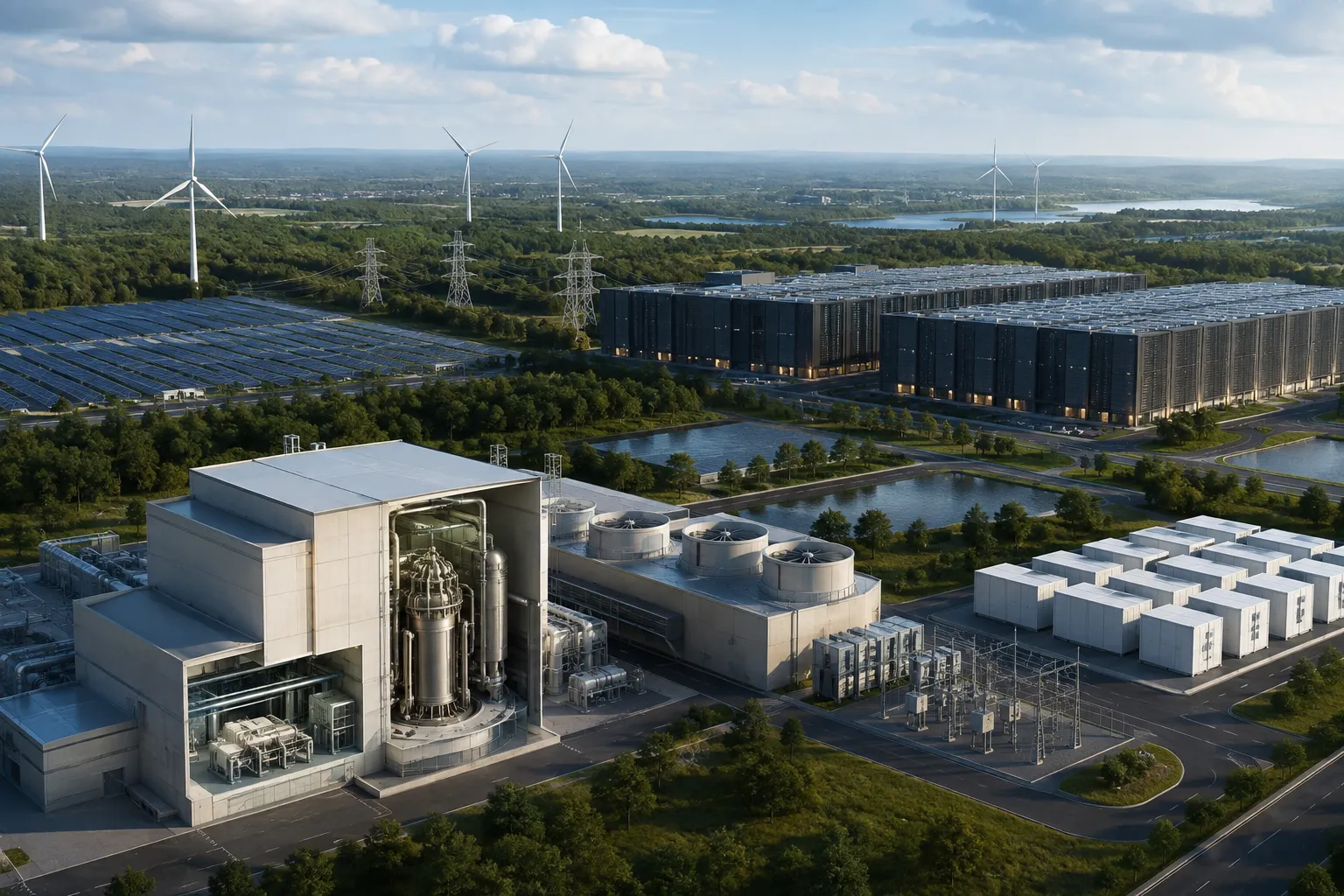
Instead, the future could involve dedicated clean-energy campuses.
Imagine a large AI computing facility connected to:
- an SMR,
- solar generation,
- wind generation,
- battery storage,
- high-capacity transmission,
- advanced cooling infrastructure.
The SMR provides firm electricity.
Renewables reduce fuel and operating costs when available.
Batteries handle rapid fluctuations and short-duration outages.
The grid provides additional flexibility.
This architecture would resemble an energy ecosystem rather than a conventional data center.
Could SMRs Solve AI’s Electricity Problem?
They could help, but they cannot solve it alone.
The IEA expects electricity demand from data centers to continue growing significantly as AI deployment expands. Its analysis also indicates that nuclear power can become an increasingly important source of data-center electricity in some regions.
However, SMRs themselves require:
- fuel,
- construction,
- cooling,
- regulatory approval,
- grid or direct connection,
- maintenance,
- waste management,
- security infrastructure.
And because most SMR projects are not yet operating at commercial scale, it would be premature to assume they can quickly satisfy the entire AI industry’s future electricity demand.
What About Nuclear Waste?
Nuclear power produces radioactive waste, and SMRs do not eliminate that fundamental issue.
The amount and characteristics of waste depend on reactor design, fuel and operating strategy.
Any large-scale SMR program therefore needs:
- fuel-cycle planning,
- spent-fuel management,
- radioactive-waste policy,
- decommissioning plans,
- long-term regulatory oversight.
Advanced reactor designs may change the nature or quantity of waste streams, but “small modular” does not mean “zero waste.”
This is an important distinction for responsible coverage of the technology.
Are Small Modular Reactors Safe?
SMRs are designed with safety systems and safety requirements, but safety cannot be evaluated solely from the label “SMR.”
Different designs use different:
- reactor physics,
- cooling systems,
- containment concepts,
- passive safety mechanisms,
- fuels,
- operating strategies.
Some advanced designs are specifically engineered around passive safety concepts that can reduce dependence on active systems or operator intervention.
But every reactor design still requires detailed safety assessment and regulatory approval.
The IAEA continues to emphasize regulatory readiness, safety assessment, licensing and infrastructure requirements as important parts of SMR deployment.
SMRs vs Large Nuclear Reactors
| Feature | Large Nuclear Reactor | Small Modular Reactor |
|---|---|---|
| Individual capacity | Very large | Smaller |
| Construction concept | Large project | Modular approach |
| Upfront investment | Very high | Potentially lower per module |
| Construction | Often site-intensive | Potential for factory manufacturing |
| Deployment | Large centralized plant | Potentially multiple modules |
| Technology maturity | Highly established | Emerging |
| Grid role | Large-scale generation | Flexible/firm generation potential |
| Data-center application | Possible | Potentially attractive for dedicated loads |
| Commercial track record | Extensive | Limited |
| Regulatory experience | Mature | Still developing for many designs |
The key word is potentially.
SMRs could offer advantages, but those advantages must be demonstrated through actual projects.
What Are the Biggest SMR Challenges?
1. Cost
SMRs need to compete with increasingly cheap renewable energy, natural gas in some markets and established nuclear technologies.
2. Construction Speed
Modular manufacturing is supposed to help, but first-of-a-kind projects can still take years.
3. Regulation
New reactor designs require appropriate licensing frameworks.
4. Fuel Supply
Some advanced reactors require specialized fuels, including HALEU in certain designs.
The U.S. DOE has been investing in domestic uranium enrichment and HALEU capabilities as part of its broader nuclear strategy.
5. Supply Chains
The industry needs specialized manufacturing capacity.
6. Waste Management
Every nuclear deployment needs a credible waste strategy.
7. Public Acceptance
Nuclear projects can face social and political opposition.
8. First-of-a-Kind Risk
The first reactor of a new design is generally harder to build than a mature standardized product.
This is perhaps the most important issue.
SMRs become truly compelling only if they can be manufactured repeatedly at predictable cost and schedule.
Why SMRs Could Be More Important After 2030
The near-term nuclear landscape is still dominated by conventional large reactors.
The IEA says nearly all reactors currently under construction globally are large-scale, while SMRs are only beginning to expand beyond the limited number already operating or under construction.
That means SMRs should not be treated as an immediate replacement for the existing nuclear fleet.
Their bigger opportunity could emerge later in the decade and into the 2030s.
If developers solve:
- manufacturing,
- financing,
- licensing,
- fuel,
- construction,
- supply chains,
then standardized SMRs could become much easier to deploy.
That is the scenario the industry is trying to prove.
“Sources Used”
https://www.iea.org/reports/electricity-2026/executive-summary
SMRs and Batteries Could Work Together
One of the most important conclusions from the future-energy discussion is that nuclear and batteries are not necessarily competitors.
They can perform different functions.
A simplified future-energy system could look like this:
SMR
↓
24/7 firm electricity
Solar + Wind
↓
Variable low-carbon electricity
Battery Storage
↓
Fast response + short-duration storage
AI Data Center / Grid
↓
Continuous electricity demand
This combination could be particularly useful for high-density computing.
The reactor supplies the energy.
The battery handles fast disturbances.
Renewables provide additional generation.
The grid connects everything together.
Could SMRs Make Batteries Less Important?
No. They could reduce the amount of long-duration battery storage needed for some applications, but batteries would still have important roles.
Batteries are extremely fast.
Nuclear reactors are not designed to perform every short-term grid-balancing function.
A battery can respond almost immediately to a power disturbance.
An SMR provides sustained generation.
The optimal system may therefore use both.
This is similar to how modern vehicles can combine different technologies rather than relying on a single component for every task.
The Bigger Future-Energy Picture
The energy system of the 2030s is unlikely to be dominated by one technology.
Instead, it could be increasingly diversified.
Renewable Energy
Provides low-cost electricity when resources are available.
Nuclear
Provides firm, low-carbon electricity.
Batteries
Provide fast-response and short-duration storage.
Long-Duration Storage
Handles longer periods of energy shifting.
Transmission
Moves electricity between regions.
AI Forecasting
Predicts renewable output and electricity demand.
Smart Grids
Coordinate millions of distributed energy resources.
This is why SMRs belong in the broader future technology conversation.
They are not an isolated nuclear innovation.
They could become one component of a much larger intelligent energy system.
What Is the Future of Small Modular Nuclear Reactors?
The most accurate answer in 2026 is:
SMRs are promising, increasingly important and moving toward deployment — but their large-scale commercial future is not yet proven.
The IAEA says more than 40 countries have expressed interest in SMR technologies and applications, reflecting growing international attention.
The IEA similarly says SMRs are receiving particularly high levels of attention from governments and private industry, while emphasizing that their success will depend on policy, regulation, innovation and financing.
That makes the next few years crucial.
If the industry can demonstrate that reactors can be:
factory-produced + safely licensed + rapidly deployed + economically competitive
then SMRs could become an important new source of electricity for industry, grids and potentially AI infrastructure.
If those conditions are not achieved, conventional nuclear, renewables, batteries, gas and other technologies will continue to dominate the energy mix.
Why SMRs Matter for the Future of Technology
Small Modular Reactors sit at the intersection of three major trends.
AI
AI is increasing demand for reliable electricity-intensive computing.
Renewable Energy
Solar and wind are expanding, increasing the need for flexible and firm power.
Electrification
EVs, heat pumps and industrial electrification are moving more energy demand onto electricity grids.
The IEA expects all three trends to contribute to continued electricity-demand growth through 2030.
That creates a new energy equation:
More AI + more EVs + more electrification
↓
More electricity demand
↓
Need for generation + storage + grid flexibility
↓
Renewables + nuclear + batteries + transmission
In that system, SMRs are not necessarily the replacement for batteries or renewables.
They could be the firm-energy layer that helps the wider system operate reliably.
FAQ
What are small modular nuclear reactors?
Small Modular Reactors are nuclear reactors designed with smaller individual generating capacities and modular construction approaches compared with traditional large nuclear power plants.
Can SMRs power AI data centers?
Yes, potentially. SMRs could provide continuous electricity to data centers either directly or through the electricity grid. The IAEA is specifically examining the use of SMRs for powering and cooling data centers.
Why are SMRs important for AI?
AI data centers require large amounts of reliable electricity. SMRs could provide firm generation that does not depend on weather conditions, complementing renewable energy and battery storage.
Can batteries replace SMRs?
Not directly. Batteries store electricity rather than generate it. They are excellent for short-duration backup and grid balancing, while SMRs could potentially provide continuous electricity generation.
Are SMRs better than solar and wind?
They serve different purposes. Solar and wind provide renewable electricity but vary with weather. SMRs can provide firm generation. A future energy system could use both technologies alongside batteries and other storage.
Are SMRs safe?
SMRs are designed around specific safety systems, but safety depends on the individual reactor design and regulatory assessment. Different SMR technologies have different safety characteristics, so the term “SMR” alone does not establish a safety level.
Are SMRs commercially available in 2026?
Some SMR technologies are already operating or under construction, but large-scale commercial deployment remains limited. The IEA reports that China and Russia have operating SMRs and that additional projects are under construction or being developed elsewhere.
When will SMRs become mainstream?
There is no reliable single date. The IAEA’s deployment roadmaps show different reactor designs reaching construction and operational stages at different times.
Can SMRs reduce dependence on batteries?
They could reduce the need for some forms of long-duration storage in certain power systems by providing continuous electricity. However, batteries would remain valuable for rapid response, backup and renewable-energy integration.
Do SMRs produce nuclear waste?
Yes. Nuclear reactors produce radioactive waste, and SMRs require appropriate fuel-cycle, spent-fuel and waste-management systems. Advanced designs may alter waste characteristics, but they do not eliminate the issue.
Why are technology companies interested in nuclear power?
AI data centers require growing quantities of reliable electricity. Nuclear power offers firm generation, making it potentially attractive for large computing facilities seeking dependable low-carbon electricity. The IEA notes growing private-sector and technology-industry interest in SMRs.