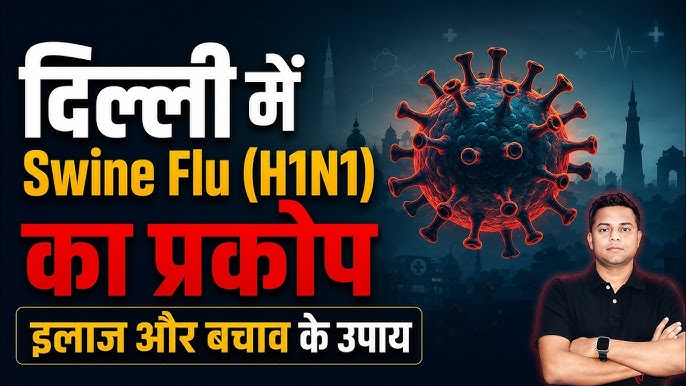




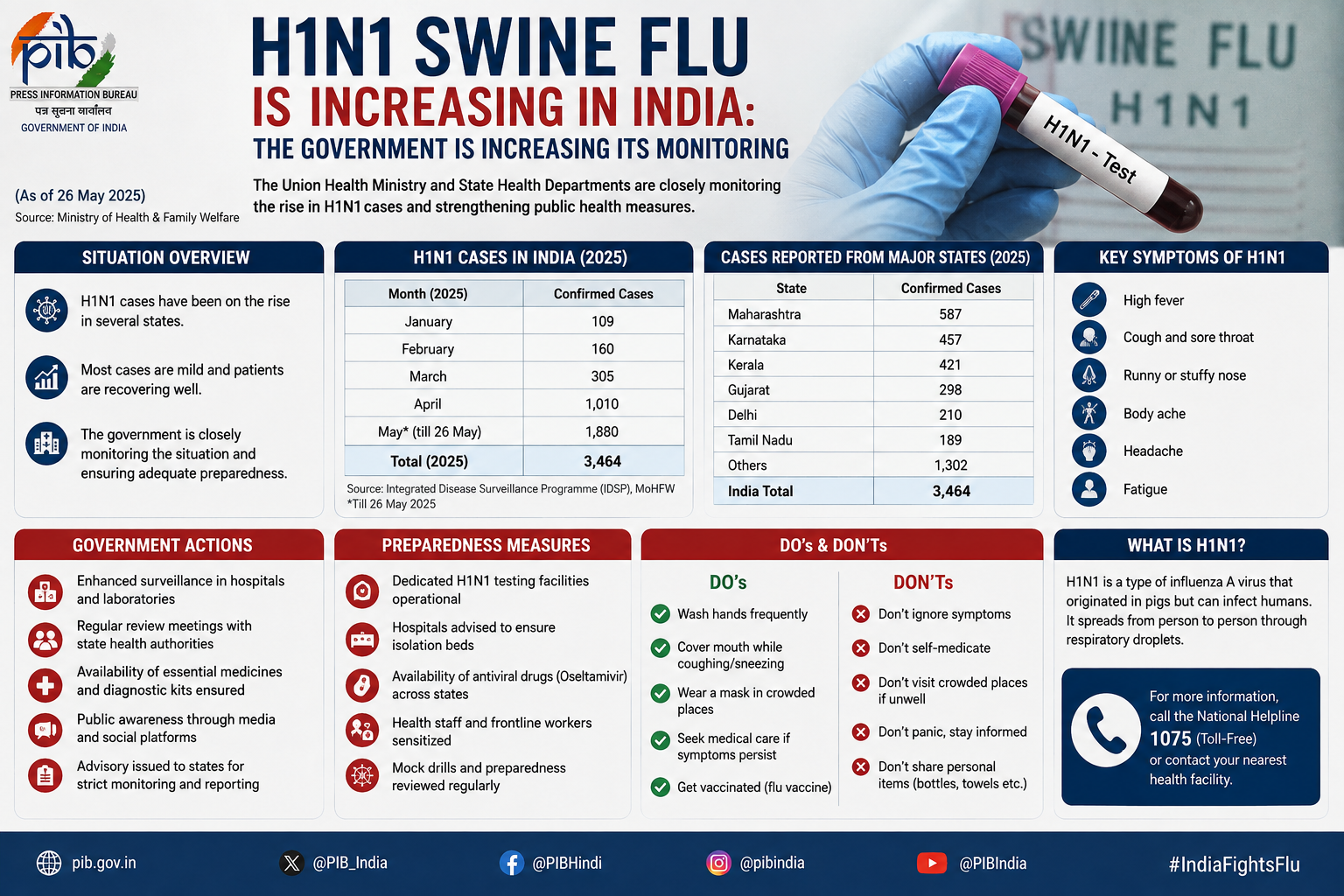
Swine Flu: These seasonal infections bring breathing problems in many parts of India. The Union Health Ministry, the Indian Council of Medical Research, the Department of Health Research, and the National Centre for Disease Control have all stepped up their monitoring. Health officials ask people to be careful but not to worry much.
The latest assessment from the government,nt however, does not show that a new or especially dangerous H1N1 strain has appeared. In a statement from the Press Information Bureau on August 25, the Indian government said that the influenza viruses moving around in India now match the patterns seen in recent years. Dr Rajiv Bahl, Secretary of the Department of Health Research and Director General of ICMR, said that there is no cause for panic and that surveillance has not found a genetic change in the virus.
This assessment from the government comes a few days after Union Health and Family Welfare Minister J.P. Nadda examined India’s H1N1 preparedness, especially in the National Capital. The review, on August 21, looked at surveillance of influenza‑like illness (ILI) and severe acute respiratory infection (SARI) trends, testing capacity, laboratory surveillance and how ready health facilities are to handle seasonal influenza cases. The minister said that India must keep being vigilant, keep surveillance strong, and spot any unusual rises or clusters of cases.
What the latest H1N1 Swine Flu surveillance shows
According to the latest NCDC material, India maintains year-round influenza surveillance through the DHR-ICMR Virus Research and Diagnostic Laboratory (VRDL) network in collaboration with the WHO National Influenza Centre at ICMR-NIV, Pune. The network currently includes 73 sentinel sites that collect and report influenza testing data throughout the year.
The NCDC’s 2026 influenza vaccine recommendation provides an important snapshot of viruses detected through this surveillance system. Since July 1, 2025, 73 influenza isolates have been received or obtained at the National Influenza Centre. From the set of samples, 49 samples were processed for whole‑genome sequencing.
The genetic analysis is particularly significant because it helps determine whether a circulating virus has changed substantially from observed strains.
The H1N1 viruses examined in the surveillance programme were placed in clade 6B.1A.5a2a.1, subclade D.3.1.1. The NCDC reported that the circulating strains broadly matched the World Health Organization’s recommended Northern Hemisphere vaccine composition for the 2026–27 season.
The same surveillance report also found that all 73 isolates tested for antiviral susceptibility—including H1N1, H3N2, and Influenza B Victoria—were sensitive to oseltamivir.
These findings are consistent with the August 25 statement from the Health Ministry and ICMR that the current H1N1 activity does not indicate the emergence of a new influenza threat.
India’s H1N1 Swine Flu numbers show why surveillance matters
India has experienced substantial fluctuations in reported H1N1 cases and deaths over the years. The data, compiled by the NCDC, show that these infections reflect the fluctuations reported by the States and Union Territories to the CSU.
India is witnessing a surge in H1N1 cases, commonly known as swine flu. The disease causes respiratory problems, and as the weather is changing in many parts of the country, the government is keeping a close eye on the situation. The Union Health Ministry, the Department of Health Research, the Indian Council of Medical Research and the National Center for Disease Control have put in place the necessary surveillance, but officials say there’s no cause for concern and people need to be cautious.
However, the government’s most recent assessment does not indicate the emergence of a novel or particularly dangerous strain of H1N1. The Indian government stated that the influenza viruses circulating in India now follow the trends observed in recent years in a statement released by the Press Information Bureau on August 25. Secretary of the Department of Health Research, Dr. Rajiv Bahl
The statistics indicate a total of 3,320 influenza cases and 14 deaths due to influenza during that time. According to the organisation, these figures on influenza are derived from reports from States and Union Territories. This indicates that surveillance and timely reports play a key role in knowing the trends.
The previous data shows that a rise in reported cases should not necessarily be seen as being indicative of a pandemic or an even more dangerous virus than influenza.
H1N1Swine Flu is now a seasonal influenza virus
So what is swine flu, as is often reported one sees in media? The flu virus emerged as popular during the year of pandemic influenza in 2009. It took up residence as one of the normal annual flu viruses that circulate among humans. According to the World Health Organization, the flu viruses that are responsible for the current infections among humans are A(H1N1) and A(H3N2).
WHO has also explained that calling A(H1N1)pdm09 ” flu” can be misleading. While the 2009 pandemic virus had a history involving swine influenza viruses, the virus now circulating among humans is a seasonal human influenza virus and does not require contact with pigs for transmission.
The distinction is significant due to the fact that the term “flu” can lead to undue panic and confusion. There are several records, as per the Indian surveillance information available, about the influenza A(H1N1) pdm09, as opposed to proof of an emergent swine-origin pandemic virus.
The government urges people not to panic.
On August of 25th, 2026, the Indian government informed citizens that seasonal swine flu often includes mild symptoms such as fever, cold, and others. This does not cause problems for the common people.
Most of the time, some people who are at high risk are affected by fevers, such as children, people with long-term health problems, pregnant women, and people with weaker immune systems. This is the core reason that the government is asking anyone who has symptoms that persist for a time or become worse to go to a doctor.
Simple precautions remain important.
The authorities are encouraging people to ensure hygiene related to the respiratory to take control of this transmission. At the same time, those who have the suspense that they are infected or not, and whose symptoms are visible. To protect ourselves, we need to wash our hands, wear masks, and make sure of proper hygiene.
The government has specifically warned against taking antiviral medicines or antibiotics without medical advice. Antibiotics do not treat influenza viruses, while antiviral treatment should be used according to clinical advice and the patient’s risk profile.
Vaccine composition updated for 2026
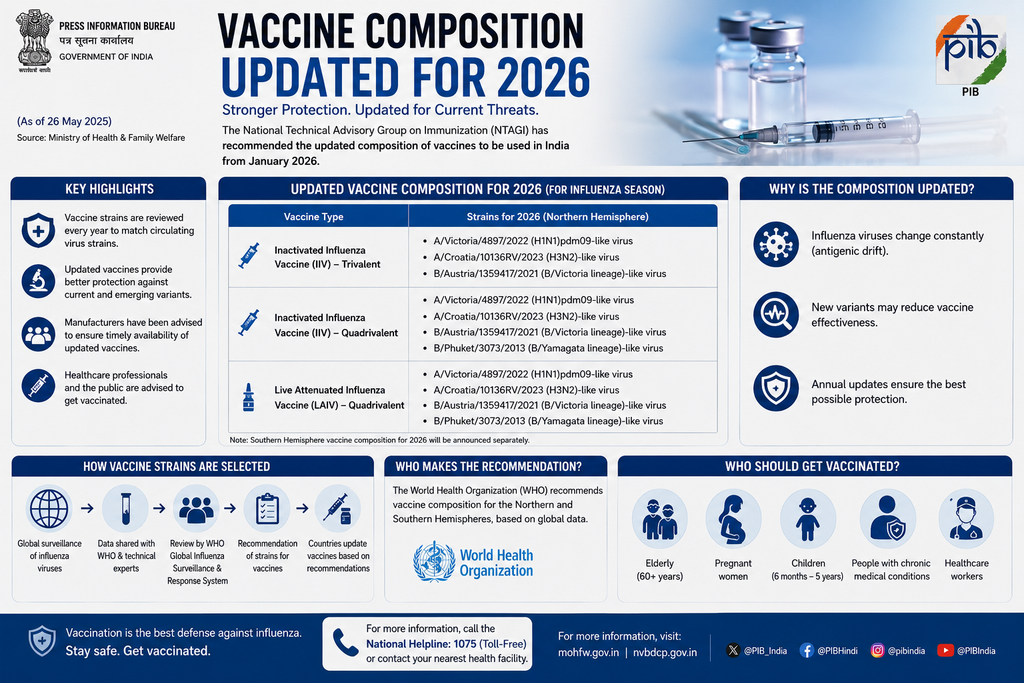
To fight this virus, there are three strains as per the WH.. This composition applies to egg-based vaccines. The same virus components were also advised for vaccines made using cell culture, recombinant protein, or nucleic acid technology.
India’s National Centre for Disease Control, or NCDC, said that the viruses they found through their surveillance system were very similar to the ones recommended by WHO. As per the NCDC report, India can use the Northern Hemisphere; however, if Northen hemispers is not available, then we can use the Southern Hemisphere vaccine in the temporarily basis.
WHO monitoring also points to seasonal Swine
flu fluctuations
India’s situation is part of a broader global influenza surveillance effort. WHO’s Global Influenza Surveillance and Response System continuously tracks influenza activity, circulating viruses,s and changes in viral characteristics.
In its weekly update covering the week ending August 2, 2026, WHO reported that global influenza detections remained low overall, although influenza positivity was elevated above 10 percent in some areas, including parts of Southern and South-East Asia and other regions. Influenza A and B viruses were detected in broadly similar proportions globally.
WHO’s surveillance reports underline an important point: influenza activity can rise in particular geographical areas even when global activity remains relatively low. Consequently, local increases need to be assessed through national surveillance rather than automatically being interpreted as evidence of a global emergency.
What authorities are watching
The government’s current approach is focused on surveillance rather than emergency restrictions.
The Health Ministry, DHR, ICMR and NCDC are continuing epidemiological, virological and genomic monitoring. According to the August 25 PIB statement, the 73-laboratory VRDL network enables authorities to detect and characterise circulating respiratory viruses and identify unusual changes in influenza activity or severity.
Officials are particularly interested in whether infections are becoming more severe, whether unusual clusters are emerging, whether hospitalisations are increasing disproportionately, and whether the virus is developing significant genetic or antigenic changes.
At present, the government says the evidence does not show such an unusual shift.
Why the “surge” needs context
The phrase “H1N1 surge” can attract public attention, but it should be used carefully. An increase in cases in a particular city, state, hospital network, or period does not necessarily mean that India is experiencing a nationwide epidemic of an unusually dangerous virus.
Influenza naturally moves through peaks and troughs. India’s historical NCDC data demonstrate major year-to-year variations in reported cases and deaths. Surveillance numbers are also influenced by testing, reporting practices, healthcare-seeking behaviour and the circulation of other respiratory viruses.
For that reason, the most important message from the latest official assessment is twofold: influenza activity deserves attention, but there is currently no evidence presented by the government of a new or unusually dangerous H1N1 strain.
Dr Rajiv Bahl’s August 25 assessment specifically said the genetic changes identified in the circulating H1N1 viruses were consistent with normal antigenic drift. Such changes occur routinely as influenza viruses circulate and, by themselves, do not demonstrate the emergence of a new dangerous strain.
The road ahead
The coming weeks will be important for public-health surveillance. Health authorities will continue to track ILI and SARI trends, laboratory results, circulating influenza subtypes and the severity of infections.
For the public, the message from authorities is straightforward: remain informed, practise respiratory hygiene, stay home when sick, protect vulnerable family members and seek timely medical care when symptoms become severe or worsen.
India’s extensive surveillance infrastructure also provides an important safeguard. The NCDC maintains dedicated H1N1 technical guidance covering epidemiology, patient categorisation, home care, mask use, clinical protocols, sample collection, laboratory testing, death audits and patient reporting.
The current H1N1 situation therefore calls for vigilance rather than panic. Seasonal influenza can cause serious illness and deaths, particularly among vulnerable groups, but the latest Indian government and ICMR assessment indicates that the circulating H1N1 viruses remain within the expected seasonal pattern.
As surveillance continues, the most reliable indicators will be official epidemiological data, laboratory findings, and assessments from the Health Ministry, ICMR, NCD, and WHO—not isolated social-media reports or unverified claims of a new “swine flu strain.”