



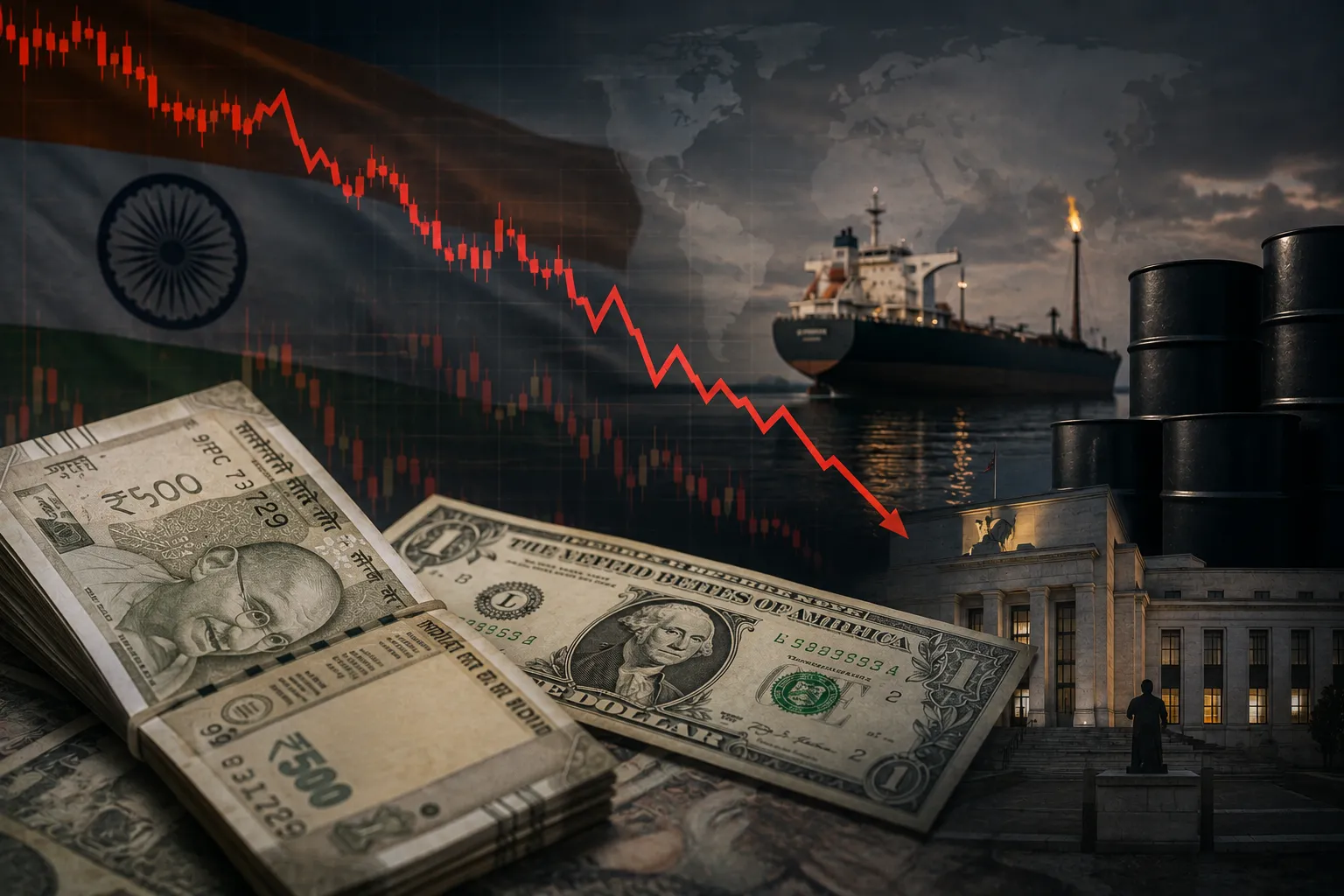
The Indian rupee is under renewed pressure because three forces are working against it at the same time: higher crude oil prices, rising expectations of a US Federal Reserve rate hike and a stronger dollar.
On August 31, 2026, the rupee opened at ₹95.56 against the US dollar, 13 paise weaker than its previous close of ₹95.43. Rising crude prices and geopolitical tensions were cited among the immediate pressures, while stronger bets on a September Fed rate hike have also supported the dollar.
Reuters reported that the rupee could remain under pressure this week as expectations of a Fed rate hike add to the headwind created by expensive oil. The currency had ended the previous week at ₹95.3775 per dollar.
So, why rupee is falling today 2026 is not a one-factor story.
It is the interaction between oil, US interest rates, dollar demand and India’s external position.
Why Is the Rupee Falling Today?
The immediate reasons are:
- Crude oil has risen sharply.
- Markets are increasing bets on a September Fed rate hike.
- Higher US yields are supporting the dollar.
- India’s importers need dollars to pay for expensive commodities.
- Geopolitical uncertainty is increasing demand for safer assets.
Brent crude rose above $90 after renewed US-Iran military escalation, while the Strait of Hormuz remained a major concern for global energy markets.
At the same time, Reuters reported that the probability of a September 15–16 Fed rate hike had risen to nearly 60% after Fed Chair Kevin Warsh delivered a hawkish message on inflation.
That combination is particularly uncomfortable for the rupee.
https://www.business-standard.com/finance/news/rupee-falls-13-paise-to-95-56-against-us-dollar-on-oil-price-rise-fed-bets-126083100160_1.html
How Do Fed Rates Affect the Indian Rupee?
The Federal Reserve influences global money flows.
When US interest rates rise—or markets expect them to rise—US dollar assets can become more attractive relative to assets in emerging markets.
The simplified chain is:
Higher Fed-rate expectations → higher US yields → stronger dollar → pressure on emerging-market currencies.
The effect does not require the Fed to actually raise rates immediately.
Markets move on expectations.
That is what is happening now.
Reuters reported that expectations for a September Fed hike rose sharply after Warsh said the central bank would need to act if it lacked confidence that inflation was moving back toward its 2% target.
For India, a stronger dollar can make it more difficult for the rupee to appreciate.
Why Are Higher Oil Prices Bad for the Rupee?
This is arguably the most important India-specific factor.
India imports a large share of the crude oil it consumes.
When crude prices rise, Indian importers need to spend more dollars to purchase the same amount of oil.
That increases demand for dollars in the foreign-exchange market.
The mechanism is:
Higher oil prices → higher Indian oil import bill → greater dollar demand → pressure on INR.
This is why the latest oil-price jump matters to the rupee.
Brent crude climbed above $90 after the latest US-Iran escalation, with the Strait of Hormuz remaining a key supply-risk concern.
For readers who want the broader economic connection, HNN24x7’s related article can be linked here:
Oil Prices and Inflation 2026: What the Oil Shock Means
That article explains how expensive crude can move beyond the energy market and create inflationary pressure.
Why Does the Strait of Hormuz Matter for the Rupee?
The Strait of Hormuz is critical because it carries a major share of global oil trade.
If shipping through the Strait becomes significantly disrupted, crude prices can rise further.
For India, that can become a currency problem.
Imagine the following chain:
Hormuz disruption → oil prices rise → India’s import bill rises → dollar demand increases → rupee faces more pressure.
The latest conflict has already reduced normal shipping activity through the Strait, according to Reuters.
That is why the rupee story cannot be separated from the current oil story.
For the immediate explanation of the crude-price rally, HNN24x7’s article Why Oil Prices Are Rising Today is the natural internal link.
Why Does a Stronger Dollar Hurt the Rupee?
The rupee’s exchange rate is expressed relative to the US dollar.
When USD/INR rises, it means one dollar costs more rupees.
For example:
- ₹90 per dollar → stronger rupee
- ₹95 per dollar → weaker rupee
- ₹100 per dollar → weaker rupee still
The dollar is also the world’s dominant reserve and settlement currency.
A combination of geopolitical uncertainty, higher US yields and expectations of tighter Federal Reserve policy can increase demand for dollars.
That can put pressure on emerging-market currencies such as the rupee.
https://www.marketscreener.com/news/rising-fed-hike-bets-pressure-rupee-oil-worries-linger-ce7858dcdd8bf127
Is the Fed the Only Reason the Rupee Is Weak?
No.
It would be misleading to explain the current rupee pressure entirely through the Federal Reserve.
Oil is an equally important part of the story.
So are:
- Importer dollar demand
- Foreign portfolio flows
- RBI intervention
- Global risk sentiment
- US Treasury yields
- India’s trade balance
- Domestic inflation expectations
Reuters reported that the RBI’s regular intervention has made traders cautious about aggressively betting on a weaker rupee, while importer hedging demand has continued to limit upside.
That means the rupee is being pressured—but the decline is not necessarily uncontrolled.
What Is the RBI Doing About the Rupee?
The Reserve Bank of India can intervene in the foreign-exchange market.
One important tool is buying or selling foreign currency.
When the rupee comes under heavy pressure, the RBI can sell dollars from its reserves to increase dollar supply in the market.
In simplified terms:
RBI sells dollars → dollar supply increases → pressure on USD/INR can ease.
But intervention has limits.
The RBI cannot permanently override global economic forces.
If oil prices remain high and US rates rise, the underlying demand for dollars can continue.
Reuters said regular RBI intervention has made traders wary of aggressively chasing rupee weakness.
Why Is the Rupee Not Falling Even Faster?
This is an important part of the story.
The rupee has remained relatively range-bound despite significant external pressures.
Reuters reported that the currency strengthened about 0.2% during the previous week to 95.3775 per dollar and had stayed within a narrow range in recent weeks.
There are several reasons.
RBI intervention
The central bank can smooth excessive volatility.
Dollar inflows
Foreign-currency inflows can temporarily increase dollar supply.
Importer hedging
Companies may hedge their future dollar requirements, affecting spot and forward markets.
Market expectations
If traders believe the RBI will resist disorderly depreciation, they may be less willing to aggressively sell the rupee.
This explains why currency markets can behave differently from what a simple oil-price relationship would suggest.
What Happens to India When the Rupee Weakens?
A weaker rupee has both negative and positive effects.
Negative effects
Imported goods become more expensive.
That includes:
- Crude oil
- Electronics
- Machinery
- Some industrial inputs
- Foreign travel
- Imported services
A weaker currency can therefore increase inflationary pressure.
Positive effects
Indian exporters can become more competitive because their overseas revenues translate into more rupees.
IT services, pharmaceuticals and other export-oriented sectors can sometimes benefit from a weaker currency.
But the overall economic effect depends on the scale and speed of depreciation.
A gradual adjustment is very different from a sudden currency shock.
Could a Weak Rupee Increase Inflation?
Yes.
This creates another important connection between your oil and rupee content cluster.
The chain can work in two directions:
Higher oil → weaker rupee → more expensive oil imports → additional inflation pressure.
At the same time:
Higher oil → higher inflation → greater pressure on monetary policy.
This is why the rupee and crude-oil stories should not be treated as separate topics.
Your related HNN24x7 article on Oil Prices Inflation 2026 provides the broader inflation explanation.
What Happens If Oil Prices Stay Above $90?
If Brent remains above $90 for a prolonged period, the pressure on the rupee could intensify.
The impact would depend on:
- India’s oil-import requirements
- The rupee-dollar exchange rate
- Global oil supply
- Strait of Hormuz shipping
- RBI intervention
- Global capital flows
A temporary move above $90 does not automatically mean a sustained currency decline.
But a prolonged oil shock would be more difficult to absorb.
Reuters said analysts expect oil to remain volatile, with Brent potentially trading in a broad $85–$95 range depending on developments around the conflict.
What Happens If the Fed Raises Rates?
A Fed hike could create additional pressure through the interest-rate channel.
If US rates rise while Indian rates remain unchanged, the relative attractiveness of dollar assets can increase.
That could encourage some capital to move toward US assets.
The resulting dollar demand can weigh on emerging-market currencies.
However, the effect is not automatic.
Markets already price expected policy changes before the Fed actually acts.
So what matters for the rupee is not only the eventual decision but also:
What the Fed does versus what markets already expected.
Could the Rupee Fall Further in 2026?
It could, but the direction will depend on oil, Fed policy and capital flows.
There are two broad scenarios.
Scenario 1: Pressure eases
The rupee could stabilize if:
- Oil prices decline
- Strait of Hormuz tensions ease
- Fed rate-hike expectations fall
- Dollar demand weakens
- Foreign capital inflows improve
- RBI intervention remains effective
In this scenario, some of the current pressure could reverse.
Scenario 2: Pressure intensifies
The rupee could weaken further if:
- Brent remains above $90
- Oil shipments through Hormuz deteriorate
- The Fed turns more hawkish
- US Treasury yields rise
- Foreign investors reduce exposure to India
- Importer dollar demand increases
The second scenario would create a much tougher environment for the Indian currency.
What Should Traders Watch Next?
If you want to understand why rupee is falling today 2026 and where it could go next, watch these indicators.
1. USD/INR
This is the most direct measure of rupee pressure.
2. Brent crude
A sustained oil rally could increase India’s import burden.
3. Fed expectations
Watch market pricing for the September Fed meeting and subsequent policy decisions.
4. US Treasury yields
Higher yields can strengthen the dollar and increase pressure on emerging-market currencies.
5. RBI intervention
Central-bank activity can limit short-term volatility.
6. Foreign portfolio flows
Large foreign inflows can support the rupee, while sustained outflows can increase dollar demand.
7. Strait of Hormuz
This may be the biggest geopolitical variable for India’s currency because of its connection to oil.
Will the Rupee Recover If Oil Prices Fall?
It could, especially if other pressures also ease.
A decline in crude prices would reduce India’s import bill and dollar demand.
That would remove one important source of pressure.
If lower oil prices occur alongside weaker Fed-rate expectations and stronger foreign capital inflows, the rupee could receive a much larger boost.
This is why India’s currency outlook is closely linked to global commodity and interest-rate markets.
Why the Rupee Story Is Also an Inflation Story
The relationship between the rupee and inflation is particularly important in 2026.
Consider this chain:
US-Iran conflict → oil rises → India’s import bill rises → rupee weakens → imported energy becomes more expensive → inflation pressure increases.
Then the process can continue:
Higher inflation → RBI policy dilemma → interest-rate expectations → investment and currency markets.
This makes the current currency movement more than a forex story.
It is also an energy, inflation and monetary-policy story.
What Does This Mean for Indian Consumers?
A weaker rupee does not immediately mean everything in India becomes more expensive.
But if depreciation persists, imported products and energy-intensive goods can become costlier.
Potential areas of impact include:
- Petrol and diesel economics
- Air travel
- Imported electronics
- Foreign education
- Overseas travel
- Imported machinery
- Some pharmaceutical inputs
- Logistics and transportation
The impact depends on how much of the cost increase businesses pass through to consumers.
The Bigger Picture: Three Forces Driving the Rupee
The current rupee story can be summarized in three major forces.
Oil
Higher crude prices increase India’s dollar requirements.
Fed
Higher US-rate expectations support the dollar and can reduce the relative attractiveness of emerging-market assets.
Geopolitics
US-Iran tensions increase both oil-market uncertainty and global risk aversion.
Together, these forces create a difficult environment for the Indian currency.
FAQ
Why is the rupee falling today in 2026?
The rupee is under pressure because crude oil prices have risen, geopolitical tensions have increased and markets have raised expectations of a US Federal Reserve rate hike. The rupee opened at ₹95.56 per dollar on August 31, 2026.
How do Fed rates affect the Indian rupee?
Higher US interest rates can make dollar assets more attractive, supporting the US dollar and putting pressure on emerging-market currencies such as the rupee.
Why do higher oil prices weaken the rupee?
India imports a large amount of crude oil. Higher oil prices increase the country’s dollar requirement for imports, which can increase demand for dollars and pressure the rupee.
Will the rupee fall further in 2026?
It could if oil remains expensive, Fed-rate expectations stay high and capital flows weaken. However, lower oil prices, easier US monetary policy and RBI intervention could help stabilize the currency.
Can RBI stop the rupee from falling?
The RBI can use foreign-exchange intervention to reduce excessive volatility, but it cannot permanently eliminate the effects of global oil prices, US monetary policy or international capital flows.
Does a weak rupee increase inflation?
It can. A weaker rupee makes imported goods and commodities more expensive, particularly dollar-priced commodities such as crude oil.
How does the US-Iran conflict affect the rupee?
The conflict can raise oil prices and increase global risk aversion. Both effects can increase pressure on the rupee.
What happens if Brent stays above $90?
A prolonged Brent price above $90 could increase India’s import costs and dollar demand, potentially creating additional pressure on the rupee.
What should investors watch next?
The most important indicators are Brent crude, USD/INR, US Treasury yields, Fed rate expectations, RBI intervention, foreign capital flows and developments around the Strait of Hormuz.
Bottom Line: Why Is the Rupee Falling Today?
The answer to “why rupee is falling today 2026” is primarily a combination of higher oil prices, stronger expectations of a US Fed rate hike and increased demand for dollars.
The rupee opened at ₹95.56 per dollar on August 31, down from ₹95.43, while Reuters reported that traders expect continued pressure from high oil and the prospect of tighter US monetary policy.
The oil factor is especially important for India because the country imports much of its crude.
The Fed factor matters because higher US yields can strengthen the dollar.
And the geopolitical factor matters because the US-Iran conflict is threatening the stability of a critical global oil-shipping route.
The next major question is therefore not simply “Will the rupee fall?”
It is:
Will oil prices remain elevated, and will the Federal Reserve actually move toward higher rates?
If both happen at the same time, the rupee could remain under pressure.
If oil falls and Fed-rate expectations ease, the currency could stabilize.
For now, the rupee is caught between expensive energy and a stronger dollar.
“Must Read”