



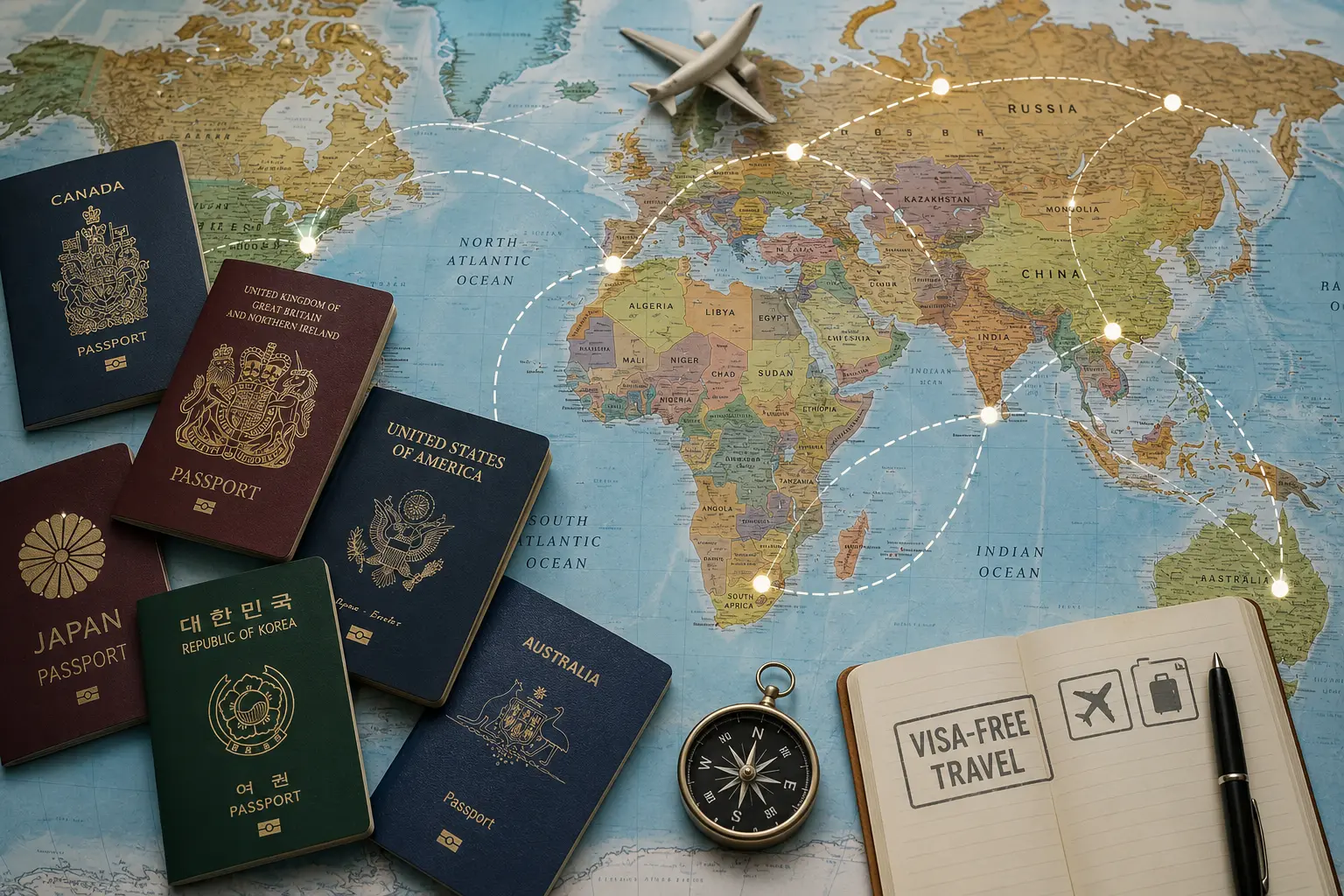
Singapore has the world’s most powerful passport in the July 2026 Henley Passport Index, giving its citizens visa-free or visa-on-arrival access to 192 destinations. The United Arab Emirates, Japan and South Korea follow closely, with 188 destinations accessible without obtaining a traditional visa in advance.
The 2026 ranking also shows a continuing shift in global travel power. Asian and European passports dominate the top positions, while the UAE has made one of the biggest long-term gains ever recorded by Henley’s index.
The United States remains in the global top 10, but its position has weakened compared with earlier years.
Which is the world’s most powerful passport in 2026?
Singapore has the world’s most powerful passport according to the July 2026 Henley Passport Index.
Singaporean passport holders can access 192 destinations without obtaining a visa in advance. The UAE, Japan and South Korea are next, each with access to 188 destinations.
Henley’s ranking covers 199 passports and 227 destinations and is based on data from the International Air Transport Association’s Timatic system. The index is updated monthly.
Top powerful passports at a glance
| Rank | Passport | Destinations without a prior visa |
|---|---|---|
| 1 | 🇸🇬 Singapore | 192 |
| 2 | 🇦🇪 UAE | 188 |
| 2 | 🇯🇵 Japan | 188 |
| 2 | 🇰🇷 South Korea | 188 |
| 3 | 🇩🇰 Denmark | 187 |
| 3 | 🇫🇮 Finland | 187 |
| 3 | 🇫🇷 France | 187 |
| 3 | 🇩🇪 Germany | 187 |
| 3 | 🇮🇪 Ireland | 187 |
| 3 | 🇮🇹 Italy | 187 |
| 3 | 🇪🇸 Spain | 187 |
| 4 | 🇦🇹 Austria | 186 |
| 4 | 🇧🇪 Belgium | 186 |
| 4 | 🇱🇺 Luxembourg | 186 |
| 4 | 🇳🇱 Netherlands | 186 |
| 4 | 🇳🇴 Norway | 186 |
| 4 | 🇵🇹 Portugal | 186 |
| 4 | 🇸🇪 Sweden | 186 |
| 4 | 🇨🇭 Switzerland | 186 |
Henley uses tied ranks, so multiple countries can share the same position.
Singapore remains No. 1
Singapore has retained the top spot in the latest Henley ranking.
Its 192-destination score means Singaporean citizens have one of the highest levels of short-term international travel access in the world without needing to obtain a traditional visa before departure.
The country’s position reflects extensive diplomatic relationships and reciprocal travel arrangements.
Singapore has also consistently ranked among the world’s strongest passports over the past decade, making it one of the clearest examples of how international mobility has become a major component of passport strength.
UAE passport makes a historic rise
The United Arab Emirates is one of the biggest stories in the 2026 ranking.
In July, the UAE climbed to joint second place, alongside Japan and South Korea, with access to 188 destinations.
Henley says the UAE has recorded the largest improvement of any passport in the index’s history over the past 20 years.
Since 2006, the UAE has added 153 destinations to its visa-free or visa-on-arrival access and climbed 57 places in the rankings.
That rise has been associated with sustained diplomatic engagement, international partnerships and changes in visa arrangements.
Why is the UAE passport becoming so powerful?
Passport strength is not determined simply by the size of a country’s economy.
Diplomatic relationships, reciprocal visa agreements, international cooperation and a country’s broader geopolitical relationships can all affect travel access.
The UAE’s rise illustrates how those relationships can substantially change a country’s position in global mobility rankings.
Japan and South Korea remain passport superpowers
Japan and South Korea remain among the strongest passports in the world.
Both are tied with the UAE at No. 2 with access to 188 destinations in the July 2026 Henley ranking.
Asian passports have played a particularly strong role at the top of global rankings in recent years.
Singapore, Japan and South Korea have repeatedly appeared near the top because their citizens enjoy extensive visa-free access across Europe, Asia, the Americas and other regions.
European passports dominate the upper rankings
Europe has an especially strong presence near the top of the 2026 ranking.
Denmark, Finland, France, Germany, Ireland, Italy and Spain share third place with access to 187 destinations.
Another large group—including Austria, Belgium, Luxembourg, the Netherlands, Norway, Portugal, Sweden and Switzerland—has access to 186 destinations.
The concentration of European Union passports near the top reflects, among other factors, extensive reciprocal visa arrangements and the mobility benefits associated with European integration.
What happened to the US passport?
The United States ranks 10th in the July 2026 Henley Passport Index.
That is a notable change from the period when the US regularly occupied the top positions.
Henley says the US is now one of the few top-ranked passports whose holders still need a visa to visit China, contributing to its relative decline.
The change does not mean that the US passport has suddenly become weak. Access to 180-plus destinations still places it among the world’s most useful passports.
Rather, other countries have expanded their citizens’ travel access more rapidly.
What does “visa-free” actually mean?
Visa-free travel generally means a traveler can enter a destination for an eligible short stay without obtaining a visa before departure.
However, passport rankings can include several forms of simplified access depending on the methodology.
These can include:
- Visa-free entry
- Visa on arrival
- Electronic travel authorization
- Other forms of entry where a traditional visa is not required beforehand
This is why the number shown by one passport ranking may not exactly match another.
Henley specifically ranks passports according to the number of destinations accessible without a prior visa, using its established methodology and IATA data.
Visa-free does not mean unlimited entry
A powerful passport does not mean a traveler can live or work indefinitely in every country without permission.
Visa-free arrangements generally apply to specific purposes and limited periods, often tourism or short business visits.
A destination can still impose:
- Maximum stay limits
- Passport-validity requirements
- Proof of onward travel
- Proof of accommodation
- Sufficient-funds requirements
- Travel insurance requirements
- Electronic travel authorization
- Restrictions on employment or study
Travelers should therefore check the destination country’s official immigration rules before booking a trip.
Which passports are strongest for global mobility?
The answer depends on what “strongest” means.
If the question is simply how many destinations can be entered without a prior visa, Henley’s July 2026 ranking places Singapore first.
But another ranking may produce a different result because it uses a different methodology.
For example, the 2026 Passport Index uses a Mobility Score that combines visa-free travel, visa-on-arrival access and other categories. Its current ranking places the UAE first, followed by France and Spain, with Singapore also near the top.
This does not necessarily mean one index is “wrong.”
It means the rankings are measuring passport mobility differently.
Henley vs Passport Index
| Feature | Henley Passport Index | Passport Index |
|---|---|---|
| Main measure | Destinations accessible without a prior visa | Mobility Score |
| Data | IATA Timatic + research | Passport/visa characteristics |
| Countries/passports | 199 | Global passport database |
| Update approach | Monthly | 2026 ranking |
| Current top passport | Singapore | UAE |
| Why results differ | Different methodology | Different scoring system |
For an article specifically about visa-free countries, Henley is particularly useful because its methodology directly focuses on access without obtaining a prior visa.
How has passport power changed over time?
Global mobility has expanded significantly since the Henley Passport Index began.
According to Henley, the average passport now provides visa-free or visa-on-arrival access to 108 destinations, compared with only 58 destinations in 2006.
That represents a dramatic expansion in international travel access.
But the gains have not been evenly distributed.
People holding passports from high-ranking countries can generally travel to far more destinations without arranging a visa in advance than people holding passports near the bottom of global rankings.
Henley describes this as a continuing divide in global mobility.
Which countries have the most visa-free access?
The countries with the highest access in the July 2026 Henley ranking are concentrated in Asia, Europe and the Gulf.
The leading group is:
- Singapore — 192 destinations
- UAE — 188
- Japan — 188
- South Korea — 188
- Denmark, Finland, France, Germany, Ireland, Italy and Spain — 187
- Austria, Belgium, Luxembourg, Netherlands, Norway, Portugal, Sweden and Switzerland — 186
Because several countries are tied, a simple “top 10” list can be misleading. The better way to report the ranking is to show the actual rank and the number of destinations.
What about India?
For Indian travelers, passport rankings are particularly relevant because the difference between passports at the top and middle of the table can translate into substantial differences in travel planning.
India is not among the top-ranked passports in the July 2026 Henley ranking.
However, the exact number of destinations available to Indian passport holders can change as countries introduce or remove visa-free, visa-on-arrival and other simplified entry arrangements.
Travelers should therefore check the current destination-specific requirement, rather than relying only on a static annual ranking.
This is particularly important because Henley’s index itself is updated monthly.
Why are some passports much stronger than others?
Passport strength reflects a combination of international relationships and travel policies.
Factors can include:
Diplomatic relationships
Countries with extensive diplomatic networks may negotiate more reciprocal travel arrangements.
Security and immigration policies
Visa policies are also influenced by concerns about migration, security, overstays and identity verification.
Economic relationships
Trade, investment and broader economic ties can influence bilateral travel arrangements.
Reciprocity
Countries frequently negotiate reciprocal arrangements, meaning citizens of both countries receive similar treatment.
International reputation and cooperation
A country’s diplomatic position and international relationships can affect how easily its citizens travel.
Henley’s research also examines the relationship between passport power and other geopolitical indicators, showing that the relationship is not straightforward.
Is a powerful passport the same as a wealthy passport?
No.
Economic wealth and passport strength are related in some cases but are not the same thing.
A small country can have an extremely powerful passport if its citizens have extensive visa-free access.
Conversely, a large or wealthy economy can have a lower passport ranking if its citizens face visa requirements in many destinations.
Henley’s separate Passport Power measure demonstrates this distinction by considering the amount of global GDP accessible visa-free, rather than simply counting destinations.
This can produce a very different ranking from a simple destination count.
Why passport rankings matter for travelers
A strong passport can reduce the time, cost and uncertainty involved in international travel.
Travelers may avoid:
- Visa application fees
- Embassy appointments
- Document preparation
- Long processing times
- Proof-of-income requirements
- Advance travel authorization for some destinations
For frequent travelers, these differences can have a major practical impact.
Passport power can also matter for business travelers, students, digital professionals and families who regularly cross borders.
The global passport gap
The biggest story behind passport rankings is not simply which country is No. 1.
It is the enormous difference between the world’s strongest and weakest passports.
Henley’s 2026 data show that while the average passport now offers access to 108 destinations without a prior visa, mobility remains highly unequal.
For some citizens, international travel can involve little more than booking a flight and meeting entry requirements at the border.
For others, visiting the same destination may require advance visas, extensive documentation and long processing periods.
That difference is one reason passport strength is increasingly treated as an indicator of global mobility.
What is the future of passport power?
Passport rankings can change quickly.
A new visa waiver agreement can move a country upward. A diplomatic dispute or policy change can remove access just as quickly.
The UAE’s rapid rise is an example of how dramatically passport power can change over time. Henley says the country has added 153 destinations to its visa-free or visa-on-arrival access since 2006.
Meanwhile, changes involving China, Brazil, the UK, Malawi and other destinations have altered the rankings of major passports in recent years.
This means passport rankings should be viewed as a snapshot of current global mobility, not a permanent measure of national status.
FAQ
Which is the world’s most powerful passport in 2026?
Singapore ranks first in the July 2026 Henley Passport Index, with visa-free or visa-on-arrival access to 192 destinations.
Which passport gives access to the most countries without a visa?
Singapore currently leads the Henley ranking with 192 destinations accessible without a prior visa.
Which countries have the top passports in 2026?
Singapore ranks first, followed by the UAE, Japan and South Korea. Major European passports including France, Germany, Italy and Spain are also among the world’s strongest.
Is the US passport still powerful?
Yes. The United States remains among the world’s strongest passports and ranks 10th in the July 2026 Henley Passport Index. However, it has fallen from its historic top positions.
Why is the UAE passport so strong?
The UAE has dramatically expanded its visa-free and visa-on-arrival relationships. Henley says it has added 153 destinations since 2006, the largest improvement recorded in the index’s history.
What does visa-free travel mean?
Visa-free travel generally means eligible travelers do not need to obtain a traditional visa before entering a destination for an eligible short stay. Entry conditions and maximum stays still apply.
Is visa-on-arrival the same as visa-free?
No. With visa-on-arrival, the traveler obtains permission after arriving at the destination, while visa-free travel generally does not require a visa to be obtained at the border. Some passport indexes group different forms of simplified access differently.
Does passport ranking mean I can travel anywhere without restrictions?
No. Visa-free access can have restrictions involving length of stay, permitted activities, passport validity, onward tickets and other entry conditions.
Why do passport rankings disagree?
Different indexes use different methodologies. Henley focuses on destinations accessible without a prior visa, while Passport Index uses a broader Mobility Score incorporating several forms of access.
How often does the Henley Passport Index change?
Henley says its index is updated monthly, so rankings and destination counts can change during the year.
“Sources Used“
https://www.henleyglobal.com/newsroom/press-releases/henley-passport-index-20th-anniversary
Bottom line
Singapore has the world’s most powerful passport in the July 2026 Henley Passport Index, with access to 192 destinations without obtaining a visa in advance. The UAE, Japan and South Korea follow with 188 destinations each.
European passports occupy much of the rest of the top tier, while the United States remains in the top 10 but has lost ground compared with its historic position.
The UAE’s extraordinary rise is one of the defining passport stories of 2026, while the broader trend shows that global mobility has expanded considerably over the past two decades.
For travelers, however, passport ranking is only a starting point. Visa policies change, and “visa-free” does not necessarily mean unlimited entry. Before traveling, passengers should always verify the latest requirements for their specific passport and destination.
“Must Read”
Climate Change & Global Warming: What Is Happening to the Planet in 2026?
NASA Space Missions 2026: Latest Launches, Artemis Updates and Major Discoveries