


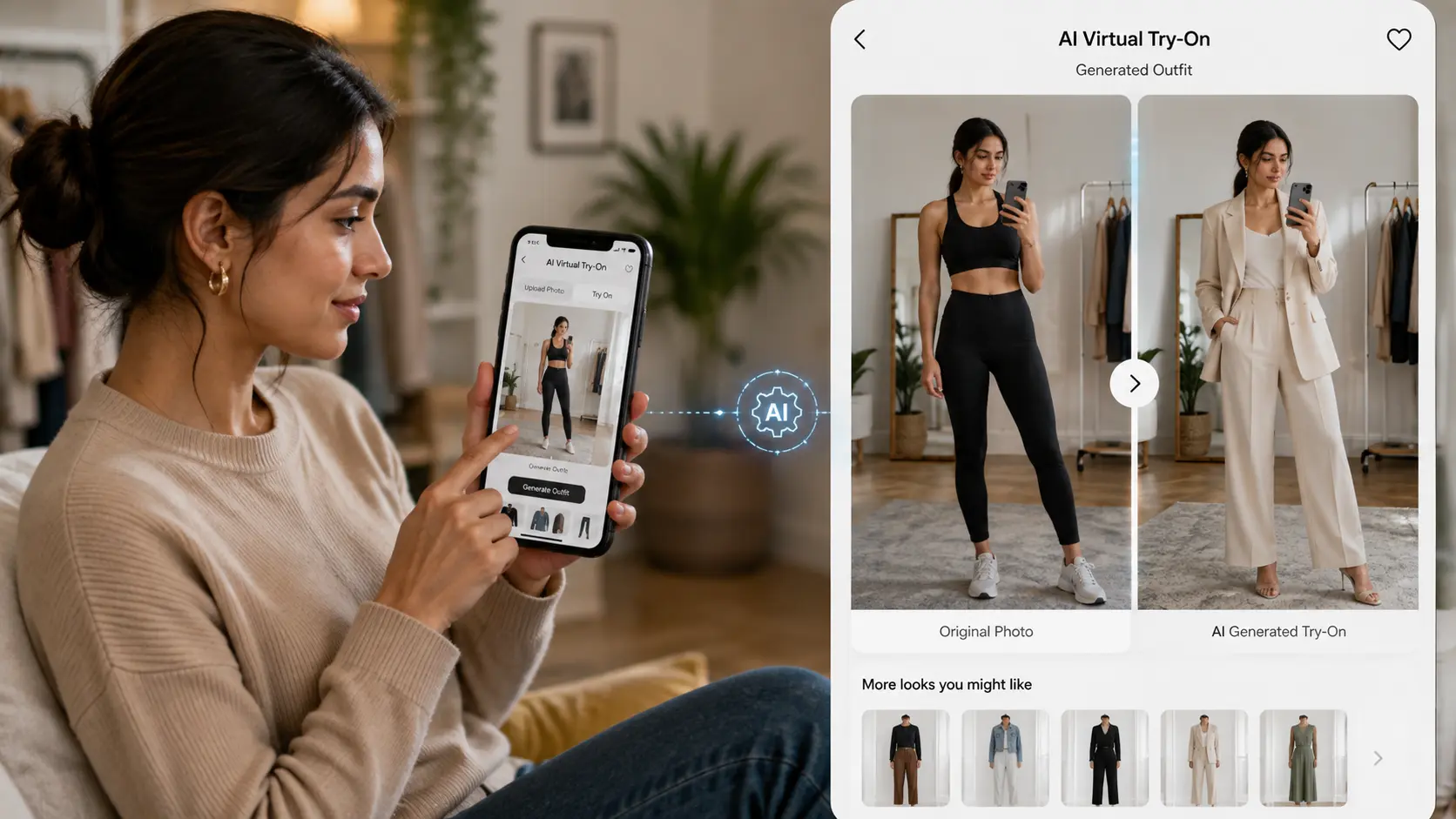
AI virtual try-on has moved from an experimental fashion-tech idea to a shopping feature that consumers can actually use.
In India, Google introduced its Virtual Apparel Try On feature in December 2025, allowing shoppers to upload a photograph and virtually try clothing—including tops, dresses, jackets and shoes—from billions of apparel listings.
By 2026, the technology has become considerably more sophisticated. AI systems can analyse a person’s image and a garment image, then generate a new picture showing what that garment could look like on the shopper.
But there is an important distinction:
A virtual try-on image can look extremely realistic without being a reliable prediction of how the garment will physically fit.
That distinction is becoming increasingly important as AI fashion technology moves into mainstream online shopping.
What is AI virtual try-on?
AI virtual try-on is a technology that uses artificial intelligence to generate an image of a person wearing a selected item of clothing without the person physically putting it on.
Instead of visiting a fitting room, a shopper can provide a photograph and select an item.
The AI then combines information from:
- the shopper’s body and pose;
- the garment’s shape;
- clothing texture;
- folds and draping;
- lighting;
- body position;
- product imagery.
The result is a generated image designed to show how the garment might look.
Google’s current apparel system, for example, combines a user’s uploaded photograph with product images and uses generative AI to create the virtual try-on result.
How does AI virtual try-on work?
The underlying technology is more complicated than simply placing a clothing PNG over a photograph.
Modern systems use computer vision and generative image models to understand two things simultaneously:
The person
The AI needs to identify elements such as:
- body position;
- visible body shape;
- limbs;
- clothing already being worn;
- perspective;
- pose.
The garment
It also needs to understand:
- garment boundaries;
- sleeves;
- neckline;
- folds;
- texture;
- patterns;
- how the material might drape.
The model then synthesizes a new image that attempts to preserve the person’s identity and pose while replacing or adding the selected clothing.
Research into virtual try-on has increasingly focused on improving this interaction between human-body structure and garment appearance. A 2026 review describes virtual try-on as a major application of deep learning in online clothing commerce, while recent research continues to tackle problems such as garment alignment and complex poses.
Why does AI virtual try-on look so realistic now?
The biggest change is the rise of powerful generative image models.
Earlier virtual fitting systems often depended heavily on predefined body models, segmentation and geometric garment warping.
Newer systems can generate much more visually natural images.
Google has described its approach as combining garment and person imagery through generative AI.
This makes it possible for the system to generate details such as:
- fabric folds;
- shadows;
- garment draping;
- body-contour interaction;
- wrinkles;
- visual texture.
Google’s documentation says its system can show how clothing drapes, clings and stretches across different body types.
That is a major improvement over simply overlaying a flat image of a shirt onto a person.
How accurate is AI virtual try-on?
It is becoming very good at visualizing appearance, but it is not yet equivalent to physically trying on clothing.
This is the most important answer for shoppers.
Google explicitly warns that generated images can contain errors involving body shape, personal features and clothing details. It also states that the feature does not indicate physical fit, recommend a size or show whether a particular size is available.
So there are really two different kinds of accuracy:
Visual accuracy
“Does this look like the garment on me?”
AI can increasingly perform well here.
Physical-fit accuracy
“Will this garment actually fit my shoulders, waist, chest, hips and length?”
This remains much harder.
A realistic generated image does not automatically answer that question.
Why visual realism is not the same as fit accuracy
Consider a pair of jeans.
An AI system may generate an image that correctly shows:
- the colour;
- general shape;
- pocket placement;
- denim appearance;
- approximate silhouette.
But it may not know with sufficient precision:
- your exact waist measurement;
- your thigh circumference;
- fabric elasticity;
- how tight the waistband will feel;
- whether the inseam is correct;
- how the garment behaves when you sit down.
Those are physical properties.
A photograph alone does not necessarily contain enough information to predict all of them.
That is why virtual try-on should currently be treated as a visualization tool, not a digital replacement for a fitting room.
What can AI virtual try-on do well?
The technology is particularly useful for style discovery.
For example, a shopper can quickly answer:
“Would this colour look good on me?”
or:
“What would I look like wearing this jacket?”
That can be extremely valuable when shopping online.
Google describes its try-on experience as a way to help shoppers visualize clothing and explore different styles.
The technology can therefore reduce one of the biggest psychological problems with online fashion shopping:
uncertainty about appearance.
AI virtual try-on can help answer these questions
“Does this style suit me?”
Potentially yes.
“Does this colour work with my appearance?”
Often useful as a visual reference.
“What does this dress look like on a body similar to mine?”
This is one of the strongest applications.
“Will this exact size fit me?”
No—not reliably enough to depend on the generated image alone.
“Will the fabric feel comfortable?”
No.
“Will the sleeves be exactly the right length?”
Not reliably.
Google has already brought AI virtual try-on to India
The technology is particularly relevant to Indian shoppers because Google launched Virtual Apparel Try On in India in December 2025.
The feature allows users to upload a photograph and virtually try clothing across Google Shopping and product listings. Google says its custom fashion AI model is designed to understand the way fabrics fold, stretch and drape across different body shapes.
Google’s April 2026 update also said the company was continuing to expand AI-powered shopping features in India, building on the Virtual Try-On launch.
That means virtual try-on is no longer just a future retail concept.
It is already part of the consumer shopping experience in India.
Google is also generating a digital version of the shopper
The technology has taken another step forward.
In December 2025, Google introduced a feature allowing U.S. shoppers without a full-body image to upload a selfie and use Nano Banana, its Gemini 2.5 Flash Image model, to generate a full-body digital version for virtual try-on.
This matters because requiring a suitable full-body photograph can be a barrier to adoption.
Instead, the system can create a digital representation and use it for subsequent clothing previews.
However, Google still warns that the quality of the generated result depends partly on the quality of the merchant’s product images.
Why the quality of the clothing photo matters
This is an often-overlooked part of AI virtual try-on.
The AI isn’t working with perfect information.
If the original product image is:
- low resolution;
- poorly lit;
- folded;
- partly hidden;
- photographed from an unusual angle;
- missing important details,
the generated try-on image can also suffer.
Google’s merchant guidance recommends high-resolution product imagery and says qualifying garments should be clearly visible, ideally on a front-facing model or mannequin or laid flat.
So virtual try-on accuracy is partly dependent on input quality.
What happens when the AI gets the clothing wrong?
Generative AI can sometimes introduce visual errors.
For example, a generated image could subtly change:
- a logo;
- a pattern;
- a seam;
- a pocket;
- a sleeve;
- garment proportions;
- body characteristics.
The result can look convincing at first glance while still being technically incorrect.
This is one reason Google’s own documentation does not present virtual try-on as an exact representation of fit.
Recent academic research is also focused on reducing artifacts and misalignment, particularly around occlusion, complex poses and garment-body interactions.
Can AI virtual try-on reduce clothing returns?
It could help, but the evidence should not be overstated.
One reason online fashion has a persistent return problem is that shoppers cannot physically assess fit and appearance before purchasing.
Researchers studying virtual try-on have specifically identified the mismatch between expected and actual size or fit as a major online-fashion problem. A 2026 CHI study examined how virtual try-on affects shopping experiences, satisfaction and return intentions.
But there is a crucial difference between:
“The technology can improve purchase confidence”
and
“The technology will eliminate returns.”
The second claim is not supported.
Virtual try-on may help shoppers make better visual decisions, while size charts, garment measurements and return policies remain important for physical fit.
Could AI eventually predict your exact clothing size?
This is one of the most interesting future developments.
A truly advanced virtual fitting system would need to move beyond image generation and understand:
- body measurements;
- garment measurements;
- fabric stretch;
- garment construction;
- brand-specific sizing;
- posture;
- preferred fit;
- movement.
Research is already moving in this direction.
A 2026 Scientific Reports study described an intelligent clothing customization system combining body-measurement extraction, style preference learning, virtual try-on and design recommendations. The reported system achieved a mean absolute error of 0.38 cm in its body-measurement task under its experimental setup.
But this should not be interpreted as proof that consumer AI virtual try-on can currently measure everyone with 0.38 cm accuracy.
That was a specific research system under controlled experimental conditions.
Real-world shopping is much messier.
AI virtual try-on vs traditional fitting room
| Feature | Physical fitting room | AI virtual try-on |
|---|---|---|
| See garment on you | Yes | Yes, digitally |
| Physical fit | Directly testable | Not reliably guaranteed |
| Fabric feel | Yes | No |
| Weight/comfort | Yes | No |
| Appearance preview | Excellent | Increasingly realistic |
| Try many items quickly | Limited | Excellent |
| Available at home | No | Yes |
| Requires physical stock | Yes | No |
| Size certainty | Higher | Limited |
| Style experimentation | Moderate | Very high |
The biggest advantage of AI is therefore convenience and visualization, not perfect physical measurement.
What are the biggest problems with AI virtual try-on?
1. Fit is still uncertain
A realistic image can create false confidence.
2. Body representation can be imperfect
AI may alter body shape or personal features.
Google explicitly lists body-shape and personal-feature errors among possible limitations.
3. Clothing details can change
Patterns, logos, seams and textures can occasionally be misrepresented.
4. Fabric behaviour is difficult
Silk, denim, wool, stretch fabrics and structured garments behave differently.
Simulating that accurately from a single photograph is technically difficult.
5. Pose matters
A garment may look correct while standing but behave differently when the wearer moves.
Complex poses remain an active research challenge.
Is AI virtual try-on safe for privacy?
Privacy depends on how the specific service handles uploaded photographs and generated images.
This is an important consideration because virtual try-on requires personal visual information.
Before using a third-party application, shoppers should check:
- what happens to uploaded photographs;
- how long images are stored;
- whether images are used for model training;
- whether photographs are shared with partners;
- whether users can delete uploaded data;
- whether the service requires an account.
There is no single privacy standard covering every AI virtual try-on provider.
Google, for example, publishes separate information about its shopping and try-on systems, so users should check the specific service they are using rather than assuming that all AI fitting tools operate the same way.
How fashion brands are adopting AI virtual try-on
The technology is moving beyond search engines.
In August 2026, Aditya Birla Fashion and Retail announced AI-driven virtual try-on technology developed with PointAI, including an in-store virtual trial room and an AI-powered Fashion Advisor. The company said it plans to roll the technology across its brand stores.
That development is significant because it shows where virtual try-on could be heading:
online shopping + physical retail + AI styling.
Instead of replacing stores, AI could become another layer inside them.
A shopper might enter a store, stand in front of a screen, select multiple outfits and see digitally generated combinations before physically trying the most promising pieces.
Is AI virtual try-on replacing the fitting room?
Not yet.
The more realistic future is that AI virtual try-on becomes a first-stage fitting room.
Think of the shopping process as:
AI preview → shortlist → physical fitting → purchase
rather than:
AI preview → guaranteed fit → purchase
This could make shopping much more efficient.
Instead of trying 20 items, a shopper might digitally eliminate 15 and physically test five.
What will AI virtual try-on look like next?
The technology is likely to move in several directions.
Better body understanding
AI will increasingly use body measurements and 3D information rather than relying only on a 2D photograph.
Better fabric simulation
Models will need to understand how different materials stretch, fold and move.
Personalized sizing
Future systems could combine body measurements with individual brand sizing.
Full outfits
Instead of trying one shirt at a time, shoppers could generate complete looks.
AI fashion advisors
The system could recommend:
“This jacket works with the trousers you already own.”
Physical-store integration
Virtual fitting rooms could become standard retail infrastructure.
What should shoppers do when using AI virtual try-on?
The safest approach is to use it as one source of information, not the final authority.
Before buying:
1. Check the size chart.
Do not ignore the manufacturer’s measurements.
2. Read material information.
Stretch, cotton, denim and structured fabrics can behave very differently.
3. Look at real customer photographs.
They can reveal details that an AI-generated image may not.
4. Check the return policy.
Especially for expensive clothing.
5. Compare multiple generated views if available.
One image may hide problems.
6. Treat the generated image as a style preview.
Not as a guarantee.
The biggest shift: from “What does this look like?” to “Can I imagine myself wearing it?”
Traditional online fashion photography answers:
What does this product look like?
AI virtual try-on is trying to answer:
What could this product look like on me?
That is a much more useful question for shoppers.
And it explains why the technology is spreading so quickly.
Google reported that its virtual try-on images generated 60% more high-quality views than other shopping images in its earlier experience, while shoppers on average tried products on using four models per product.
The commercial incentive is therefore obvious.
The better consumers can visualize themselves in a product, the easier it becomes to move from browsing to buying.
The bottom line
AI virtual try-on is becoming one of the most practical applications of generative AI in fashion e-commerce.
In 2026, consumers can already upload photographs and see AI-generated versions of themselves wearing products, while retailers are beginning to integrate similar technology into physical stores.
But the technology’s biggest limitation remains important:
A realistic virtual image is not the same as an accurate physical fit.
AI is increasingly good at showing appearance—how a garment might look, drape and coordinate with your body.
It is still less reliable at answering fit—whether the sleeves are exactly right, whether the waist will feel comfortable or whether a particular size will actually fit.
That means the future of AI fashion is probably not a world without fitting rooms.
It is a world where the fitting room begins before you ever enter one.
https://support.google.com/merchants/answer/16159685
https://blog.google/intl/en-in/products/virtual-apparel-try-on-tool-comes-to-india/
https://link.springer.com/article/10.1186/s13640-026-00691-w
FAQ
What is AI virtual try-on?
AI virtual try-on uses artificial intelligence to generate an image showing what a clothing item could look like on a person, usually using a product image and a photograph of the shopper.
How accurate is AI virtual try-on?
It can be highly convincing for visual appearance, but it is not a guaranteed prediction of physical fit. AI-generated images can contain errors involving body shape, personal features and clothing details.
Can AI virtual try-on tell me what size to buy?
Not reliably. Google’s current system explicitly says its generated image does not indicate fit, recommend a size or indicate size availability.
Can I use AI virtual try-on in India?
Yes. Google launched Virtual Apparel Try On in India in December 2025, allowing shoppers to upload a photograph and virtually try eligible apparel.
Does AI virtual try-on replace a physical fitting room?
Not currently. It is better understood as a visualization and shopping-discovery tool. Physical fitting remains more reliable for determining actual comfort and fit.
Can AI virtual try-on reduce fashion returns?
It may help shoppers make more informed decisions, but it cannot guarantee fewer returns because visual appearance and physical fit are different problems.
Can AI virtual try-on show how fabric will drape?
Modern systems can generate realistic representations of draping, folds and shadows. However, the generated image remains an approximation rather than a physical simulation.
Is AI virtual try-on safe for privacy?
It depends on the provider. Users should review how photographs are stored, processed, shared and deleted before uploading personal images.
What is the future of AI virtual try-on?
The technology is likely to move toward more accurate body measurement, personalized sizing, better fabric simulation, complete outfit generation and AI-powered fashion recommendations.
“Must Read”