

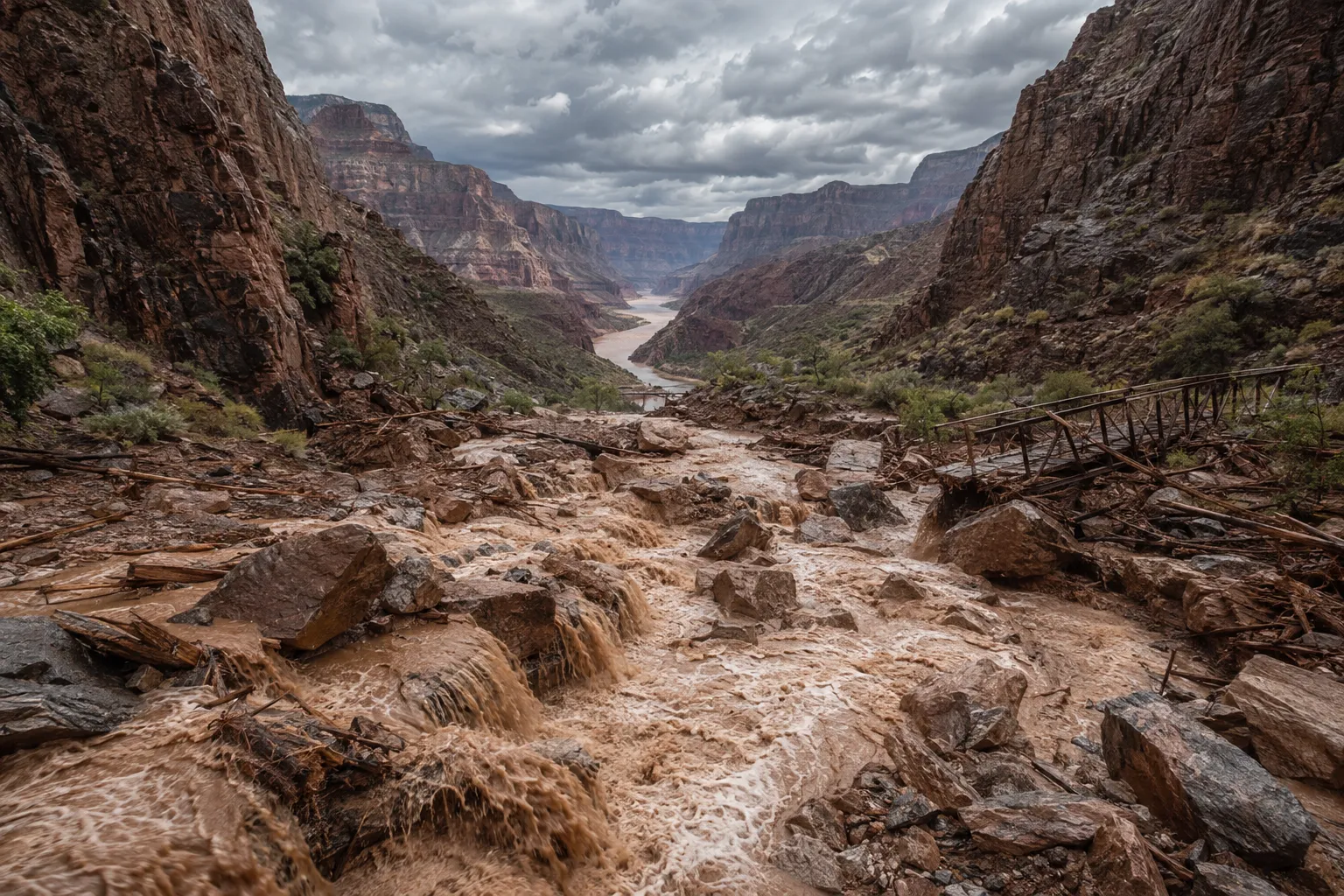
A powerful flash flood swept through Bright Angel Canyon and the Phantom Ranch area of Grand Canyon National Park in Arizona on August 29, 2026, turning normally manageable waterways into dangerous torrents within minutes.
The National Park Service said the flooding began at approximately 2:30 p.m. after intense thunderstorms brought heavy rain to the canyon area. The resulting flood destroyed or damaged numerous footbridges, carried large boulders and debris into the Colorado River, and forced the evacuation of dozens of people.
By the morning of August 30, the National Park Service said 62 people had been evacuated from Phantom Ranch and the lower North Kaibab Trail. The agency also requested public assistance to help account for people who may have been hiking, camping or staying in the affected inner-canyon corridor.
The event shows why flash floods in the Grand Canyon can become life-threatening even when rainfall at a person’s exact location does not initially appear extreme.
What Happened in the Grand Canyon Flash Floods 2026?
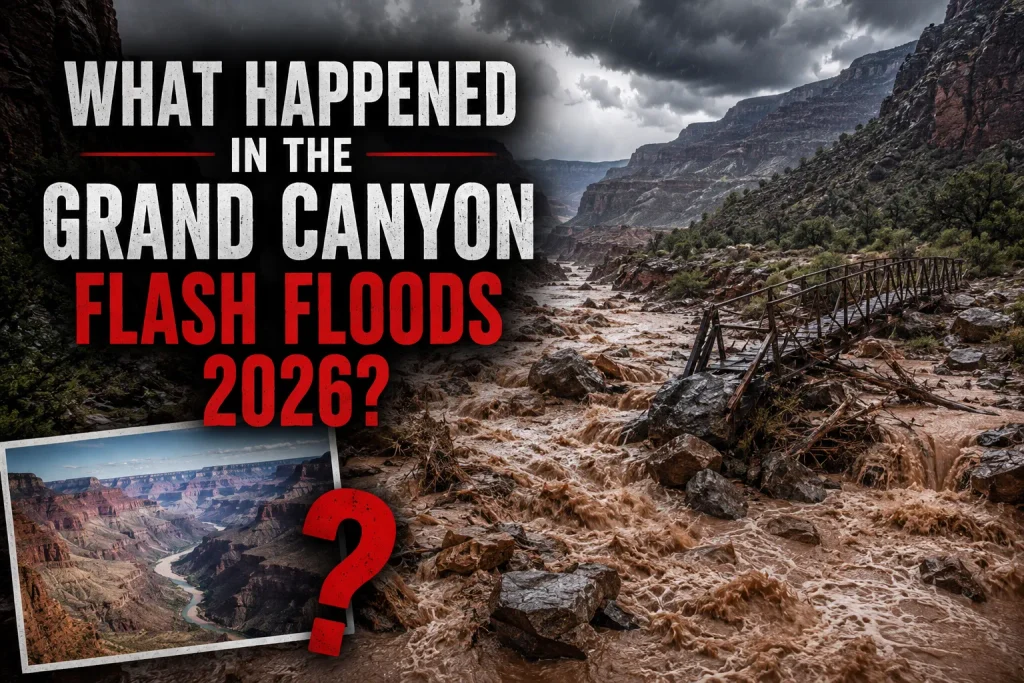
The major flooding occurred in Bright Angel Canyon, particularly around Phantom Ranch and Bright Angel Creek.
According to the National Park Service, the event began at about 2:30 p.m. on August 29. Heavy rainfall from thunderstorms rapidly sent water through the steep canyon system.
The flood was powerful enough to destroy nearly all of the footbridges spanning Bright Angel Creek in the affected area. Infrastructure throughout Bright Angel Canyon was damaged, while debris and metal structures were swept into the Colorado River.
The North Kaibab Trail from the North Kaibab Trailhead to Phantom Ranch was subsequently closed, along with Phantom Ranch, Bright Angel Campground, the Phantom Ranch Canteen and cabins. The Black Bridge and Silver Bridge were also affected by the emergency closure at the time of the NPS update.
How Many People Were Evacuated?
At least 62 people had been evacuated by the morning of August 30, according to the National Park Service.
Some evacuees were transported from the inner canyon by helicopter, while additional evacuations were being coordinated from areas including Cottonwood Campground and Phantom Ranch.
The number of people potentially missing or unaccounted for changed as authorities worked to establish who had been in the affected area.
An earlier NPS update referred to more than 20 individuals who could be missing or unaccounted for. A subsequent NPS request asked the public for information about approximately 15 individuals who may have been in the Bright Angel Creek corridor, North Kaibab Trail, Bright Angel Campground or the area known as “the Box.”
That changing figure is important: the missing-person count was still being verified during the active emergency response, rather than representing a final confirmed casualty figure.
Why Was the Grand Canyon Flash Flood So Dangerous?
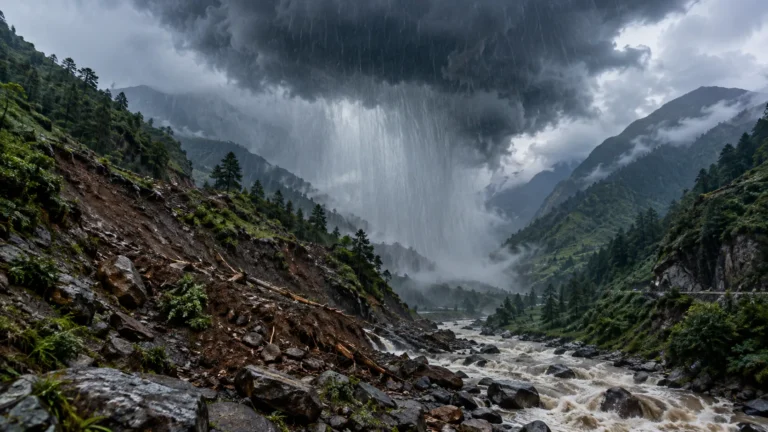
The biggest danger was not simply the amount of rain. It was the combination of intense rainfall, steep terrain, narrow drainage channels and extremely rapid runoff.
1. Heavy rain fell in a very short time
National Weather Service meteorologist Justin Johndrow told KNAU that roughly 0.5 to 1 inch of rain fell in about 30 minutes during the storm that triggered the major flooding.
In a canyon environment, that can be enough to produce an extraordinary surge of water because there is little time for rainfall to gradually drain away.
The National Weather Service had also warned that flash flooding was possible across northern Arizona, including normally dry washes, creeks and areas affected by recent wildfires.
2. The Grand Canyon is extremely steep
The Grand Canyon’s terrain makes rapid runoff particularly dangerous.
Water falling on higher ground can quickly travel downhill through narrow channels toward the Colorado River. A hiker several miles away from the storm can therefore face a sudden surge generated by rainfall upstream.
That is why the National Park Service specifically warns visitors to know the weather upstream, rather than relying only on conditions directly above them.
3. Floodwater can carry enormous debris
A flash flood in a steep canyon does not behave like water flowing across a flat urban street.
It can pick up:
- Large rocks and boulders
- Mud and sediment
- Trees and vegetation
- Damaged structures
- Metal infrastructure
- Other debris
The August 29 flood pushed large boulders, metal structures and other debris into the Colorado River.
This dramatically increases the destructive force of the water.
4. Recent wildfire damage may have amplified runoff
Another important part of the story is the 2025 Dragon Bravo Fire.
KNAU reported that portions of the rainfall fell across the Dragon Bravo Fire burn scar. Burned landscapes can have reduced vegetation and altered soil conditions, allowing rainfall to run off rapidly rather than being absorbed as effectively.
That does not mean the wildfire alone caused the flood. Rather, the burn scar was one factor that may have increased runoff and contributed to the severity of flooding and debris flows.
https://www.nps.gov/grca/learn/news/significant-flash-flooding-closes-phantom-ranch-and-north-kaibab-trail.htm
Why Can a Flash Flood Happen When It Isn’t Raining Where You Are?
This is one of the most important lessons from the Grand Canyon event.
A flash flood can be generated by rainfall upstream or at higher elevation.
Imagine standing beside a relatively calm creek while a powerful storm is occurring several miles away on higher ground. Rain falls over the upper drainage area. That water moves downhill through channels and eventually reaches you as a sudden wall or surge of water.
This is particularly dangerous in the Grand Canyon because visitors may be deep inside narrow canyon corridors with limited escape routes.
The National Park Service warns that flash floods can occur without warning and advises people near creeks to move to higher ground immediately if they hear a roaring sound or see rapidly rising water.
What Damage Did the Flood Cause?
The flooding caused extensive damage throughout Bright Angel Canyon.
According to the National Park Service:
- Nearly all footbridges across Bright Angel Creek in the affected area were destroyed.
- Hiker access across parts of the creek was eliminated.
- Phantom Ranch was closed.
- Bright Angel Campground was closed.
- The North Kaibab Trail was closed.
- The Colorado River was temporarily closed to river traffic because of debris and metal structures.
- Park officials began assessing damage to trails, bridges, utilities and facilities.
The damage also extended to an essential part of the park’s infrastructure: the Transcanyon Waterline.
The waterline was damaged and became non-operational, leaving the park with limited water reserves. The National Park Service announced Stage 4 water restrictions on the South Rim beginning August 31 and said overnight hotel accommodations would be closed as the park worked to conserve its remaining water supply.
Is the Grand Canyon Closed After the Flood?
Parts of the Grand Canyon were closed, but the entire national park was not simply shut down.
The National Park Service’s hiking update listed several areas that remained open while Phantom Ranch and the North Kaibab Trail were closed because of the August 29 flooding.
Visitors should therefore check the latest National Park Service closure information before entering the affected areas because conditions can change rapidly after major storms.
Additional thunderstorms and heavy rainfall were also possible, creating the risk of further flash flooding, debris flows and rockfall.
Grand Canyon Flash Floods vs. Glacial Lake Outburst Floods
The Grand Canyon event is also a useful reminder that not every catastrophic flash flood has the same cause.
The August 29 Grand Canyon flood was associated with intense thunderstorm rainfall and rapid runoff through steep terrain.
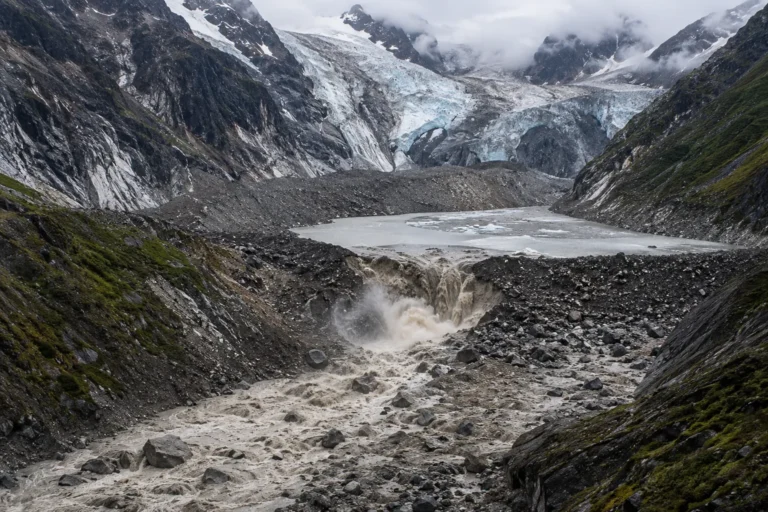
That is different from a glacial lake outburst flood, in which water stored behind or within a glacial system is suddenly released.
For readers trying to understand how these different disasters work, see HNN24x7’s explainer:
What Is a Glacial Lake Outburst Flood? Why These Sudden Floods Are So Dangerous
The distinction matters because both events can produce extremely rapid flooding, but their triggers and physical processes are different.
How Is the Grand Canyon Flood Different From the Deadly Nepal Flash Flood?
The timing of the two disasters has drawn attention because the Grand Canyon flooding occurred shortly after the devastating Nepal flash flood.
But the underlying mechanisms are different.
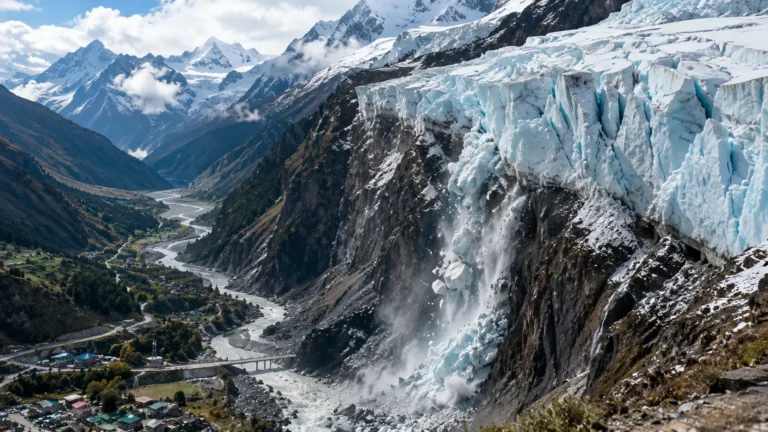
The Nepal disaster involved a high-mountain collapse involving ice and rock that triggered catastrophic downstream flooding, while the Grand Canyon event was driven primarily by intense rainfall and rapid runoff through the canyon drainage system.
For a deeper explanation of the Nepal disaster and its geological mechanism, readers can explore:
What Caused the Deadly Nepal Flash Flood? Glacier Collapse, Landslide and the Science Explained
The comparison is useful because it shows that the term “flash flood” describes the speed and nature of flooding, not necessarily one single cause.
Why Are Flash Floods So Dangerous in the Grand Canyon?
The danger comes from several factors working together:
Rapid rainfall → steep runoff → narrow canyon channels → rising water → debris flow → limited escape routes.
A person hiking deep inside the canyon may have very little time to react once water begins moving through a drainage channel.
The National Park Service specifically warns visitors that flash floods can occur without warning and recommends moving to higher ground when flood conditions develop.
The Grand Canyon’s spectacular terrain is therefore also part of its natural hazard profile.
What Happens Next?
The immediate priorities are accounting for people, completing evacuations, assessing infrastructure damage and monitoring additional storms.
The National Park Service has asked anyone with information about hikers, backpackers or campers who were in the affected Bright Angel Creek corridor on August 29 to contact its Investigative Services Branch.
Meanwhile, officials are assessing the damage to trails, bridges, utilities and other facilities.
Because more thunderstorms and heavy rainfall were possible, the situation could continue to change even after the initial floodwaters recede.
The Bigger Lesson From the Grand Canyon Flash Floods 2026
The Grand Canyon flash floods of 2026 demonstrate why flash flooding is fundamentally different from ordinary river flooding.
The water does not need days to rise.
A powerful storm can deliver intense rainfall over a relatively small area, and the combination of steep terrain and narrow drainage channels can transform that rainfall into a destructive surge remarkably quickly.
For hikers and visitors, the most important lesson is that clear skies overhead do not necessarily mean the area is safe. Conditions upstream can determine what happens downstream.
And in a canyon as steep and complex as the Grand Canyon, knowing the weather upstream, understanding escape routes and reacting immediately to warnings can be critical.
FAQ
What happened in the Grand Canyon flash floods 2026?
A major flash flood struck Bright Angel Canyon and the Phantom Ranch area of Grand Canyon National Park on August 29, 2026. Heavy thunderstorms produced rapid runoff that damaged bridges, trails and other infrastructure and forced the evacuation of dozens of people.
How many people were evacuated from the Grand Canyon?
The National Park Service said 62 people had been evacuated from Phantom Ranch and the lower North Kaibab Trail by the morning of August 30. Additional evacuations were planned.
How many people are missing after the Grand Canyon flash flood?
The number changed during the developing response. An NPS update initially sought information about more than 20 potentially missing or unaccounted-for people, while a later NPS notice referred to approximately 15 individuals. The figures were still being verified.
What caused the Grand Canyon flash flood?
The major flood was triggered by intense thunderstorm rainfall on August 29. Meteorologists reported roughly 0.5 to 1 inch of rain falling in about 30 minutes in the affected area, producing rapid runoff through the steep canyon terrain.
Why is flash flooding especially dangerous in the Grand Canyon?
The Grand Canyon has steep slopes, narrow drainage channels and limited escape routes. Water from storms upstream can rapidly move into areas where visitors may not be experiencing heavy rain themselves.
Was the Colorado River closed after the flood?
Yes. The National Park Service temporarily closed the Colorado River to river traffic because metal structures and debris had entered the river.
Is Phantom Ranch open after the flooding?
No. Phantom Ranch, Bright Angel Campground, the Phantom Ranch Canteen and cabins were closed following the August 29 flash flood.
Did the Grand Canyon flash flood damage the park’s water system?
Yes. The flooding damaged the Transcanyon Waterline, leaving it non-operational and prompting the National Park Service to introduce severe water-conservation measures on the South Rim.