



Yes, higher oil prices can push inflation higher—but the size and duration of the effect depend on how long crude remains expensive and whether the increase spreads beyond energy.
The latest oil prices inflation 2026 story has become more important after Brent crude moved back above $90 following renewed US-Iran military escalation around the Strait of Hormuz. Reuters reported Brent at about $90.31 a barrel after the latest US strike on Iran’s Larak Island, with WTI also rising.
The key economic question is no longer simply “Why is oil expensive?”
It is:
“How much of this oil shock will eventually show up in the prices households and businesses pay?”
That distinction matters.
A temporary jump in crude can produce a short-lived increase in headline inflation. A prolonged oil shock can become much more disruptive if higher energy costs spread into transportation, manufacturing, food, services and wages.
How Do Higher Oil Prices Cause Inflation?
The simplest transmission mechanism is:
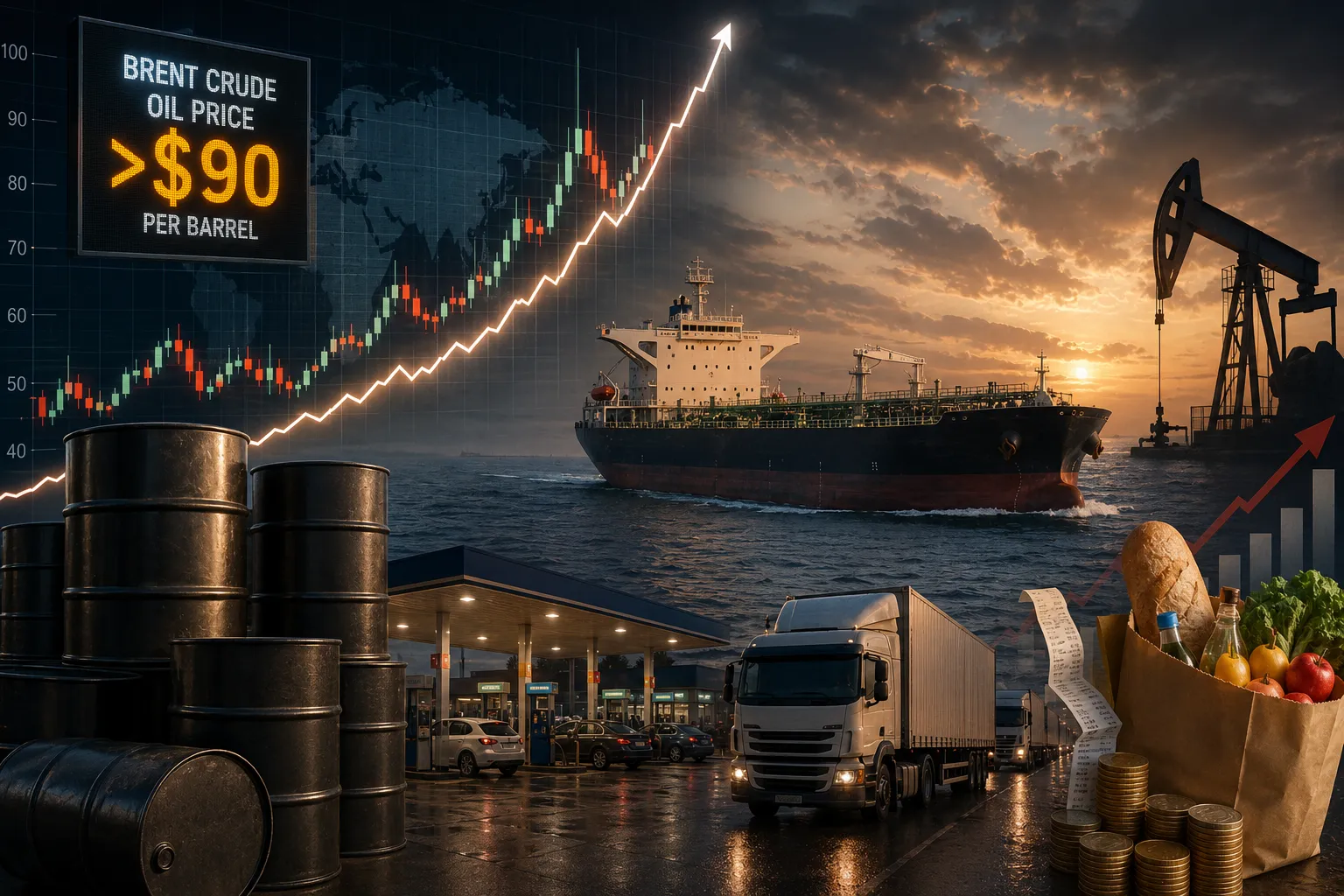
Higher crude prices → higher fuel and energy costs → higher business costs → higher consumer prices → higher inflation.
Oil is not only used to make petrol and diesel.
It is connected to a huge part of the economy through:
- Transportation
- Aviation
- Shipping
- Manufacturing
- Chemicals
- Plastics
- Agriculture
- Logistics
- Construction
- Electricity generation in some countries
When crude becomes significantly more expensive, businesses often face higher operating costs.
Some absorb those costs.
Others pass part of them to customers.
If enough companies raise prices, the effect begins to appear in broader inflation measures.
Why Is the 2026 Oil Shock Different?
The current oil shock is closely connected to the US-Iran conflict and the Strait of Hormuz.
The latest US strike on Larak Island and Iran’s retaliation have renewed concerns about the security of oil shipments through the Strait. Reuters reported that the escalation pushed Brent above $90 and that shipping through the waterway has already been severely reduced.
That creates a supply-risk premium.
Markets are not necessarily saying that the world has suddenly run out of oil.
Instead, traders are asking:
What happens if a major share of oil cannot move normally through the Strait for an extended period?
That possibility is enough to affect crude prices.
Will Brent Above $90 Automatically Cause Inflation?
No.
This is one of the most important distinctions to make.
An increase in Brent crude does not translate one-for-one into consumer inflation.
The final impact depends on several factors:
- How much oil prices rise
- How long they stay elevated
- How much of the increase businesses absorb
- How quickly fuel prices change
- Government taxes and subsidies
- Currency movements
- Global economic growth
- Inflation expectations
- Wage negotiations
- Whether the shock spreads into non-energy prices
A brief spike can therefore have a relatively limited inflation effect.
A prolonged oil shock is much more dangerous.
How Does Oil Affect Petrol and Diesel Prices?
The most direct channel is fuel.
When crude becomes more expensive, refiners generally face higher input costs.
Depending on the country and pricing system, this can eventually feed into petrol, diesel, jet fuel and other refined products.
But consumers do not pay the crude price directly.
Retail fuel prices also include:
- Refining costs
- Transportation
- Taxes
- Distribution margins
- Currency exchange rates
- Government pricing policies
Therefore, a 10% increase in Brent does not necessarily mean petrol prices rise exactly 10%.
Still, if crude remains elevated, fuel prices generally face upward pressure.
Why Does Expensive Fuel Affect Food Prices?
The oil-to-food connection is less obvious but important.
Food has to be:
Produced → processed → packaged → transported → stored → distributed.
Every stage can consume energy.
Farm machinery uses fuel.
Trucks use diesel.
Ships consume fuel.
Food-processing facilities require electricity and energy.
Packaging can also involve petroleum-derived materials.
So a prolonged oil shock can raise food costs indirectly even when crude oil is not a major ingredient in the food itself.
This is one reason energy shocks can eventually spread beyond the energy category.
What Are “Second-Round” Inflation Effects?
Second-round effects occur when an initial price shock begins influencing broader economic behavior.
For example:
Oil rises → transport costs rise → companies raise prices → workers demand higher wages → businesses raise prices again.
The first increase is directly connected to energy.
The later increases are broader.
This is why central banks pay particular attention to whether an energy shock is remaining isolated or becoming embedded in inflation expectations and wage-setting.
The ECB has explicitly warned that prolonged high energy prices can create indirect and second-round effects through price-setting, wages and inflation expectations.
Could Oil Prices Push Core Inflation Higher?
Yes, but usually less directly than headline inflation.
Headline inflation includes volatile categories such as energy and food.
Core inflation generally removes energy and food to provide a measure of underlying price pressure.
When crude rises sharply, headline inflation can react relatively quickly.
Core inflation may initially remain more stable.
But if high energy costs increase transportation, production and service costs, the shock can eventually spread into core categories.
The ECB’s July 2026 assessment is a useful example: it said the energy shock was continuing to feed into higher prices, with firms reporting higher input costs and increased expectations for their selling prices, although underlying inflation had remained relatively contained at that point.
That is the economic distinction to watch:
Energy inflation first. Broader inflation later—if the shock persists.
How Long Does an Oil Shock Affect Inflation?
There is no single fixed timeline.
The initial effect can appear relatively quickly through fuel and energy prices.
Broader effects generally take longer.
A simplified timeline looks like this:
| Stage | Potential impact |
|---|---|
| Days to weeks | Oil futures, fuel and energy markets react |
| Weeks to months | Transport and business input costs change |
| Months | Consumer prices may reflect higher operating costs |
| Longer term | Wage expectations and broader inflation may respond |
The longer oil remains elevated, the greater the risk that temporary inflation becomes more persistent.
Could the Strait of Hormuz Make the Inflation Shock Worse?
Yes.
This is the most important geopolitical risk in the current oil-price story.
The Strait of Hormuz is a critical route for global energy shipments.
If shipping is disrupted for a prolonged period, global oil supply could become tighter.
That could create a much larger oil-price shock than a temporary geopolitical spike.
The current conflict has already sharply reduced normal tanker traffic through the waterway, according to Reuters.
The economic chain could then become:
Hormuz disruption → fewer oil shipments → higher crude → higher fuel costs → higher transportation costs → higher inflation.
That is the scenario markets are watching most closely.
https://www.reuters.com/business/energy/oil-jumps-more-than-2-after-us-attack-irans-larak-island-2026-08-30/
Could Higher Oil Prices Force Central Banks to Raise Interest Rates?
They could, but central banks face a difficult trade-off.
Higher oil prices can increase inflation.
The traditional monetary-policy response to persistent inflation is tighter monetary policy.
But higher interest rates do not produce more oil.
They cannot reopen a blocked shipping route or increase crude production overnight.
That creates a dilemma.
A central bank could face:
Higher inflation + weaker economic growth
This combination is often described as stagflation risk.
The European Central Bank has already highlighted this problem, warning that prolonged energy disruption could push energy prices higher while also hurting household incomes, investment and economic activity.
Could the 2026 Oil Shock Cause Stagflation?
It could increase the risk, but it does not automatically mean stagflation will occur.
Stagflation generally refers to an uncomfortable combination of:
- High inflation
- Weak economic growth
- Often elevated unemployment
An oil shock can contribute to this combination because expensive energy raises business costs while simultaneously reducing household purchasing power.
For example:
Oil rises → petrol becomes expensive → households have less money for other purchases → demand weakens.
At the same time:
Oil rises → business costs increase → prices rise → inflation remains elevated.
That combination is what policymakers want to avoid.
What Does Higher Oil Mean for the US Economy?
For the United States, the impact is mixed.
Higher oil prices hurt consumers through fuel and energy costs.
They can also increase transportation and production expenses.
But the US is also a major oil producer.
Higher crude prices can therefore benefit some domestic energy companies and producers.
The broader economic impact depends on which effect dominates.
If energy prices remain high for an extended period, however, the inflationary pressure can become more important for monetary policy.
Current US market expectations are already sensitive to the inflation implications of the renewed oil shock. Reuters reported on August 31 that expectations for a Federal Reserve rate increase had risen sharply amid renewed inflation concerns and higher crude prices.
What Does Higher Oil Mean for Europe?
Europe is particularly exposed to imported energy costs.
The ECB has already documented how the energy shock has been feeding into input costs and price expectations.
Its July assessment said the effects of the energy shock were likely to keep inflation above target into the first half of 2027, although the bank expected inflation to decline afterward if energy prices eased.
This illustrates an important point:
The duration of the oil shock may matter more than the one-day price spike.
If Brent briefly rises above $90 and then falls, the inflation effect can be manageable.
If energy remains expensive for many months, the consequences become much larger.
What Does Higher Oil Mean for India?
India is especially sensitive to global crude prices because the country imports a large share of its crude oil requirements.
Higher international oil prices can affect:
- India’s import bill
- Trade balance
- Rupee pressure
- Petrol and diesel economics
- Transportation costs
- Inflation
- Household purchasing power
The currency is also important.
If crude rises while the rupee weakens against the US dollar, India’s effective import cost can increase even more.
That means Indian consumers and businesses can face a double pressure:
Higher global oil price + weaker rupee = more expensive imports.
For the latest immediate explanation of the crude-price move, readers can follow HNN24x7’s related article:
Why Oil Prices Are Rising Today: What the Latest Brent Move Means
This is a strong internal link because that article explains the oil-price catalyst, while this page explains the inflation consequences.
What Happens If Oil Prices Stay Above $90?
A sustained Brent price above $90 would not automatically create runaway inflation.
But it would increase pressure on the global economy.
The outcome would depend on how long prices stay elevated.
If Brent stays high for a few weeks
The effect could remain concentrated in energy and fuel prices.
If Brent stays high for several months
Transport, manufacturing and food costs could increasingly reflect the shock.
If Brent stays high because Hormuz remains disrupted
The economic consequences could become considerably larger because the issue would be an actual supply-chain disruption rather than merely a financial-market risk premium.
If prices eventually fall
Some of the inflation pressure could fade, although businesses and consumers may not immediately see every cost decline.
What Could Bring Oil Prices Back Down?
Several developments could reduce the inflation threat.
1. US-Iran de-escalation
A ceasefire or meaningful diplomatic agreement could remove some of the geopolitical risk premium.
2. Normal shipping through Hormuz
If tanker traffic returns to normal, concerns about physical supply disruption could ease.
3. Increased oil production
Additional supply from major producers could help offset losses.
4. Weaker global demand
A slowing global economy could reduce oil consumption.
5. Higher inventories
Large commercial or strategic inventories can provide a buffer against temporary supply disruptions.
This is why oil-price forecasting remains highly uncertain during geopolitical crises.
What Should Investors Watch Next?
Anyone tracking oil prices inflation 2026 should watch five indicators closely.
Brent crude
A sustained move higher would indicate that the market continues to price significant supply risk.
Strait of Hormuz traffic
This may be more important than the headline oil price itself.
Fuel prices
These provide the first direct channel into household inflation.
Inflation expectations
If households and businesses begin expecting persistent inflation, the shock can become harder to contain.
Central-bank policy
If policymakers become more concerned about second-round inflation effects, interest-rate expectations can change rapidly.
Oil Prices Inflation 2026: The Bigger Picture
The current oil shock is a reminder that inflation is not driven only by domestic demand.
A geopolitical event thousands of kilometres away can affect prices through global commodity markets.
The chain can be surprisingly long:
US-Iran conflict → Strait of Hormuz risk → crude oil → fuel → transport → production → food and services → consumer inflation.
But that chain is not automatic.
The biggest variable is persistence.
A temporary oil spike can produce temporary inflation.
A prolonged oil shock can become a broader economic problem.
That is why central banks are watching the latest developments so closely.
FAQ
Will higher oil prices increase inflation in 2026?
They can. Higher oil prices directly increase energy costs and can indirectly raise transportation, production and consumer prices. The effect becomes more significant if crude prices remain elevated for an extended period.
How do oil prices affect inflation?
Oil affects inflation through fuel, transportation, manufacturing, logistics and other energy-intensive activities. Higher business costs can eventually be passed on to consumers.
Can Brent crude above $90 cause inflation?
Brent above $90 does not automatically cause a major inflation increase. The impact depends on how long prices remain at that level and how widely higher energy costs spread through the economy.
What is an oil shock?
An oil shock is a rapid and significant change in oil prices, usually caused by a supply disruption, geopolitical event, production change or major shift in demand.
Can an oil shock cause stagflation?
Yes, a prolonged oil shock can increase stagflation risk by raising inflation while simultaneously reducing household purchasing power and economic growth.
Will higher oil prices increase interest rates?
They can increase pressure on central banks to maintain or raise interest rates if the oil shock causes persistent inflation. However, central banks also have to consider the negative effect of high energy prices on economic growth.
How does the Strait of Hormuz affect inflation?
A major disruption to the Strait could reduce the flow of oil to global markets, potentially pushing crude prices higher and creating broader inflationary pressure.
How will higher oil prices affect India?
Higher crude prices can increase India’s import costs and put pressure on fuel prices, transportation costs, the rupee and inflation, particularly if the oil shock persists.
How long does an oil-price shock affect inflation?
The initial energy effect can appear relatively quickly, while broader effects on transportation, production and consumer prices can take months. The longer oil remains expensive, the greater the risk of persistent inflation.
Bottom Line: Could Higher Oil Prices Push Inflation Higher?
Yes. Higher oil prices can push inflation higher, particularly if Brent remains elevated for an extended period or if the Strait of Hormuz suffers a sustained disruption.
The first impact is likely to appear through fuel and energy prices.
The bigger risk is that higher energy costs spread into transportation, manufacturing, food, services, wages and inflation expectations.
The ECB’s recent assessments already show how an energy shock can feed into firms’ input costs and selling-price expectations.
For 2026, therefore, the crucial question is not simply whether oil reaches $90, $95 or another round-number threshold.
It is:
How long does the oil shock last, and does it remain an energy shock—or become a broader inflation shock?
That distinction could determine whether the latest rise in crude is a temporary price spike or a much bigger challenge for consumers, businesses and central banks.