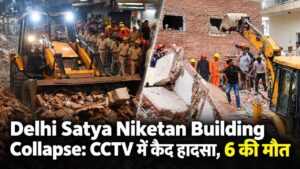



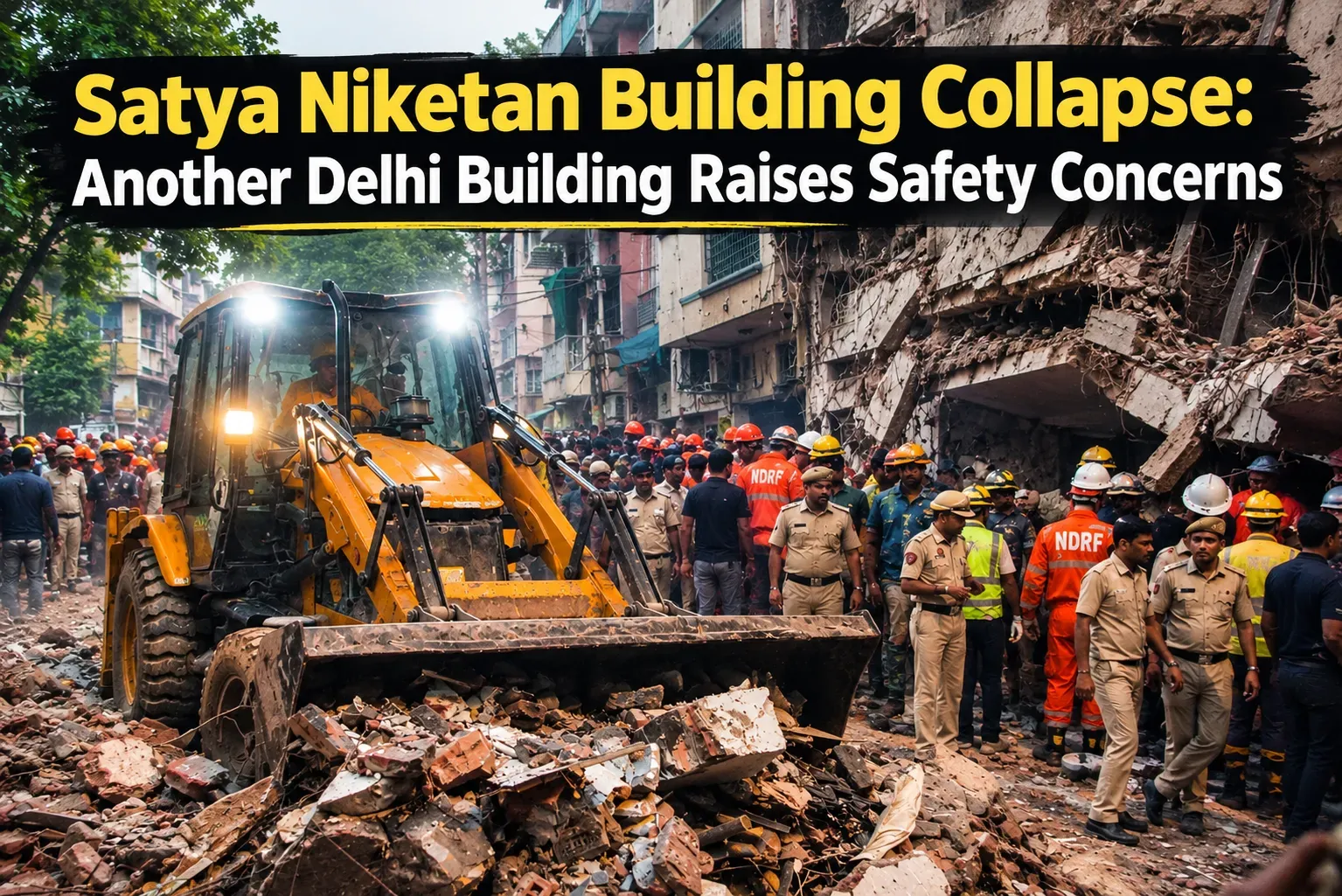
Satya Niketan Building Collapse: The scene in Delhi’s Satya Niketan has been difficult to look away from. A five-storey building being used as a boys’ paying guest accommodation collapsed on Sunday afternoon, trapping students and turning a crowded neighbourhood near Delhi University’s South Campus into a rescue zone.
As I followed the developments, one thing became increasingly clear: this is no longer just a story about a Delhi building collapse. The condition of another building next to the collapsed structure has now added another layer of concern for authorities.
The latest reports say six people have died and 11 have been rescued after the collapse. Rescue teams from the National Disaster Response Force (NDRF), Delhi Fire Service, Delhi Police and other agencies worked through the night to search the debris.
What happened in the Satya Niketan building collapse?
The incident took place at around 1:30 pm on September 6, 2026, in the Satya Niketan area of southwest Delhi. The building, reportedly known as “Hostel Daze,” was being used as a boys’ PG and had several students staying inside.
The structure had a basement and five upper floors and was reportedly decades old. According to reports, repair or renovation work was underway when the building suddenly collapsed. Police have registered a case against the alleged owner, while the exact cause of the structural failure is still being investigated.
Eyewitnesses described the collapse as sudden and terrifying. Some residents said the impact felt almost like an earthquake. Locals and students immediately joined the emergency response, removing debris with their hands and whatever tools were available while professional rescue teams reached the congested lane.
For me, the most disturbing part of the Satya Niketan PG collapse is that many of the people inside were young students living away from their families.
Rescue teams continue searching through the rubble
After the Delhi building collapsed, multiple agencies were brought in to locate people who might still be trapped.
NDRF teams, Delhi Fire Services, Delhi Police and other emergency personnel used heavy equipment and specialised search methods. Rescue teams also used sniffer dogs while carefully removing the debris because survivors could potentially still be underneath.
At different stages of the operation, the number of people believed to be trapped changed because authorities were still trying to establish exactly how many students were inside the PG at the time.
That uncertainty made the rescue operation even more difficult.
The narrow and congested lanes of Satya Niketan Delhi also created challenges for emergency vehicles and rescue machinery. Residents told reporters that reaching the location quickly was difficult because of the tightly packed surroundings.
Why is another building worrying officials?
This is where the story becomes even more serious.
Following the Delhi Satya Niketan building collapse, authorities inspected nearby structures. An adjoining building was evacuated and sealed after officials found it to be in a dangerous and dilapidated condition. Its occupants were moved to safety.
The concern did not end there. The MCD later ordered the demolition of Property No. 13 in Satya Niketan, describing the structure as being in a “ruinous/dangerous condition” and saying it posed a risk to occupants and people in the surrounding area. The order gave the owner or occupier three days to demolish the property, failing which the MCD could undertake the demolition and recover the cost.
That development tells me why officials are taking the situation so seriously. Once one building fails, the immediate question is whether nearby structures could have similar weaknesses.
Was illegal construction involved?
This is one of the major questions surrounding the Satya Niketan building collapse.
Initial reports have raised concerns about the building’s construction and the number of floors it had. The MCD has reportedly flagged the collapsed structure as a G+4 building in a resettlement-colony area where the permitted construction pattern is much more limited. However, officials have cautioned that the exact role of unauthorised construction or renovation will have to be established through investigation.
There are also reports that repair or construction work was being carried out in the basement or lower portion of the building before the collapse. Whether that work weakened the structure is still a matter for investigators to establish.
I would be careful about declaring one factor as the confirmed cause until the official inquiry is complete.
Source to be used: The New Indian Express
Delhi PG collapse raises bigger questions about student housing
The Satya Niketan building collapse has exposed a larger problem that goes beyond one property.
Satya Niketan has developed into a major student-housing hub because of its proximity to Delhi University’s South Campus. Over the years, residential properties have increasingly been converted into PG accommodations and private hostels to meet demand from students.
That creates a difficult situation.
Students need affordable accommodation close to their colleges. Property owners see strong demand for PG rooms. But when residential buildings are modified, extra floors are added or structural changes are made without proper oversight, the safety risk can increase.
The question I think Delhi now needs to answer is simple: How many other PG buildings are being used without adequate structural and safety checks?
MCD orders action against illegal buildings
The response has already moved beyond the individual collapse.
Following the tragedy, the Municipal Corporation of Delhi ordered the immediate sealing of illegal constructions involving more than four floors and warned that action would be taken against officials found responsible for allowing unauthorised structures.
This could become one of the most important consequences of the Delhi building collapse.
However, sealing buildings after a tragedy is not enough. Authorities need a system that identifies dangerous structures before people are injured or killed.
Regular structural inspections, verification of building plans, checks on unauthorised additional floors and safety audits of PG accommodations should be part of that process.
What action has the Delhi government taken?
Delhi Chief Minister Rekha Gupta ordered a magisterial inquiry into the incident after visiting the site. An FIR was also ordered against the building owner, and police subsequently registered a case in connection with the collapse.
The investigation will have to establish several things:
- Whether unauthorised construction was carried out
- Whether renovation work affected the structure
- Whether building and safety rules were violated
- Whether officials failed to detect violations
- Whether the building was legally permitted to operate as a PG
- Why the structure was allowed to remain in a dangerous condition, if prior violations are established
Only after these questions are answered can responsibility be properly fixed.
What the Satya Niketan tragedy means for Delhi
For me, the biggest lesson from the Satya Niketan news is that building safety cannot be treated as paperwork.
A building may look normal from outside while carrying serious structural risks. This becomes even more important in neighbourhoods where old residential properties have been converted into hostels, PGs, shops or other commercial establishments.
The Satya Niketan PG collapse should therefore trigger a wider safety audit—not just at the affected site but across densely populated student areas of Delhi.
The city has seen repeated concerns over ageing structures, unauthorised construction and inadequate enforcement. If inspections happen only after a building collapses, the system is already reacting too late.
Conclusion
The Satya Niketan building collapse has not only been a tragic incident but has also raised serious questions about the safety of PGs, student accommodations and ageing buildings in Delhi. The evacuation and inspection of nearby structures show that the danger may not always be limited to the building that has already collapsed.
For me, the biggest lesson from this incident is that building safety checks should happen before a tragedy, not after one. Areas like Satya Niketan, which house a large number of students, need regular structural inspections, strict action against unauthorised construction and proper safety checks for PG accommodations.
The investigation must establish what caused the collapse and whether construction or renovation work played a role. At the same time, authorities should inspect other potentially unsafe buildings across Delhi so that another Delhi building collapse can be prevented.
Ultimately, the real success of the administration will not simply be measured by the action taken after the Satya Niketan PG collapse, but by whether such a tragedy can be prevented from happening again.
Read More..