



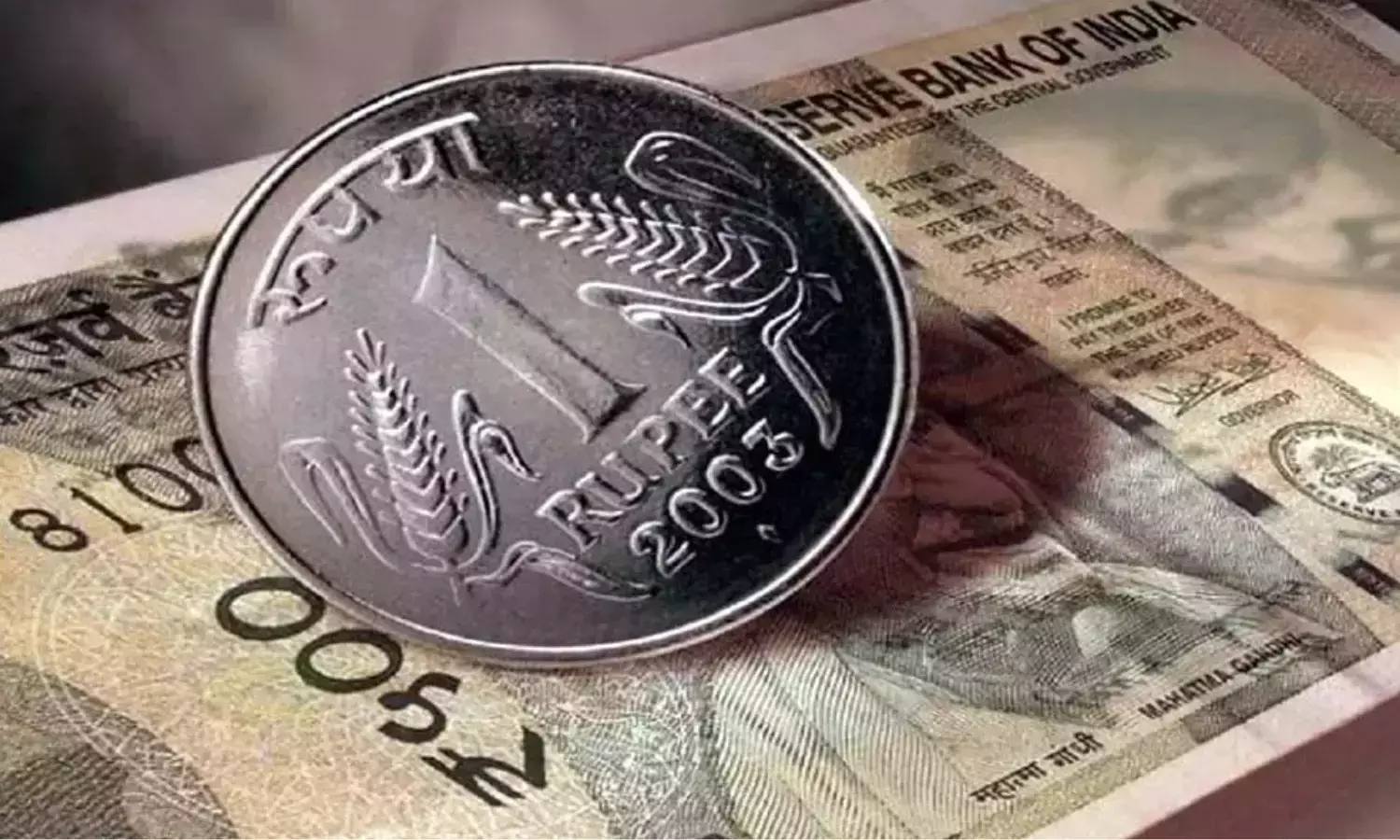
The Indian rupee has faced a weak period, falling to 17 paise to Rupees 95.59 paise against the US dollar in early trading on Monday, August 17, 2026. This situation reflects heavy pressure on the domestic currency from changing foreign-exchange flows, elevated crude oil prices, and provides thee cautions to investors. The rupee had closed at Rs. 95.42 against the dollar on Friday after gaining three paise. The rupee had closed at Rs. 95.50 before drastically falling to the range of ₹95.59.
The latest move at this time caught attention as global financial markets are closely observing developments related to geopolitics that include oil prices, US monetary policy, and capital flows into emerging markets. The Reserve Bank of India (RBI) recently decided on the Foreign Currency Non-Resident (Bank), or FCNR (B), deposit swap facility, which has also become an important aspect in influencing market sentiment.
Why Do Imports Become More Expensive When the Rupee Weakens?
RBI changes FCNR(B) swap deadline
One of the immediate factors behind Monday’s weakness is the Reserve Bank of India’s decision to bring forward the deadline for its concessional foreign-exchange swap facility for FCNR (B) deposits.
The RBI announced on Aug 14 that the provided facility would be available only for deposits mobilised until August 31, instead of the earlier September 30 deadline. The facility was to encourage foreign-exchange inflows into India by allowing banks to access relatively favourable foreign-exchange swaps.
With this response, the program has been successful. According to the RBI, the facility had attracted $56.84 billion by 13th of August 2026. The strong inflow explains why the central bank has decided to shorten the window, but the change has nevertheless generated uncertainty among currency traders and investors.
Reuters reported that traders expected the rupee to open around on the apporx ₹95.60–₹95.64 per dollar and viewed the shortened FCNR(B) window as having the potential to drive sentiment.
Oil prices remain a major vulnerability.
Another major pressure point for India is crude oil. Brent crude futures were trading close to $89 per barrel on Monday; these prices have an adverse effect during the tension in geopolitics.
India imports a large portion of its crude oil requirements. Consequently, a sustained increase in global oil prices raises the country’s burden on import bills and increases the demand for dollars. When Indian oil companies and other importers need dollars for payments to overseas suppliers, the rupee can come under pressure to depreciate.
The International Monetary Fund had made the specifically highlighted the exposure of the India’s to oil prices. In July, the IMF mentioned the higher prices of oil resulting from Middle East tensions and a weaker monsoon as a major risk to India’s FY2026-27 growth outlook. The IMF estimated that India imports nearly 80% of its oil and therefore remains in the particular manner to energy-price shocks.
International Factors and Global Economic Environment
IMF Warns of global uncertainty
The flow of the rupee is not understood in an easy manner by analyzing only domestic factors. India’s currency is also influenced by the broader global financial environment.
The International Monetary Fund has warned that the global economy is facing significant uncertainty because of the game of geopolitics, trade restrictions, energy-price volatility, and changing financial conditions. In its July 2026 World Economic Outlook update, the IMF projected global growth at around 3% for 2026 and 3.4% for 2027, while global headline inflation was revised upward to 4.7 for 2026.
Higher global inflation can complicate the monetary policy decisions of major central banks. If interest rates in the advanced economies remain relatively high, international investors may prefer dollar-dominated assets, potentially putting pressure on emerging-market currencies such as the rupee.
The US dollar therefore provides a crucial variable for the Indian economy. Movements in US inflation, employment, retail sales, Treasury yields, and expectations surrounding Federal Reserve policy can quickly influence global capital flows.
Geopolitical tensions add another layer of risk.
The ongoing Middle East conflict has become particularly important for India because of its effect on crude oil and shipping costs.
Reuters reported that traders believed the RBI had been intervening in the foreign-exchange market to prevent excessive rupee volatility. State-run banks were reportedly selling dollars during periods of pressure, an action widely viewed by market participants as being undertaken on behalf of the central bank.
This illustrates the RBI’s balancing act: it does not necessarily need to defend a particular exchange-rate number, but it can use its substantial foreign-exchange reserves to reduce disorderly movements in the currency.
What the Rupee Weakness Means for the Indian Economy
Imports become more expensive
A weaker rupee makes imports costlier because Indian companies need more rupees to purchase the same amount of foreign currency.
The impact is especially important for crude oil, electronics, machinery, chemicals, gold and other imported commodities. If the rupee remains weak for a prolonged period, businesses may pass higher input costs on to consumers.
The latest trade data already demonstrate the pressure from higher import costs. India’s merchandise trade deficit increased to $31.98 billion in July 2026, its highest level in six months. Imports rose to $76.22 billion, compared with $70.84 billion in June. Reuters reported that higher crude prices and global freight costs contributed to the increase.
Inflation and interest rates
Currency depreciation can contribute to inflation, although the effect depends on the scale and duration of the fall and on global commodity prices.
A weaker rupee can increase the domestic price of imported fuel, raw materials and capital goods. Higher energy costs can then spread through transportation, manufacturing and logistics.
However, India currently has significant policy buffers. The RBI can use monetary policy and foreign-exchange operations to manage financial conditions, while the government can respond through fiscal and supply-side measures if required.
The IMF’s current assessment still places India among the world’s faster-growing major economies. Its latest country information projects real GDP growth of about 6.4% for 2026 and consumer-price inflation of around 4.7%.
Exporters receive some benefit
Currency depreciation is not entirely negative.
Indian exporters can become more competitive because their products and services become relatively cheaper in foreign-currency terms. IT services, pharmaceuticals, engineering products, textiles, chemicals and other export-oriented industries may benefit from a weaker rupee.
India’s July merchandise exports reached a record $44.24 billion, supported by petroleum products, electronics and engineering goods. Services also remained a major strength, with a services surplus of $16.95 billion.
The benefit, however, depends on how much imported content is used by exporters. Companies that rely heavily on imported components may see part of the currency advantage cancelled out by higher input costs.