



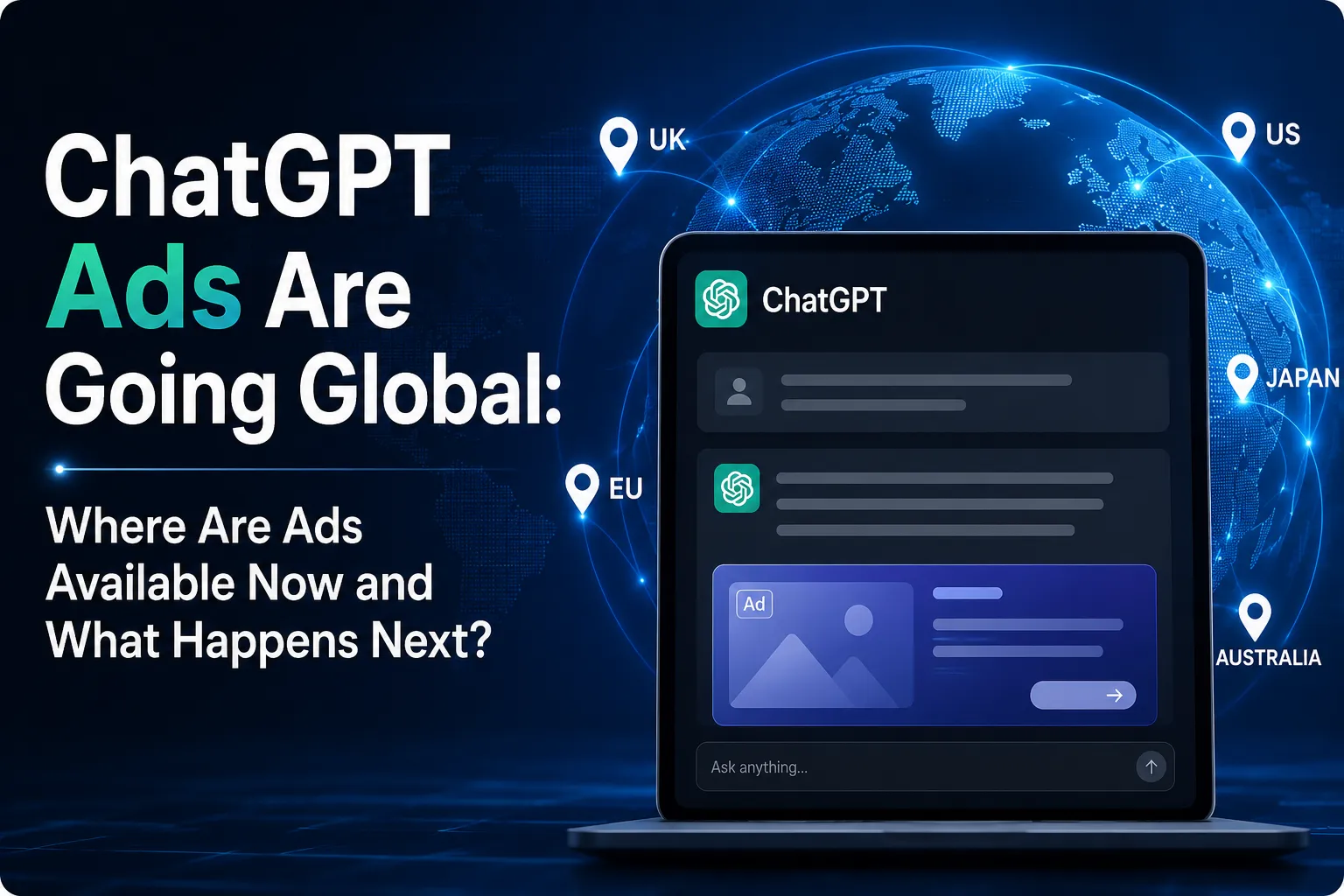
ChatGPT ads are no longer limited to the original US pilot. OpenAI has expanded its advertising program to additional markets and, in August 2026, announced its largest expansion yet: 31 European countries.
OpenAI says the European expansion began on August 24, six months after its initial US advertising test. The rollout includes major markets such as Germany, France, Spain, Italy, Sweden, Norway, Denmark, the Netherlands and Austria.
The expansion is significant because it moves ChatGPT Ads closer to becoming a global advertising platform, rather than a limited experiment.
But there is an important distinction between where ChatGPT users may see ads and where advertisers can currently buy ads through self-service Ads Manager.
That distinction is especially important for businesses watching the new AI advertising market.
https://openai.com/index/chatgpt-ads-expands-across-europe
What Are ChatGPT Ads?
ChatGPT Ads are sponsored placements that appear separately from ChatGPT’s organic answers.
OpenAI says ads can appear below the end of a ChatGPT response and are clearly labeled as sponsored. The advertising system operates separately from the system generating ChatGPT’s answers.
The basic idea is different from traditional search advertising.
Instead of a user typing a short keyword such as “best running shoes,” someone might have a longer conversation explaining:
- what they need,
- their budget,
- their preferences,
- what they have already considered,
- and what problem they are trying to solve.
OpenAI sees that conversational context as an opportunity for advertising.
The company describes ChatGPT as a place where people are already exploring, comparing and making decisions, creating potential opportunities for advertisers to reach users during those stages.
Where Are ChatGPT Ads Available Now?
As of August 31, 2026, ChatGPT’s advertising rollout spans the United States, Canada, Australia, New Zealand, the United Kingdom, Mexico, Brazil, Japan, South Korea and 31 European markets at various stages of the rollout.
OpenAI’s latest announcement says the European expansion covers 31 countries.
The initial European rollout includes:
- Germany
- France
- Spain
- Italy
- Sweden
- Norway
- Denmark
- Netherlands
- Austria
and other European markets included in the 31-country expansion.
However, advertiser self-service availability is not identical across these countries.
OpenAI’s current Ads Manager availability page lists self-service access as available in the United States, United Kingdom, Canada, Australia, New Zealand, Mexico, Brazil, Japan and South Korea. India and the newly expanded European markets are currently listed as “Coming Soon” for self-service Ads Manager access.
This means a business can potentially be in a market where ChatGPT Ads are rolling out while still waiting for direct self-service buying access.
Is ChatGPT Ads Available in India?
ChatGPT Ads are not yet listed as available for self-service advertisers in India.
OpenAI’s current Ads Manager availability table lists India as “Coming Soon.”
That does not necessarily mean India is permanently excluded.
OpenAI says advertising availability is evolving as testing expands, and businesses in unsupported markets can create an Ads Manager account and receive notification when their country becomes available.
For Indian marketers, therefore, the key phrase is:
India: Coming Soon for self-service Ads Manager access.
Which ChatGPT Users See Ads?
ChatGPT advertising is currently focused on the lower-cost consumer tiers.
OpenAI says ads may appear for users on:
- Free
- Go
Meanwhile, Plus, Pro, Business, Enterprise and Edu accounts do not have ads.
OpenAI also says accounts identified as belonging to users under 18 are not shown ads.
This creates a relatively clear business model:
Free and Go → advertising-supported access
Paid plans → ad-free experience
OpenAI has also introduced an ads-free option for eligible Free users, although switching to it comes with lower usage limits and reduced feature access.
Do ChatGPT Ads Change ChatGPT’s Answers?
OpenAI says no.
This is one of the most important issues surrounding the rollout.
OpenAI states that ads are separate from ChatGPT’s answer-generation system and that advertisers cannot shape, rank or alter ChatGPT responses.
Ads are also visually separated and labeled as sponsored.
That distinction is crucial because ChatGPT is often used for recommendations and decision-making.
For example, if a user asks:
“Which laptop should I buy for video editing?”
an advertisement may appear below the answer.
But OpenAI says the paid placement does not determine which products ChatGPT recommends in its answer.
The company describes this separation as part of its advertising principles.
Does OpenAI Sell ChatGPT Conversations to Advertisers?
OpenAI says it does not sell users’ data to advertisers and that advertisers do not receive users’ chats, chat history, memories or personal details.
Instead, advertisers receive aggregate information about ad performance, such as views or clicks.
OpenAI says its advertising system can use conversation context to determine relevant advertising, with ad personalization controls available to users.
That distinction matters.
The system may use information about the conversation to select relevant advertising, while the advertiser itself does not receive the underlying private conversation.
How Do ChatGPT Ads Work?
The advertising model is built around conversational intent.
Traditional search advertising often starts with a keyword.
ChatGPT starts with a conversation.
For example:
Traditional search:
“best hiking shoes”
ChatGPT conversation:
“I am going to Ladakh next month, I need lightweight hiking shoes for rocky terrain, my budget is ₹10,000 and I don’t want waterproof boots.”
The second interaction contains much more information about the user’s intent.
OpenAI believes this can allow advertisements to become more relevant to the actual decision a person is trying to make.
This could make conversational advertising one of the most important new developments in digital marketing.
What Advertising Tools Does OpenAI Offer?
ChatGPT Ads is evolving beyond a simple sponsored-placement system.
OpenAI says its advertising platform now supports:
- CPC bidding
- Conversion optimization
- Geo-targeting
- Custom audiences
- OpenAI Pixel
- Conversions API
- Third-party measurement integrations
These tools are intended to give advertisers more control over campaign objectives and measurement.
OpenAI has also been developing a self-service Ads Manager Beta.
The platform currently supports campaign creation, billing, access management, reporting and conversion measurement, while OpenAI continues to expand its capabilities.
When Did ChatGPT Ads Start?
The first ChatGPT advertising test began in the United States on February 9, 2026.
The initial pilot was limited to logged-in adult users on Free and Go plans. Plus, Pro, Business, Enterprise and Education users were excluded.
OpenAI then gradually expanded the pilot.
The company said Canada, Australia and New Zealand were the next markets, followed by the United Kingdom, Mexico, Brazil, Japan and South Korea. By August 11, OpenAI confirmed that those latter five markets had launched.
Then came the European expansion.
On August 18, OpenAI announced that ChatGPT Ads would expand into 31 European markets, representing its largest expansion since the advertising program began.
ChatGPT Ads Timeline
| Date | Development |
|---|---|
| February 9, 2026 | Initial US advertising test begins |
| March 2026 | OpenAI says early pilot results support expansion |
| Spring 2026 | Expansion begins beyond the US |
| May 2026 | UK, Mexico, Brazil, Japan and South Korea expansion announced |
| August 11, 2026 | OpenAI confirms launch in those five markets |
| August 24, 2026 | 31 European markets added |
| August 31, 2026 | Platform continues global expansion |
Why Is OpenAI Expanding ChatGPT Ads So Quickly?
The obvious reason is revenue.
Running AI systems at global scale requires substantial computing infrastructure.
OpenAI says advertising can help support broader access to ChatGPT while keeping Free and lower-cost access available.
But there is another reason.
ChatGPT occupies a potentially valuable position in the consumer decision-making process.
People increasingly use AI to:
- research products,
- compare services,
- plan travel,
- choose software,
- understand financial concepts,
- find solutions,
- learn about brands,
- and decide what to buy.
That means AI could become an important new advertising environment.
Instead of advertising beside a list of search results, businesses can potentially appear alongside a conversation about a user’s actual problem.
That is a fundamentally different advertising model.
How Is ChatGPT Advertising Different From Google Search Ads?
The biggest difference is conversation versus keywords.
Search advertising traditionally works around queries and search-result pages.
ChatGPT Ads operate inside a conversational interface.
That changes the information available about user intent.
Consider the difference:
Google-style query:
“best camera under $1,000”
ChatGPT conversation:
“I am a beginner photographer who mainly shoots wildlife. I travel frequently and need something lightweight. My budget is $1,000. Should I buy a mirrorless camera or DSLR?”
The second interaction contains significantly richer intent signals.
That could make AI advertising highly valuable for brands.
But it also creates a greater responsibility around privacy and the separation between advertising and AI-generated recommendations.
What Does ChatGPT Ads Mean for Digital Marketing?
The emergence of ChatGPT Ads could create a new category of AI-native advertising.
Search engines have traditionally monetized information discovery.
Social networks monetize attention and user interests.
ChatGPT could monetize decision-making conversations.
That is potentially a major shift.
A user may not simply search for a product.
They may ask an AI to help them determine:
- which product fits their needs,
- which service is better,
- what price is reasonable,
- which alternatives exist,
- and what they should consider before buying.
That means advertisers may increasingly compete not just for keywords, but for relevance inside AI-assisted decision journeys.
What Does This Mean for SEO?
ChatGPT Ads do not mean traditional SEO is disappearing.
In fact, they could make AI visibility and traditional search visibility even more important.
There will increasingly be two separate questions:
1. Can a brand appear organically in an AI-generated answer?
2. Can the brand reach the user through paid advertising?
These are different channels.
For publishers such as HNN24x7, the development also reinforces the importance of creating content that AI systems can understand clearly.
Strong entities, factual statements, original reporting, structured information and authoritative sources can all help content become more useful in AI-mediated discovery.
Paid AI advertising and organic AI visibility are therefore likely to develop alongside each other.
What Happens Next for ChatGPT Ads?
OpenAI has not announced a single date when ChatGPT Ads will become available worldwide.
Instead, the company is following a phased rollout.
OpenAI says it expects to continue expanding into new markets while developing additional advertising formats, objectives, buying models, optimization tools and measurement capabilities.
That means several developments are likely to matter.
More countries
The current European expansion could be followed by additional countries as OpenAI evaluates the program.
India is particularly important because it is already listed as Coming Soon for Ads Manager.
More advertising formats
OpenAI says the platform will evolve to support additional formats and objectives.
Better measurement
Conversion optimization, OpenAI Pixel and Conversions API indicate that OpenAI is moving beyond basic impressions and clicks toward performance advertising.
Greater advertiser access
The company has already begun moving toward self-service Ads Manager, although availability differs by country.
Could ChatGPT Ads Become a Major Competitor to Google and Meta?
Potentially, but it is too early to say.
OpenAI is entering a digital advertising market dominated by extremely mature platforms.
Google has decades of search-advertising infrastructure.
Meta has enormous social and behavioral advertising networks.
ChatGPT has something different:
direct conversational intent.
If users increasingly use AI before making purchasing decisions, that intent could become commercially valuable.
But ChatGPT Ads is still officially in beta and early-stage scaling, and OpenAI says there are not yet established performance benchmarks across advertisers, industries and campaign types.
So it is too early to assume that ChatGPT Ads will immediately rival established advertising platforms.
What Should Advertisers Do Now?
Businesses interested in ChatGPT advertising should focus on the basics before the platform becomes more widely available.
Understand conversational intent
Think beyond individual keywords.
Ask:
What problem is the customer trying to solve?
Build strong landing pages
An advertisement may generate interest, but the landing page still needs to deliver what the user expects.
Prepare for AI discovery
Brands should make their websites easy for AI systems to understand.
Clear product information, transparent pricing, strong entity signals and authoritative content become increasingly important.
Watch country availability
OpenAI’s Ads Manager availability changes as the platform expands. Advertisers should check the official country list rather than relying on old rollout announcements.
What Should ChatGPT Users Know About the Ads?
For users, the biggest points are straightforward.
Ads are sponsored.
They are separated from ChatGPT’s answers.
Advertisers cannot change ChatGPT’s answers.
OpenAI says advertisers do not receive private conversations.
Free and Go users may see ads.
Plus, Pro, Business, Enterprise and Edu users do not.
Users also have controls over ad personalization and can choose an ads-free Free experience where available, although that option comes with lower usage limits.
FAQ
What are ChatGPT ads?
ChatGPT ads are sponsored advertising placements that appear separately from ChatGPT’s generated answers. OpenAI says they are clearly labeled and do not influence the answers produced by ChatGPT.
Where are ChatGPT ads available in 2026?
OpenAI has expanded ChatGPT Ads from the US into Canada, Australia, New Zealand, the UK, Mexico, Brazil, Japan, South Korea and 31 European markets. Availability differs between user-facing ad rollout and advertiser self-service access.
Are ChatGPT ads available in India?
India is currently listed as Coming Soon for self-service Ads Manager access.
Who sees ChatGPT ads?
Ads may appear for users on the Free and Go plans. Plus, Pro, Business, Enterprise and Edu accounts do not receive ads. Accounts identified as belonging to users under 18 are also excluded.
Do ChatGPT ads influence answers?
No. OpenAI says ads are separate from the answer-generation system and advertisers cannot alter or rank ChatGPT’s answers.
Does OpenAI sell ChatGPT conversations to advertisers?
OpenAI says advertisers do not receive users’ chats, chat history, memories or personal details and that OpenAI does not sell customer data to advertisers.
Can businesses advertise on ChatGPT?
Yes, where advertiser access is supported. OpenAI is expanding Ads Manager and currently offers self-service access in several markets, while other countries are listed as coming soon.
Is ChatGPT Ads available worldwide?
Not yet. OpenAI is taking a phased approach and continues to expand the program market by market.
The Bottom Line
ChatGPT Ads are moving from a US experiment toward a genuinely international advertising platform.
The biggest milestone so far is OpenAI’s August 2026 expansion into 31 European markets, following earlier launches across Canada, Australia, New Zealand, the UK, Mexico, Brazil, Japan and South Korea.
But “global” does not mean every country has the same access.
For advertisers, self-service Ads Manager is currently available in a smaller group of countries, while India and the 31 European expansion markets are listed as coming soon for self-service access.
The larger story is bigger than advertising availability.
OpenAI is attempting to create a new advertising environment built around conversational intent—reaching people while they research, compare and make decisions.
If that model works at scale, digital advertising could increasingly move from:
searching for information → asking AI for help → discovering products inside the conversation.
For now, ChatGPT Ads remains a beta platform.
But the rapid expansion suggests OpenAI is no longer treating advertising as a small experiment.
It is becoming part of the company’s broader strategy for making AI access more sustainable while building a new global advertising business.
“Must Read”Why are Earthquakes hard to predict? Can AI make it better?