



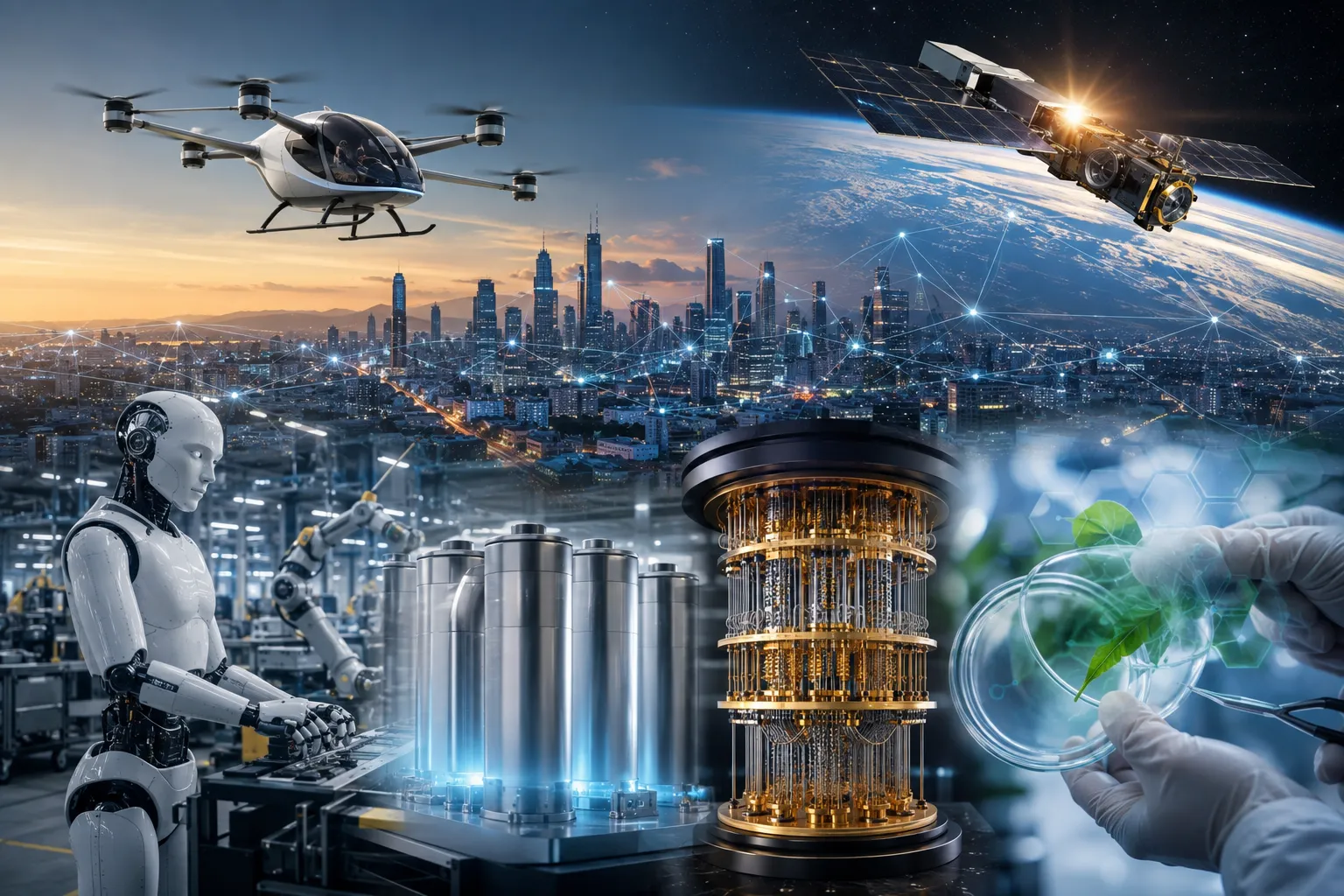
Future technology is no longer limited to science-fiction concepts. Artificial intelligence is already being used for weather forecasting and scientific research, robots are moving into industrial environments, battery developers are testing new chemistries, and aviation regulators are building frameworks for electric vertical take-off and landing aircraft.
At the same time, some technologies remain much further from everyday use. Space-based solar power, practical space elevators and large-scale de-extinction are still subjects of significant technical, economic or ethical debate.
That distinction matters.
The future is unlikely to arrive as one dramatic technological breakthrough. Instead, it is more likely to emerge from several technologies developing at different speeds and then becoming connected: AI with robotics, batteries with electric transportation, digital twins with smart infrastructure, and biotechnology with computational science.
This guide examines 15 emerging technologies to watch in 2026 and beyond, focusing on what they are, why researchers and companies are pursuing them, where they stand today and what could prevent them from becoming mainstream.
What Is Future Technology?
Future technology refers broadly to technologies that are still developing, entering early deployment or have significant potential to change how people, businesses and governments operate.
That makes the term broader than simply “new technology.”
A technology can be new but already mature. An emerging technology, by contrast, may still be undergoing research, engineering, regulatory review or commercial experimentation.
The journey from laboratory idea to everyday product can take years or decades. Technical feasibility is only one part of that process. Costs, manufacturing capacity, infrastructure, safety standards, regulation, consumer acceptance and access to investment can determine whether a promising invention ever reaches mass adoption.
This is why technologies on the list below should not be treated as a prediction that all 15 will become mainstream.
Some are already entering practical use. Others remain experimental. A few are still closer to long-term research than commercial reality.
Why Is Future Technology Advancing So Quickly?
Several technological trends are reinforcing one another.
Artificial intelligence is helping researchers process enormous datasets, simulate systems and automate parts of scientific and engineering workflows. The European Centre for Medium-Range Weather Forecasts, for example, is already running experimental machine-learning forecasts, with some models capable of producing 10-day forecasts in roughly a minute.
Computing power and specialised hardware are making increasingly sophisticated simulations and AI models possible.
Materials science is opening new possibilities for batteries, electronics, energy systems and advanced manufacturing.
Biotechnology is becoming increasingly computational, with AI tools being used to understand proteins, genomes and biological systems.
Robotics is benefiting from advances in sensors, machine vision, AI and simulation.
And in sectors such as energy and space, large-scale investment and private-sector participation are allowing technologies that once existed mainly in government or academic laboratories to move toward demonstration and commercial testing.
The result is not simply faster invention. It is a growing technological ecosystem in which one breakthrough can accelerate another.
15 Emerging Technologies to Watch
1. AI-Powered Weather Forecasting
Artificial intelligence is becoming an increasingly important tool for weather prediction. Instead of relying exclusively on traditional numerical weather models, researchers can train machine-learning systems on enormous historical weather datasets and use them to generate forecasts rapidly.
The potential benefits include faster forecasting, more localised predictions and improved support for extreme-weather preparedness.
ECMWF says AI-based forecasting is changing weather and climate prediction and reports that its experimental machine-learning models can generate 10-day forecasts much faster than conventional forecasting workflows.
The important point is that AI does not necessarily replace conventional meteorology. Instead, hybrid approaches may combine physical models, observations and machine learning.
AI-powered weather forecasting — AI Weather Forecasting: How Artificial Intelligence Is Changing Weather Prediction
2. Underwater Data Centers
Putting computer servers underwater sounds futuristic, but it has already been tested.
Microsoft’s Project Natick investigated subsea data centres as a way of using the surrounding environment for cooling while potentially locating computing infrastructure close to coastal populations and renewable-energy resources. Its second-phase experimental data centre was deployed off Orkney, Scotland, in 2018 and retrieved in 2020.
The concept could offer advantages in cooling efficiency, rapid deployment and reduced water use. But underwater infrastructure also creates difficult questions around maintenance, marine environments, connectivity, recovery and economics.
Microsoft’s current materials still describe Natick as an experimental research project rather than a mainstream commercial data-centre model.
underwater data centers — Underwater Data Centers: Why Tech Companies Are Exploring Servers Beneath the Ocean
3. Next-Generation Batteries
Lithium-ion batteries dominate modern electric vehicles and energy storage, but researchers are exploring alternatives that could improve energy density, safety, charging performance, cost or resource availability.
Potential candidates include solid-state batteries, sodium-ion batteries and lithium-sulfur systems.
The challenge is scaling.
The International Energy Agency notes that sodium-ion supply chains remain considerably less developed than lithium-ion supply chains. Solid-state batteries have attracted substantial interest, but their expected advantages still need to be demonstrated at scale in real-world applications.
That means the future of batteries is unlikely to depend on one chemistry replacing everything else. Different chemistries may eventually serve different applications, from electric vehicles and grid storage to specialised electronics.
next-generation batteries — Beyond Lithium-Ion: What Could Become the Next Generation of Batteries?
Cross-link opportunity: Battery advances could directly influence the development of flying cars and electric air mobility.
4. Small Modular Nuclear Reactors
Small modular reactors, or SMRs, are nuclear reactors designed around smaller and potentially more modular construction approaches than traditional large nuclear plants.
Their potential applications include electricity generation, industrial heat and energy-intensive facilities.
Supporters see modular construction as one possible way to reduce project complexity and provide reliable low-carbon electricity. But SMRs still face major challenges involving financing, licensing, construction, supply chains and public acceptance.
The IAEA is actively working with regulators and countries on the safety and regulatory requirements associated with SMR deployment, illustrating that regulation is a central part of the technology’s development.
SMRs should therefore be viewed as an emerging nuclear technology rather than a guaranteed future replacement for conventional power plants.
small modular nuclear reactors — Small Modular Nuclear Reactors Explained: Could They Power the Future?
5. Digital Twins
A digital twin is a digital representation of a real-world object, system, process or environment.
It can represent something as small as a machine component or as complex as a factory, building, transport network or city.
The value comes from connecting the digital representation with data from the real system. Engineers can then use simulations and monitoring to understand performance, identify potential problems and test scenarios without changing the physical system first.
NIST describes digital twins as electronic representations of real-world entities and highlights the importance of interoperability, standards, cybersecurity and trust as the technology develops.
Digital twins could become particularly important in smart cities, manufacturing, infrastructure planning and climate resilience.
digital twins — Digital Twins Explained: How Virtual Copies of Cities, Factories and Systems Work
6. Space-Based Solar Power
Space-based solar power proposes collecting solar energy in orbit and transmitting it to receiving stations on Earth.
The attraction is straightforward: solar collectors in space could potentially access sunlight without the same day-night limitations experienced by ground-based systems.
But the engineering challenge is enormous.
Large structures would need to be manufactured, assembled and maintained in orbit. Electricity would have to be transmitted safely to Earth, while launch and infrastructure costs would need to fall sufficiently for the concept to compete with terrestrial energy.
The European Space Agency has studied space-based solar power for decades and identifies technical feasibility alongside substantial economic and infrastructure challenges.
For now, this remains a long-term energy technology rather than a conventional electricity source.
space-based solar power — Space-Based Solar Power: Could Satellites One Day Beam Electricity to Earth?
7. Flying Cars and Electric Air Mobility
The phrase “flying cars” often suggests science fiction, but the real technology being developed today is more specific: electric vertical take-off and landing aircraft, or eVTOLs, along with the broader concept of advanced air mobility.
These aircraft are being designed for applications such as air taxis, cargo movement and short-distance passenger transport.
The U.S. Federal Aviation Administration has already established a regulatory framework for powered-lift aircraft, including pilot qualifications and operating requirements.
That does not mean flying cars are about to become ordinary personal vehicles.
Certification, battery performance, noise, infrastructure, airspace integration and operating economics remain significant challenges.
The more realistic near-term scenario is specialised commercial air mobility rather than every household owning a flying vehicle.
flying cars and electric air mobility — Flying Cars in 2026: How Close Are We to Everyday Air Travel?
8. Lab-Grown Meat
Cultivated meat, sometimes called lab-grown meat, is produced by growing animal cells in controlled environments rather than raising and slaughtering an entire animal.
The technology could eventually provide another way to produce meat while potentially reducing some of the land and resource requirements associated with conventional livestock production.
But production costs, manufacturing scale, regulatory approval, consumer acceptance and the economics of large bioreactors remain major barriers.
Regulation is also evolving. In the United States, the FDA uses a pre-market consultation process to evaluate the safety of foods made from cultured animal cells, with USDA regulation also relevant to products covered by the joint regulatory framework.
The technology is therefore moving beyond pure laboratory research, but it is not yet a universal replacement for conventional meat.
Internal link opportunity: lab-grown meat — Lab-Grown Meat vs Traditional Meat: What Is the Future of Food?
9. De-Extinction Technology
De-extinction describes attempts to use tools such as ancient DNA analysis, genome engineering, selective breeding or cloning-related techniques to create organisms that resemble extinct species or recover some of their traits.
It is important to distinguish this from literally recreating an extinct species exactly as it once existed.
The IUCN has emphasised that current approaches would not necessarily produce genetically, behaviourally or ecologically identical copies of extinct species. It also stresses that conservation benefits, ecological risks and alternatives should be considered before any proposed release.
That makes de-extinction as much a conservation and ethics question as a genetic-engineering question.
The most defensible applications may ultimately involve conservation research, genetic technologies and ecological restoration rather than simply recreating famous extinct animals.
de-extinction technology — Can Scientists Bring Back Extinct Animals? How De-Extinction Technology Works
Cross-link opportunity: AI-powered scientific discovery may help researchers analyse biological data relevant to conservation.
10. Space Elevators
A space elevator is one of the most ambitious concepts in future transportation.
The basic idea is to create a very long tether extending from Earth toward geostationary orbit. Payloads could theoretically climb the tether rather than being launched into space using conventional rockets.
The potential benefit would be enormous: if the required materials and engineering systems existed, the cost and energy requirements of repeatedly sending cargo into orbit could theoretically be transformed.
The problem is that the required tether would need extraordinary strength-to-weight characteristics, while surviving enormous mechanical, atmospheric and orbital stresses.
No practical Earth-based space elevator currently exists.
For that reason, the concept belongs firmly in the long-term research and speculative engineering category.
space elevator — Space Elevator Explained: Could Humans Really Build an Elevator to Space?
11. Humanoid Robots
Humanoid robots are being developed to perform tasks in environments designed around the human body.
That makes them particularly interesting for factories, warehouses and logistics because they could potentially use existing spaces, tools and workflows without requiring every environment to be redesigned.
The International Federation of Robotics identifies humanoids as a major robotics trend, but also makes an important distinction between the vision of general-purpose humanoids and the more limited industrial applications currently being pursued.
The biggest question is not whether a robot can walk like a human. It is whether it can reliably perform useful work at a competitive cost.
For now, specialised industrial robotics remains considerably more mature than fully general-purpose humanoid machines.
12. Quantum Computing
Quantum computers use quantum mechanical effects to process information differently from conventional computers.
Rather than simply replacing today’s computers, quantum machines are being developed for specialised problems where quantum algorithms could eventually offer major advantages.
Potential applications include chemistry, materials science, optimisation and cryptography.
But useful large-scale quantum computing remains difficult. Qubits are sensitive to errors, and fault-tolerant systems require sophisticated error correction.
Recent research has demonstrated progress in fault-tolerant architectures, but NIST describes quantum error correction as essential to large-scale quantum computing while highlighting the remaining engineering and scientific challenges.
Quantum computing is therefore one of the technologies where impressive laboratory progress should not be confused with widespread commercial readiness.
13. Brain-Computer Interfaces
Brain-computer interfaces, or BCIs, attempt to translate neural activity into commands that can control computers or other devices.
The strongest near-term case is medical.
BCIs could potentially help people with paralysis communicate, control assistive devices or interact with computers without conventional muscle movement.
This field is moving from laboratory research toward increasingly realistic clinical applications. In July 2026, the U.S. National Institutes of Health reported on an NIH-funded brain-computer interface that allowed a person with paralysis to use the system at home to help communicate.
However, major questions remain around long-term reliability, implantation, signal quality, safety, privacy, data ownership and ethics.
Consumer applications may eventually emerge, but medical applications are currently the more established direction.
14. Carbon Capture and Removal
Carbon capture and carbon removal are related but distinct technologies.
Carbon capture generally involves separating CO₂ from industrial emissions before it reaches the atmosphere. Direct air capture, by contrast, removes CO₂ directly from ambient air.
These technologies could play a role in sectors where eliminating emissions entirely is technically difficult, while carbon removal could address some residual or historical emissions.
The challenge is scale and cost.
The IEA’s 2026 energy-innovation assessment notes that major first-of-a-kind projects, including direct-air-capture projects, continue to face high costs and policy uncertainty.
At the same time, investment and project development are continuing. The IEA’s global CCUS database tracks large-scale projects around the world, including direct-air-capture facilities.
Carbon removal should therefore be viewed as one component of climate strategy, not as a substitute for reducing emissions.
15. AI-Powered Scientific Discovery
One of the most consequential uses of AI may happen far away from consumer chatbots.
Scientists are increasingly using AI to analyse biological data, predict molecular structures, identify patterns, assist simulations and explore possible materials or medicines.
AlphaFold provides a powerful example. Google DeepMind reports that its protein-structure work has become a widely used scientific resource, with the AlphaFold Protein Structure Database containing predictions for more than 200 million protein structures and being used by researchers globally.
The larger idea is AI for science: using machine learning to accelerate parts of the research process while humans remain responsible for experimental validation, interpretation and scientific judgment.
This could eventually influence drug discovery, materials science, climate research, agriculture and many other disciplines.
Which Future Technologies Are Closest to Becoming Mainstream?
Not every emerging technology is at the same stage.
A useful way to understand the landscape is to separate technologies that already have early commercial applications from those that still require major scientific breakthroughs.
| Technology | Current Stage | Potential Timeline | Main Use | Biggest Challenge |
|---|---|---|---|---|
| AI-powered weather forecasting | Early deployment/research integration | Near term | Forecasting and disaster preparedness | Accuracy, reliability and operational integration |
| Advanced batteries | Commercial development | Near to medium term | EVs and energy storage | Cost, scale and supply chains |
| Digital twins | Early commercial deployment | Near term | Industry, infrastructure and cities | Data integration and cybersecurity |
| Humanoid robots | Experimental/early industrial deployment | Near to medium term | Manufacturing and logistics | Reliability and economics |
| eVTOL / air taxis | Certification and early deployment phase | Near to medium term | Passenger and cargo mobility | Certification, infrastructure and cost |
| Cultivated meat | Early commercial/regulatory stage | Medium term | Food production | Cost, scale and acceptance |
| SMRs | Development/regulatory stage | Medium to longer term | Electricity and industrial energy | Cost, licensing and construction |
| Quantum computing | Experimental | Longer term | Specialised computation | Error correction and scalability |
| Brain-computer interfaces | Clinical research/early applications | Near to medium term | Assistive communication | Safety, reliability and accessibility |
| Carbon removal | Demonstration/early commercial scale | Medium term | Climate mitigation | Energy, cost and scale |
| Space-based solar power | Research/demonstration concepts | Long term | Electricity generation | Orbital infrastructure and economics |
| Space elevator | Theoretical research | Long term/uncertain | Space transportation | Materials and engineering |
These categories are not guarantees. A technology can progress quickly, stall for years or be overtaken by a competing approach.
Which Technologies Could Have the Biggest Impact?
The biggest impact may not come from the technology that looks the most futuristic.
Everyday life
AI, robotics, advanced batteries and digital twins could have the most direct effect because they can integrate into existing products and infrastructure.
Energy
Advanced batteries, SMRs, carbon capture and potentially space-based solar power could influence how electricity is generated, stored and distributed.
Transportation
Battery technology and eVTOL aircraft could reshape parts of transportation, although the scale and speed of change will depend heavily on economics and regulation.
Healthcare
Brain-computer interfaces and AI-powered scientific discovery could be particularly significant because they address problems that conventional computing or medical technologies struggle to solve.
Food
Cultivated meat could introduce another production method, although its environmental and economic benefits will depend heavily on how the technology is manufactured at scale.
Climate
AI weather forecasting, digital twins, advanced energy systems and carbon removal could contribute to climate adaptation or mitigation in different ways.
Computing
AI and quantum computing represent two very different paths. AI is already widely deployed, while quantum computing remains a research-intensive technology with uncertain commercial timing.
Space
Space-based solar power and space elevators illustrate the opposite end of the spectrum: potentially transformative ideas that require major breakthroughs in engineering and economics.
What Could Stop These Technologies From Becoming Mainstream?
Technical capability is only one part of technological progress.
Several factors can slow adoption.
Cost: A technology can work perfectly and still fail commercially if it is too expensive.
Regulation: Aviation, nuclear energy, biotechnology and medical devices require rigorous regulatory processes because mistakes can have serious consequences.
Infrastructure: New technologies often need entirely new supporting systems. eVTOL aircraft, for example, require suitable charging, landing and airspace infrastructure.
Safety: Technologies that interact directly with humans or the environment face higher barriers to deployment.
Supply chains: Batteries, semiconductors, specialised materials and advanced manufacturing equipment all depend on complex global supply networks.
Public acceptance: People ultimately decide whether many technologies become everyday products.
Energy requirements: Some emerging technologies, particularly AI infrastructure and carbon-removal systems, can require substantial amounts of electricity.
Environmental impact: A technology described as sustainable still needs to be evaluated across its complete lifecycle.
Scientific uncertainty: Some technologies simply have problems that researchers have not solved yet.
This is why the path from invention to mainstream adoption is rarely linear.
What Will Future Technology Look Like by 2030?
The safest way to think about 2030 is to separate what is already happening from what remains experimental.
What Is Already Happening
AI is being integrated into scientific research, weather forecasting, software, business operations and increasingly physical systems.
Robotics is expanding beyond traditional factory automation, while manufacturers are investigating humanoid and AI-enabled systems.
Advanced battery chemistries are being developed alongside continued improvements to lithium-ion technology.
Digital twins are becoming increasingly relevant to industrial systems, infrastructure and simulation.
eVTOL and powered-lift aircraft have moved into a more formal regulatory environment in the United States.
What Is Still Experimental
Large-scale cultivated meat, commercial SMRs, general-purpose humanoid robots, practical quantum computing and widespread brain-computer interfaces remain dependent on continued technical and commercial progress.
They may become more important by 2030, but their exact adoption levels cannot be stated with confidence today.
What Remains Speculative
Space elevators and large-scale space-based solar power remain much further from everyday deployment.
Their underlying concepts can be studied scientifically, but major engineering and economic obstacles remain.
The key lesson is that 2030 will probably not have one single “future technology.” Instead, it may be defined by the convergence of many technologies that have matured at different speeds.
Frequently Asked Questions
What is the future technology in 2026?
There is no single future technology. The most important emerging areas in 2026 include AI-powered scientific discovery, advanced batteries, robotics, digital twins, quantum computing, biotechnology, eVTOL aircraft, carbon removal and advanced energy systems.
Which technology will dominate the future?
AI is one of the strongest candidates for broad technological influence because it can be incorporated into many other fields, including robotics, medicine, weather forecasting and scientific research. But no technology can be guaranteed to dominate the future.
What are the most promising emerging technologies?
Among the most promising are AI for science, advanced batteries, digital twins, robotics, brain-computer interfaces, quantum computing and new energy technologies. Their promise differs depending on whether the goal is commercial adoption, scientific impact or societal transformation.
What technology could change the world?
Technologies that can affect multiple sectors may have the greatest potential impact. AI, advanced energy storage, biotechnology, robotics and computing are particularly important because they can become enabling technologies for other innovations.
Which future technologies are already available?
AI systems, digital twins, advanced robotics and some forms of AI-based weather forecasting are already in practical or experimental use. Other technologies, such as eVTOL aircraft and cultivated meat, are moving through regulatory and commercial development.
What technologies could become mainstream by 2030?
Advanced AI applications, digital twins, specialised robotics, improved batteries and potentially some forms of electric air mobility have relatively clear paths toward broader adoption. The timing of quantum computing, SMRs, cultivated meat and BCIs is more uncertain.
What is the next big technology after AI?
There may not be a single successor to AI. Instead, some of the most important developments may involve AI combined with other technologies, including robotics, biotechnology, scientific computing and autonomous systems.
Are flying cars really coming?
Electric vertical take-off and landing aircraft are real technologies, and aviation regulators are developing frameworks for them. However, this does not mean conventional personal flying cars will become common soon. Certification, infrastructure, economics and safety remain major considerations.
Is de-extinction actually possible?
Scientists can use genetic technologies to investigate or create proxies for some extinct species, but that is different from perfectly recreating an extinct species. The IUCN stresses substantial biological, ecological and ethical uncertainties surrounding such efforts.
Will quantum computers replace normal computers?
Probably not. Quantum computers are being developed for specialised problems where quantum algorithms may offer advantages. Conventional computers will remain essential for general-purpose computing.